









Kaziranga: Amrit Haldar goes on a mission every night with his AK-47. The 28-year-old State Reserve Police Force constable is part of a special squad to keep poachers away from Kaziranga National Park’s greatest treasure: the greater one-horned rhino.
“We have clear orders for poachers. Shoot at sight. I haven’t come across anyone in my tenure, but we have instructions to shoot if we see anyone with weapons,” said Haldar, who was recruited in 2023 as part of a mass frontline hiring drive launched by the Assam government to combat poaching in Kaziranga.
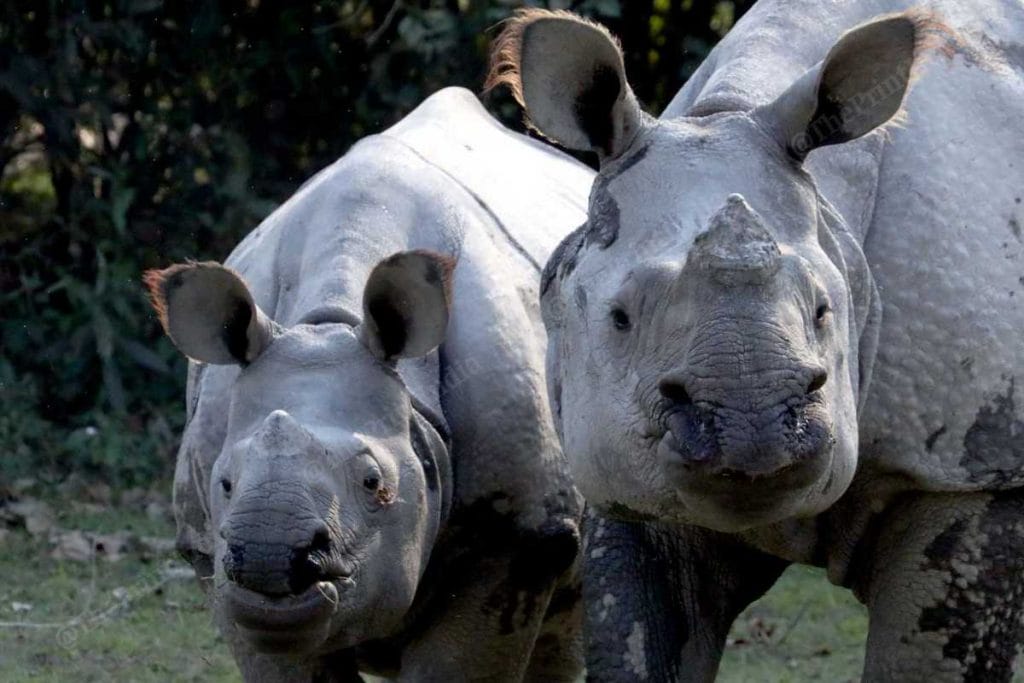
Measures like these are already showing results across Kaziranga. Poaching is down, rhino numbers are up. And the Kaziranga National Park is a success story in India’s wildlife conservation efforts that comes on top of tiger population increase.
Haldar is at his park camp 24×7. It’s one of many outposts that have been set up every five square kilometres in the park. The danger does not always come from poachers. Angry rhinos can charge without warning and do fatal damage with their horns. Just this February, a forest home guard was killed and another injured in a rhino attack.
“Sometimes we have to do a blank fire when the rhino tries to attack,” he said.
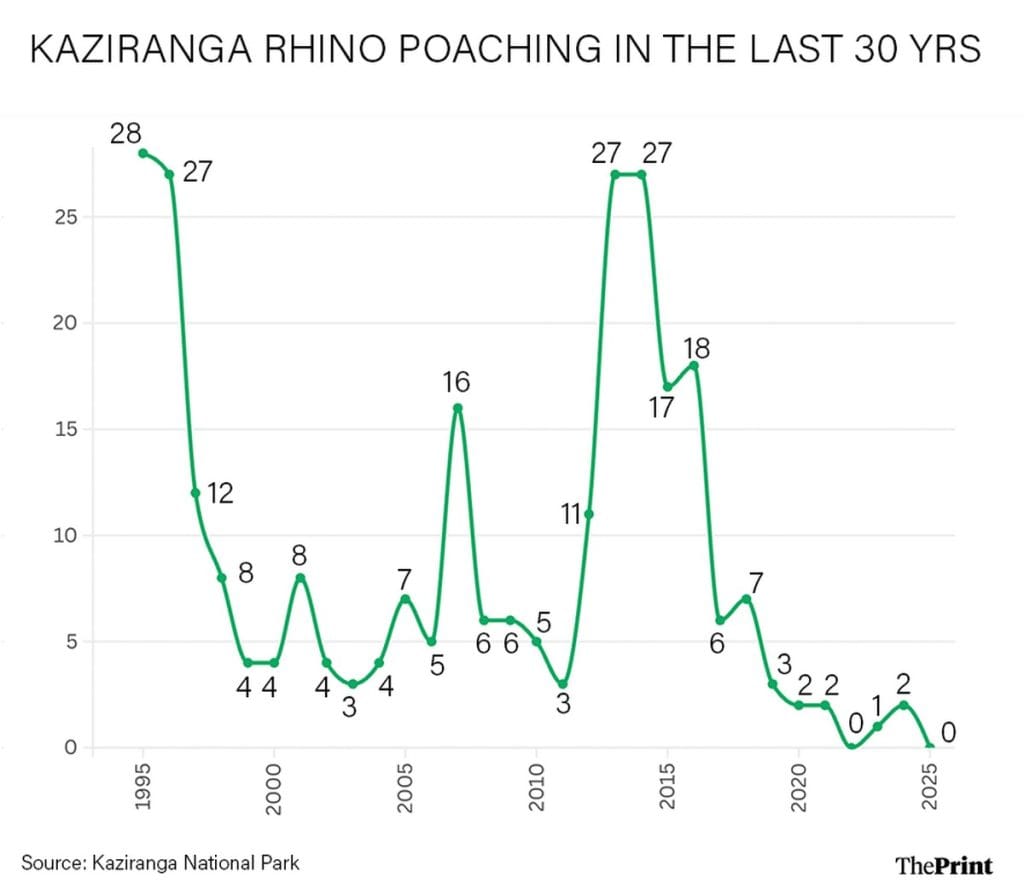
India has the largest population of one-horned rhinos in the world, almost 70 percent of the total global numbers. But even as the rhino population grew steadily over the decades in Kaziranga, poaching was a massive challenge for the state. Images of dead rhinos with their horns sawed off and bullets lying nearby were common. And the problem was growing worse. In 2013, at least 38 rhinos were killed by poachers, up from around 11 the previous year.
There was a time when poaching defined the conversation around Kaziranga. Today, with two years of zero poaching and numbers steadily rising, we are talking about recovery and expansion — about sending rhinos back to landscapes where they once existed
-Sonali Ghosh, director of Kaziranga National Park
The tide began to turn around a decade ago. As outcry grew, the state tightened enforcement of shoot-on-sight orders and measures such as special task forces, high-tech devices, drone monitoring, and an increased number of anti-poaching camps. Twenty poachers were shot dead in 2015, BBC reported—more than the number of rhinos poached. The rangers were called “ruthless” and the “militarisation of conservation” was critiqued, but the park defended its stance, saying “Rhino to Assam is what Taj Mahal is to India.” The concerted efforts are showing lasting results.
In the last five years, only five poaching incidents have been recorded. In 2022 and 2025, there were none at all. The park counted 2,613 rhinos in its 2022 census, up from 2,048 in 2009. Gunbattles with suspected poachers have also dropped, with three such incidents reported in 2025.
Now conservation is also part of Assam’s connectivity and infrastructure story. On 18 January, Prime Minister Narendra Modi performed the bhoomi poojan of the Rs 6,950-crore Kaziranga Elevated Corridor Project. The project includes a four-lane elevated stretch of NH-715, with around 35 km built as a wildlife corridor so animals can pass safely beneath the highway. During the event, Modi recounted his much-publicised elephant safari at Kaziranga two years ago and said it was one of the most special moments of his life.
The “pride of Assam” now draws hundreds of visitors every day.
Also Read: How Lucknow’s DNA lab is decoding Indian cheetah’s genetic history from 200-yr-old samples
The thorn in a ‘spectacular’ success
Things were dire not too long ago.
For years, experts and environmentalists rang alarm bells about rhino poaching.
In his 1996 report Under Siege, Vivek Menon, co-founder of the Wildlife Trust of India, linked poaching to rising extremism and a collapse of law and order. Between 1989 and 1993, he noted, India had lost 15 per cent of its total rhino population to poaching.
“With the influx of arms into Assam since the early 1980s… killing a rhinoceros has become easier for poachers. Guards armed with antiquated bolt-action rifles often come across poachers armed with semi-automatic weapons,” he wrote, adding that horns were fetching as much as Rs 3 lakh on the black market and were an easy avenue to “finance extremist activities”. Rhinos were shot, strangled with nooses, even electrocuted.
It was one of the darkest chapters in the zig-zag conservation trajectory of Kaziranga. Rhino numbers had risen steadily—from just 12 in 1908 to 366 in 1966, eventually crossing 2,000 in 1999—but the ‘success story’ always had a layer of threat. Spikes in poaching repeatedly tested gains.
The battle for rhinos began in 1905 when Viceroy Lord Curzon acted on his wife Mary’s dismay at the near extinction of the species due to rampant hunting and declared it a reserve forest. Protection strengthened in 1950 when it was renamed Kaziranga Wildlife Sanctuary, followed by the 1954 Assam Rhinoceros Preservation Act which officially banned hunting. Numbers that hovered around 100 in the 1950s climbed to over 400 by the 1970s, even as a fresh spike in poaching claimed 55 rhinos between 1965 and 1970—a time when traditional means of livelihood were suffering in the wake of drought as well as recurring floods.
Habitat protection, community participation, and state policy kept numbers from falling dangerously low, but the problem kept returning even after Kaziranga became Assam’s first national park in 1974 and a UNESCO World Heritage Site in 1985. It was a constant thorn in the side of its “spectacular conservation achievement”. Until about 10 years ago.
The latest uptick in poaching in 2013, reportedly fuelled by rising horn prices and demand from China for its purported medicinal and aphrodisiac properties, triggered the most take-no-prisoners response in the park’s history.
“From five or ten animals, today we have more than 3,000 [across Assam]. Thousands have died naturally over the years, and still the population has grown. That shows the strength of protection and management,” said Dr KK Sharma, Padma Shri awardee and Professor of Surgery and Radiology at the College of Veterinary Science, Assam Agricultural University, Guwahati.
‘Zero-poaching’ to new populations
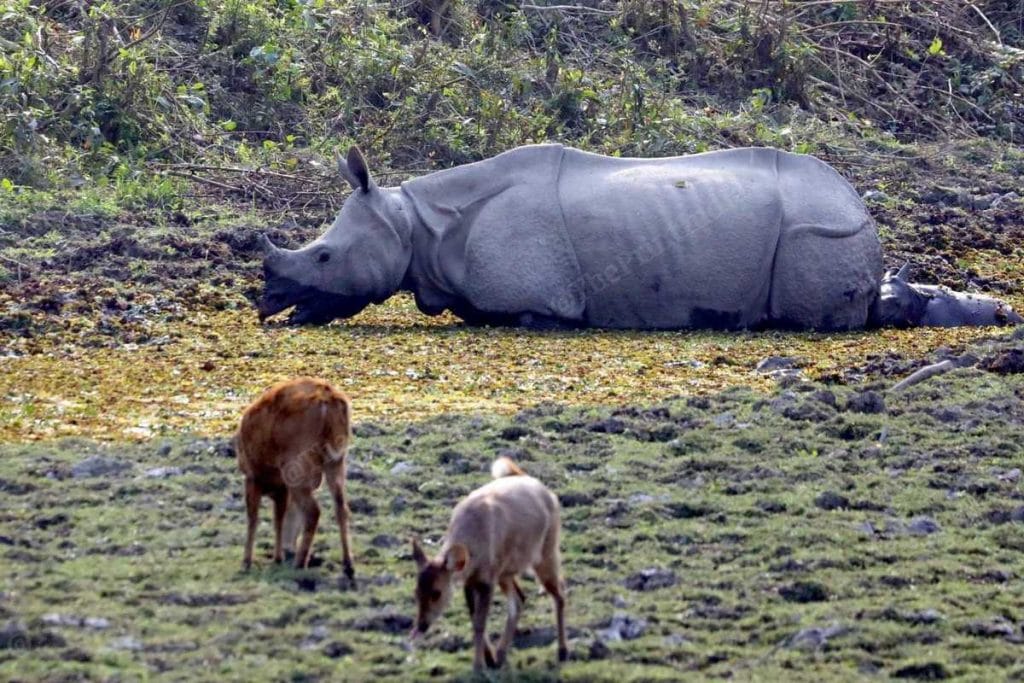
In the Bagori range of Kaziranga, rhinos are visible in glorious abundance. Some graze meditatively in tall grass, others wallow in the wetlands. For tourists craning their necks from jeeps and elephant saddles, the sight of a male’s long, sharp horn — visible from afar — is the ultimate prize, met with the endless clicking of photos.
There are around 140 tigers in the park, but the rhinos are the undisputed stars.
“Rhinos have been here for so many years, but with the increasing numbers, more and more people are coming,” said Debojeet, a safari driver. “Those who come here are more crazy about rhinos than the tigers.”
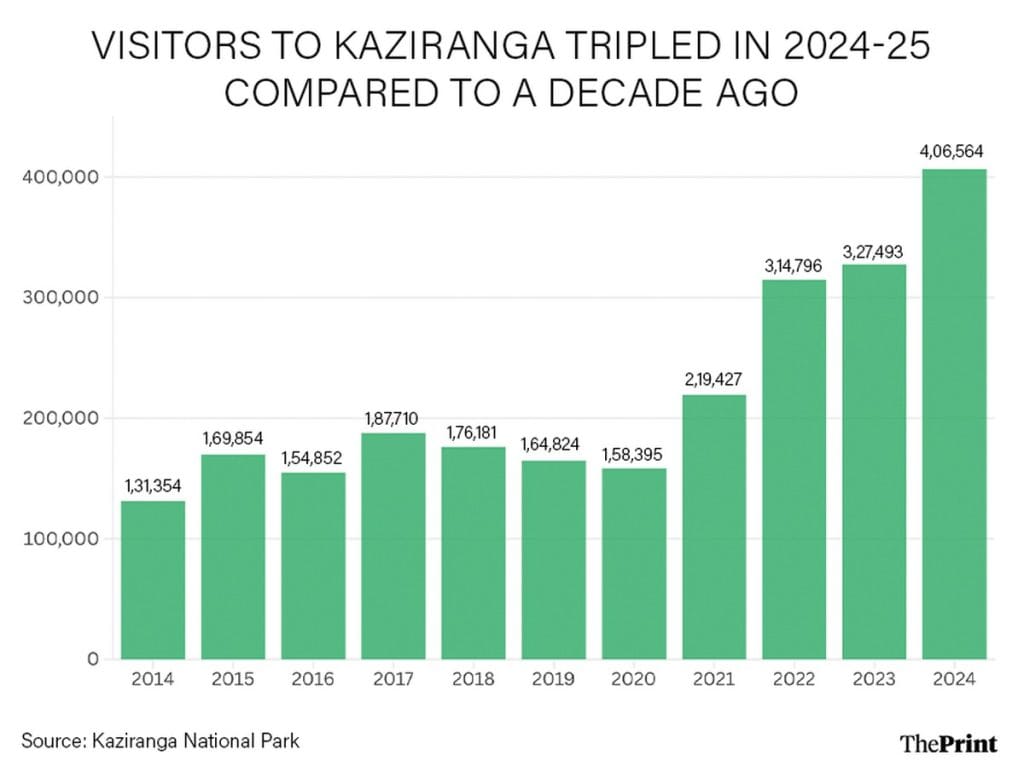
Tourism has increased by 205 per cent over the last decade, from 1.31 lakh visitors in 2014 to over 4 lakh in 2025, according to park records. Last year, the park saw 6,700 foreign visitors, the highest international footfall it has ever logged. High-profile visits from the likes of PM Modi and Priyanka Chopra, combined with improved tourist facilities, have boosted the park’s profile.
But the real pull is the strides made in conservation.
Park officials say the ‘Kaziranga model’—a mix of zero-tolerance policy and high-tech surveillance—saw poaching incidents drop 86 per cent between 2016 and 2024. In 2022, no poaching was recorded for the first time since 1977, a feat repeated last year.
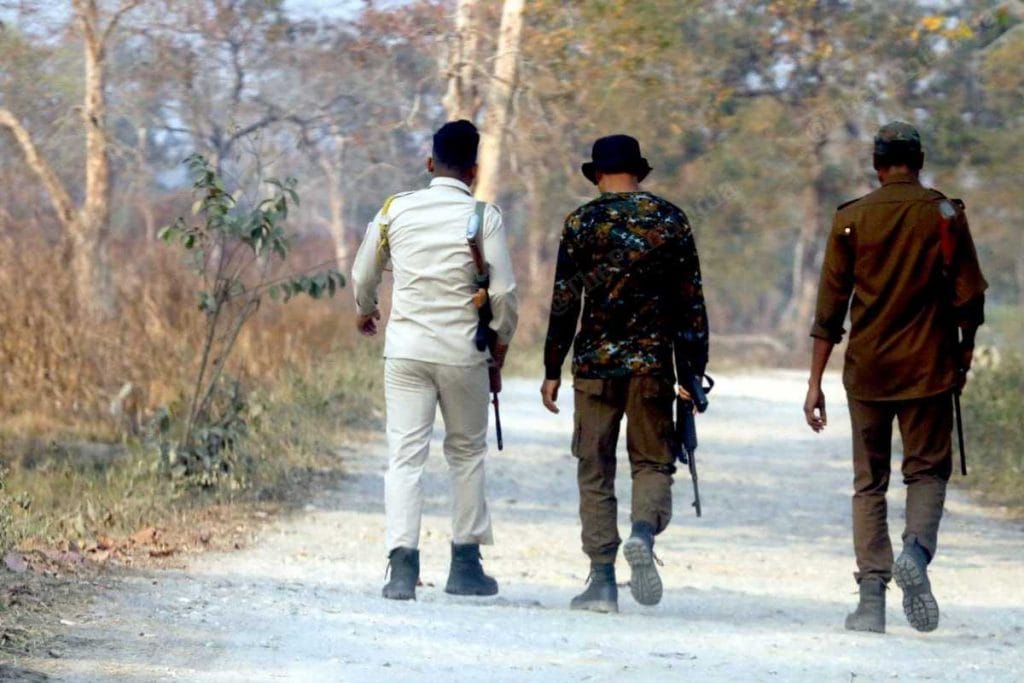
“A total of 253 anti-poaching camps are functioning under Kaziranga National Park and Tiger Reserve areas. Out of these, 172 camps are under the Eastern Assam Wildlife Division, 36 camps under the Biswanath Wildlife Division, and 45 camps under the Nagaon Wildlife Division,” said Indian Forest Service (IFS) officer Sonali Ghosh, director of Kaziranga National Park.
This ground force is supported by drones for aerial surveillance, wireless networks linking camps, and the GPS-enabled M-STrIPES system — originally designed for tigers — to coordinate patrols.
“These technologies help forest staff track movement in vulnerable areas, coordinate patrol teams in real time, analyse threat patterns, and deploy forces strategically. As a result, detection has improved, response time has reduced, and rhino poaching incidents have declined,” said Ghosh.
From five or ten animals, today we have more than 3,000 [across Assam]. Thousands have died naturally over the years, and still the population has grown. That shows the strength of protection and management
-Dr KK Sharma, Professor at the College of Veterinary Science, Guwahati.
The ramped-up physical infrastructure is matched by strict enforcement of a zero-tolerance anti-poaching policy, fast-track prosecution of offenders, and stronger intelligence coordination.
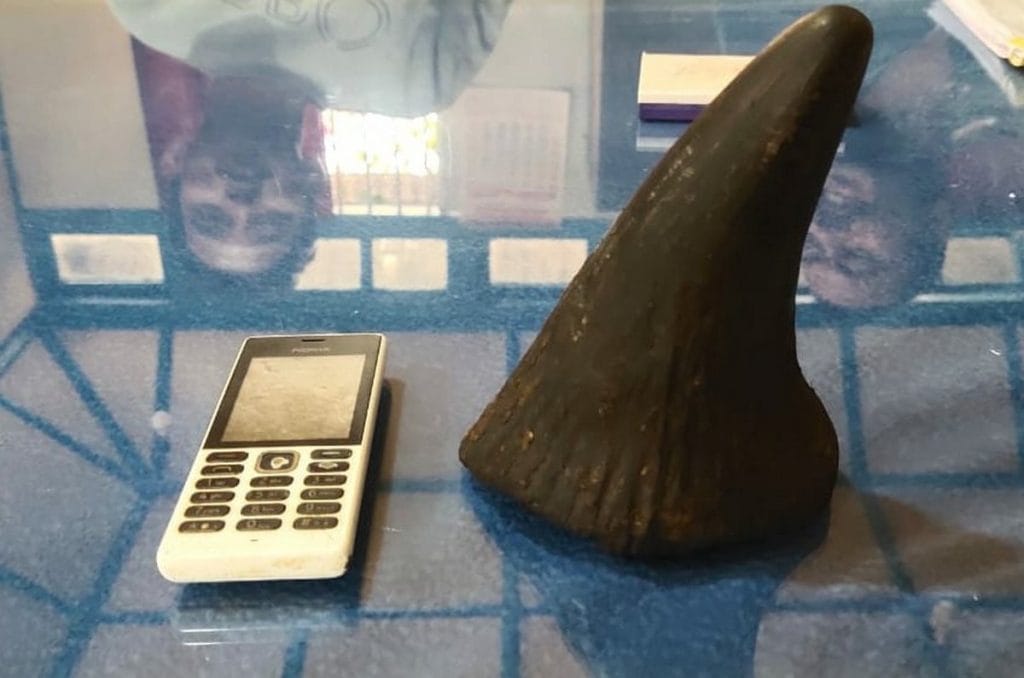
To tackle the black-market demand for rhino horns, which can sell for Rs 1 crore or more apiece, the state has also made dramatic use of symbolism.
On World Rhino Day in 2021, the Assam forest department burned a stockpile of more than 2,400 rhino horns on huge metal-framed pyres in Bokakhat. Marigold garlands draped the base of the furnace and ceremonial kalash honoured the fallen rhinos. The idea was to challenge the belief that rhino horns have medicinal properties. Chief Minister Himanta Biswa Sarma also attended the event.
“The use of rhinos’ horns for medicinal purposes is a myth,” he said in one of his several tweets after the event. “One-horned rhino is not only integral to our civilisation, but also a symbol of our prized heritage and identity.”
Today is a historic day for Assam & India. We have taken an extraordinary step of burning stockpile of 2479 horns of single-horned Rhinos, first-of-its-kind globally in volume terms, pursuing vision of Hon PM Sri @narendramodi of putting an end to poaching in Assam 1/2@PMOIndia pic.twitter.com/4SuN0XuCWB
— Himanta Biswa Sarma (@himantabiswa) September 22, 2021
The subtext was that harming rhinos would not be taken lightly.
“It gave the message that we have zero tolerance to poaching,” said Ghosh.
Apart from curbing poaching, another long-term goal was to establish rhino populations beyond Kaziranga to reduce overcrowding and prevent inbreeding.
Dozens of rhinos have been translocated to other protected areas in Assam, such as Manas National Park and Bura Chapori Wildlife Sanctuary, under Indian Rhino Vision (IRV), a programme helmed by WWF-India, the Assam forest department, and the Indian Rhino Foundation. The programme surpassed its target of 3,000 rhinos across a total of seven protected areas.
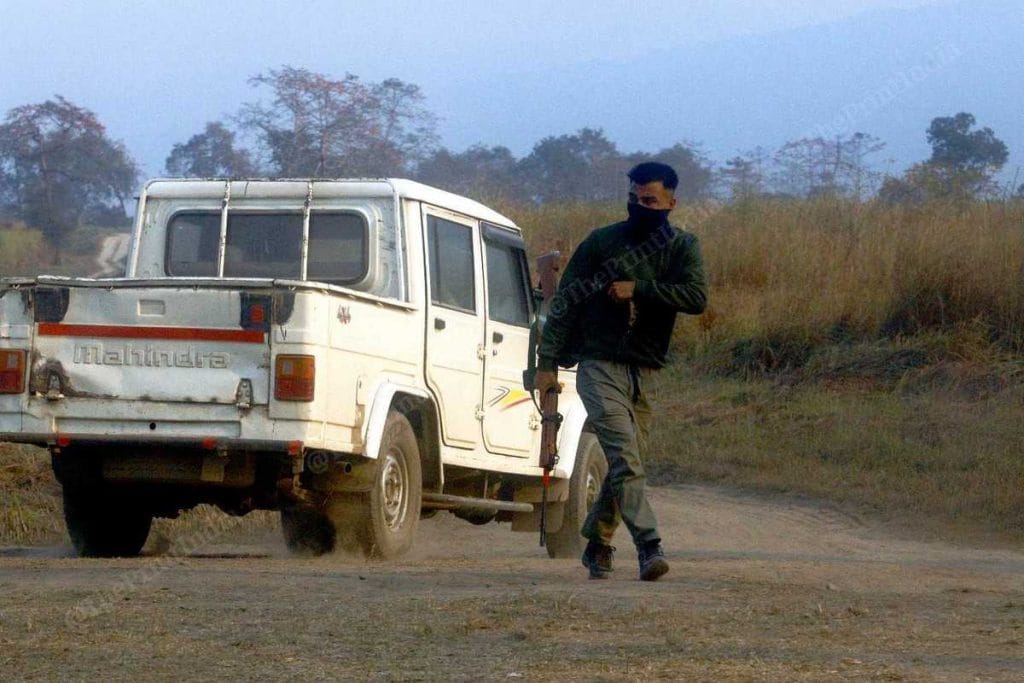
The animals are radio-collared, closely monitored, and protected by dedicated anti-poaching teams to help re-establish stable breeding populations outside Kaziranga. The goal for the next phase, IRV 2.0, is to reach a total of 4,500 to 5,000 rhinos in Assam by 2030.
“There was a time when poaching defined the conversation around Kaziranga. Today, with two years of zero poaching and numbers steadily rising, we are talking about recovery and expansion — about sending rhinos back to landscapes where they once existed,” said Ghosh.
Van Durgas on the highway
Reduce rhino poaching – Check.
Increase rhino numbers – Check.
Now, the next challenge for the park authorities is managing human-wildlife conflict, whether it’s animals straying into villages or being forced onto highways during floods.
“We have to ensure there is minimum conflict — that animals do not harm people and people do not harm animals. That challenge always remains for us as foresters,” said Ghosh.
A hand-picked team of women frontliners, called ‘Van Durgas’, is central to this effort.
In 2023, the Assam Forest Department recruited more than 2,500 forest guards for anti-poaching patrols, drone monitoring, and community outreach. Under the direction of the park’s first woman field director, Sonali Ghosh, this intake included 300 women.
The inaugural all-women team of 108 guards was stationed at the King Cobra Camp in the Agoratoli range. These ‘Van Durgas’ are trained along with their male counterparts in weapon handling, night drills, and jungle patrols.
“Prime Minister Narendra Modi visited the park and met our women forest guards. He is the one who gave them the name ‘Van Durga,’” said Ghosh.

Constables Manisha Das and Karishma Gogoi are among the recruits who spend their nights on the Kaziranga highway to deal with accidents and potential animal-human standoffs.
“This is what we were hired and trained for,” said Gogoi, rifle in hand. “If we see any such conflict, we use blank fire first to lead the animal away and inform our ranger. But such incidents are very rare. Things get severe when the flood happens.”
When the Brahmaputra bursts its banks and inundates forests, these guards also become rescue workers. Wild animals often have to cross National Highway 715 to reach the safety of the Karbi Anglong highlands. It is a journey fraught with the risk of road accidents and drownings.
During the 2024 Assam floods, at least 130 animals, including six one-horned rhinos, were reported dead in Kaziranga, most due to drowning. Forest teams rescued nearly 100 animals, including rhino calves, even as several anti-poaching camps remained submerged for days. Videos showed wildlife crossing NH-715 and rescuers lifting a mud-caked rhino calf from floodwaters. Chief Minister Sarma also shared a clip of himself directing the rescue of a stranded calf in Kaziranga.
“Every flood, animals move from the park to higher areas and that is when road accidents become a major challenge for us,” said Ghosh.
The long-term answer to this seasonal crisis is the Kaziranga Elevated Corridor. The 35-km stretch between Kaliabor and Numaligarh is designed to let rhinos, tigers, and elephants pass safely beneath the traffic as they make their way to the hills.
Also Read: Has Delhi Zoo lost its purpose? Jackal, antelopes, elephant Shankar’s death in model facility
One animal, two markets
Mahima Patel travelled all the way from Gujarat to Kaziranga just to see the one-horned rhino with her family. Waiting at the entrance of the Bagori range, she recalled the moment the park made it onto their Northeast tour itinerary.
“I saw when PM Modi came and talked about the park and the one-horned rhino, and that is when I decided I wanted to see this animal,” Patel said, adding that watching videos of the park on her phone sealed the deal.
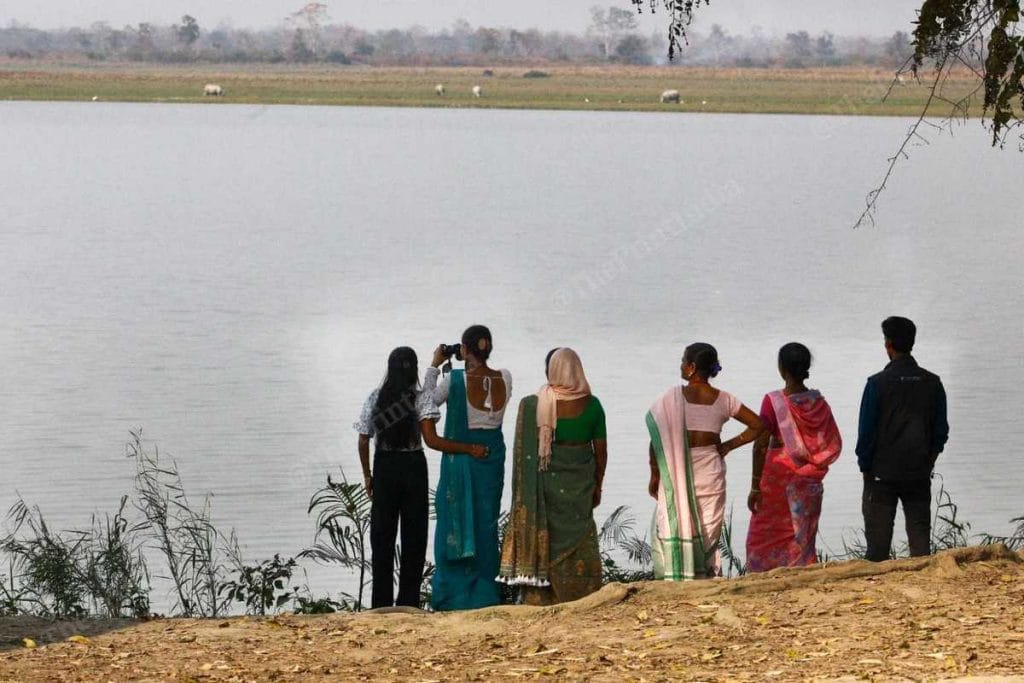
Within a few metres of their Gypsy entering Bagori range, they spotted a female rhino having lunch with her calf. “There is one!” Patel shouted, nearly jumping out of her seat before the driver asked her to lower her voice. Her husband then sighted another rhino in the opposite direction. Within minutes, they were counting rhinos at different spots in the marshland and clicking pictures.
But this serene tableau is a fragile achievement. Despite the zero-poaching years and the rising tourist footfalls, the danger is not entirely off the radar. As long as the market for horns exists, the forest guards will have to stay on their toes.
“Poaching is still happening at places, and we cannot say that we have entirely solved the issue,” said IFS officer Parveen Kaswan, who led the hunt for notorious rhino poacher Rikoch Narjari, sentenced to seven years in prison last October. “We have to be active and take all the measures to prevent it all the time. Constant vigil is the only thing that can prevent poaching.”
(Edited by Asavari Singh)