





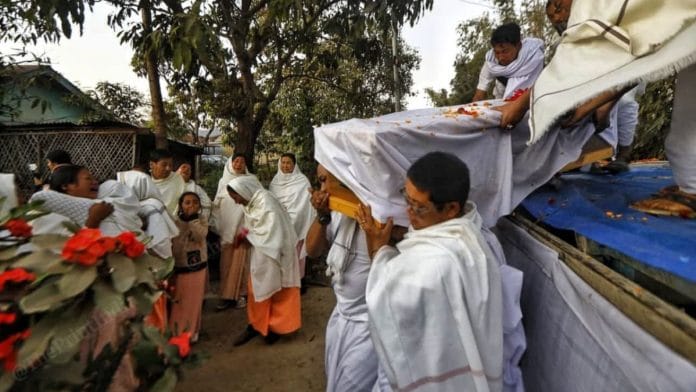



Imphal: When Mayanglambam Rishikanta Singh returned to his native village in Manipur after two years—inside a wooden casket—his family realised they had no photographs of the man he had become. The only three framed pictures on the wall of their house in Kakching district’s Khunou village show him as a child or in school uniforms.
The only photograph they now possess of his adulthood is the one from the viral video of his killing: Singh pleading for his life before being shot dead. They have framed it, garlanded it, and placed it on display.
The funeral was anything but solemn. It was more of a protest and war cry. A speaker tied to an auto blares, “Rishikanta, Rishikanta — they brutally killed you. You didn’t deserve it.” Soon, a truck carrying Singh’s body rumbled along a potholed road into his native village.
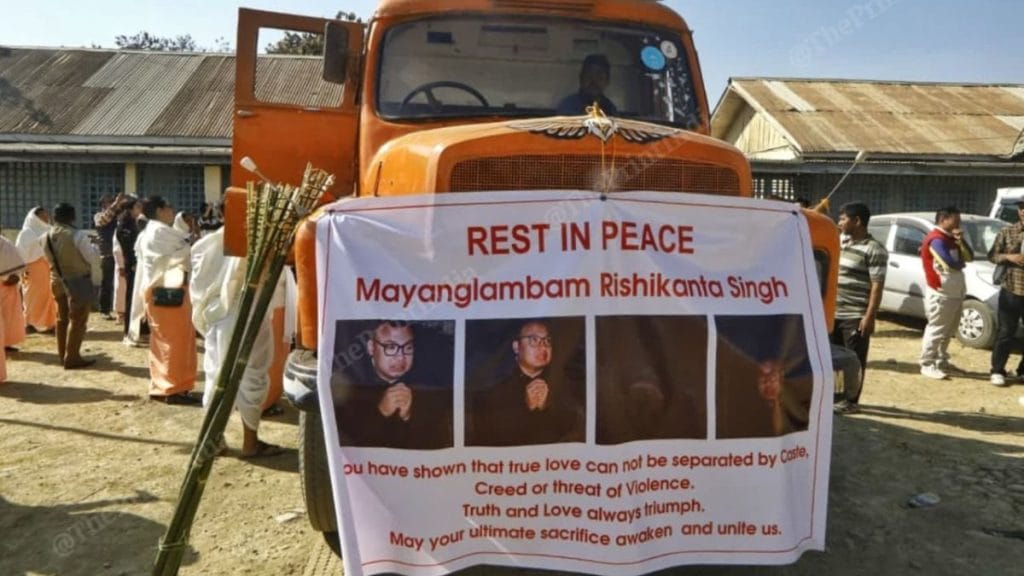
A poster tied to its front bumper sways with every jolt. It has a photo from the viral video, which became the face of renewed ethnic tensions in Manipur. The poster reads: “Truth and love always triumph. May your ultimate sacrifice awaken and unite us.”
Men dressed in black play the flute.
The funeral procession travelled nearly 80 kilometres from the mortuary in Imphal to Khunou. The route was monitored by the state, escorted by security forces and witnessed by members of the Meitei community.
“The killing of Rishikanta is a reminder of what Manipur has become,” said Sunil Singh, a Meitei man attending the last rites. The cries of the mourners rose and dissolved into silence, only to rise again. As if each pause brought a new memory of Singh crashing over them.
Renewed ethnic tensions
It was Singh’s final journey. But it had started long before when he left his job in Nepal and moved to the Kuki-dominated Churachandpur area.
Singh, 31, was killed on 21 January, a month after he began living with his Kuki partner. His killing has become a stark reminder of the toll conflict has inflicted on the region. It has also exposed long-standing tensions between the Meitei and Kuki-Zo communities. And now, the communities are comparing their losses. Social media has become a battleground with posts from members of both communities recounting the deaths of their own people in the violence that rocked the region in 2023.
Since May 2023, ethnic clashes in Manipur have left at least 260 dead and thousands displaced.
For his friends, Singh is a warrior who defied a forbidden geographical line for love. For the Meitei community, he is a martyr. For the security forces, he brought his own death upon himself. At the mortuary of Jawaharlal Nehru Institute of Medical Sciences, constables kept a watchful eye on Singh’s body, quietly discussing among themselves his decision to move into the Kuki area despite knowing the risks.
Singh’s family had initially refused to accept his body. But after two meetings with Manipur Governor AK Bhalla, who assured them that their demands would be met, they finally changed their decision.
“I wish he had changed his decision and never gone to Churachandpur,” said his elder sister, Ashalata. But his family didn’t know about his decision.
Also read: A dangerous love in Manipur. ‘Arrest the Kuki woman’ is the new protest slogan
Final journey
As the truck snaked along the narrow roads toward Khunou village, it was met by a line of people paying their last respects. Old men wept, women threw roses onto the body, and children looked on, trying to make sense of the grief around them. A speaker tied to an auto followed the procession, blaring the details of the video to remind people of the violence that had taken a young boy from their community.
“Rishikanta was kidnapped, abducted and killed because he was a Meitei. There is no other reason,” a young boy thundered. “There is no buffer zone. It’s an attempt to divide Manipur.”
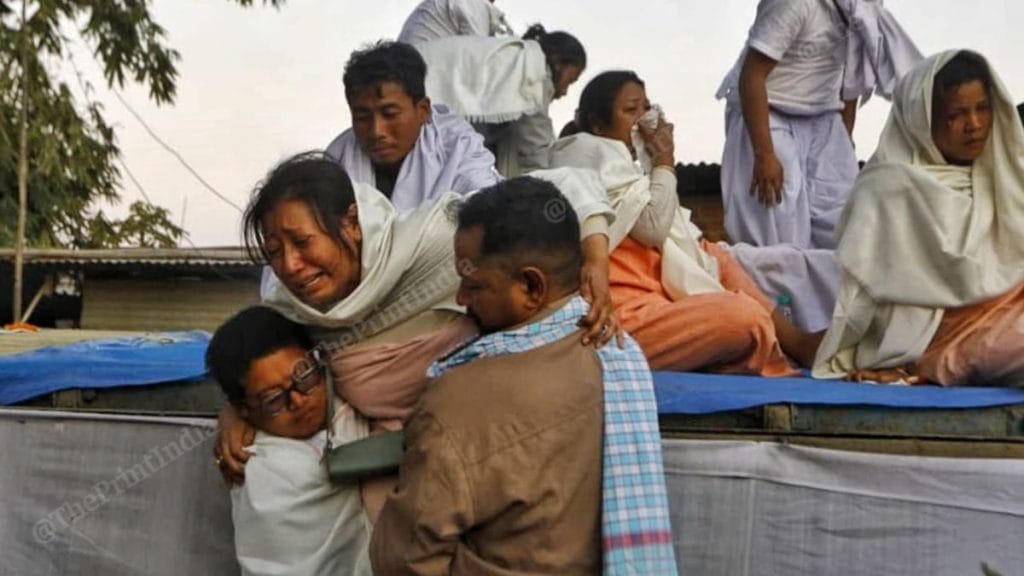
In the courtyard of his house, when Singh returned, the stoic face of his father, M Tombi Singh, broke into tears as the wooden casket was placed inside. A pandit performed the pooja, and a Manipuri song was sung to ease his journey filled the air.
In December last year, before he was killed, Singh celebrated Christmas with his wife and members of the Kuki community. He was a regular visitor to the neighbourhood church.
“He had embraced Christianity to be with his wife. But even that didn’t save him,” one of his friends said.
Also read: Noida Sector 150 residents up in arms after techie death. ‘We live Ram ke bharose like beggars’
‘Burying martyrs is an ancient practice’
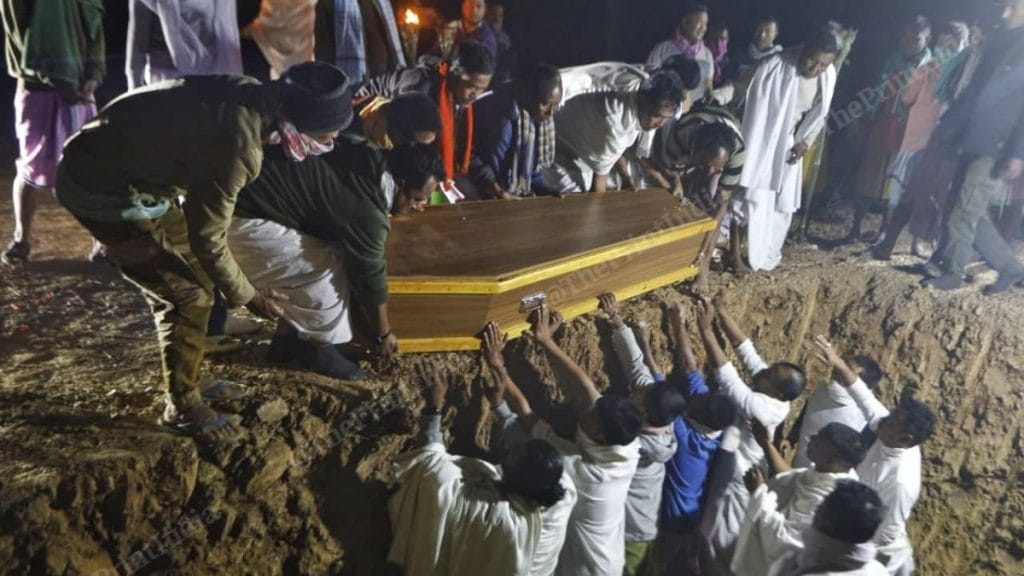
A martyr must be buried, not burned. More than three kilometres from his house, on a hillock, a grave had been dug. That was the first time the men saw his face. Pale and swollen, his body appeared heavy. They leaned closer, trying to locate the gunshot. “Can you see the gunshot?” the men whispered among themselves.
Before Hinduism took root in the region, the Meiteis used to bury their dead. The shift began under King Pamheiba (or Garib Niwaj), who converted to Hinduism in the 1700s. “But whenever we have to pay respects or honour a martyr from the Meitei community, we bury them. This is in keeping with our ancient practice,” said Ranjit Singh, a Meitei who had joined the funeral.
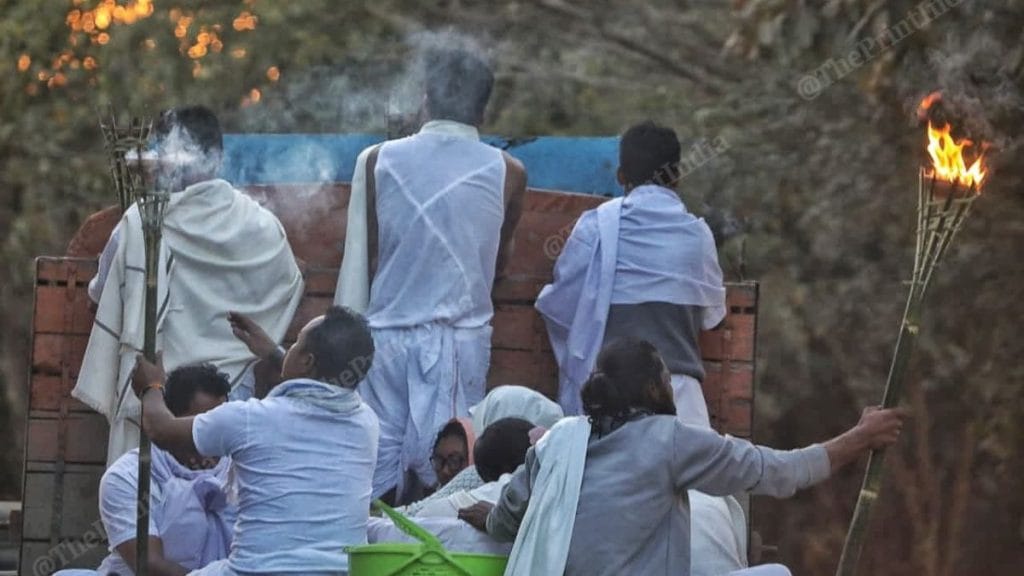
In earlier times, the community used to worship their own ancestral gods.
Along with over a dozen men, the SHO and his team were on the hillock. A generator lit the area dimly as he was laid to rest. Incense sticks and jujube fruits were offered. They followed a passageway of stairs made of mud.
He did not go alone. With him went the poster that read, “You have shown that love cannot be separated from caste, creed, or threat of violence.”
(Edited by Saptak Datta)