





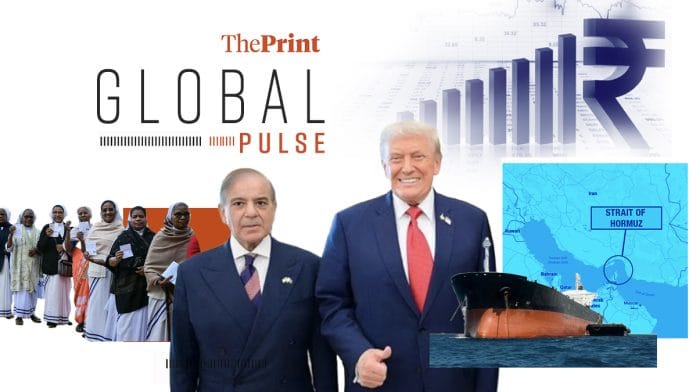



New Delhi: The US-Iran ceasefire brokered by Pakistan buoyed global markets and eased oil prices, but the relief may be short-lived. In Bloomberg’s India newsletter, Menaka Doshi writes about the risks for inflation, growth and India’s energy supplies.
“Stock and bond markets [have] rallied on news of the ceasefire, and oil slumped well below $100 a barrel. The dollar hit a four-week low as risk appetite recovered across the world,” she writes.
For India “details are fuzzy on how quickly the 800 stranded ships will start clearing the Strait of Hormuz” as it will take some time for energy supplies from West Asia to return to their pre-war levels.
“In this backdrop, the Reserve Bank of India held the benchmark interest rate unchanged at 5.25%. It projected inflation at 4.6% this fiscal versus 2.1% in FY26 and growth at 6.9% versus 7.6%. That’s a more optimistic view than many economists who have cut growth forecasts to as low as 5.9% in recent days to reflect India’s oil dependence,” she writes.
Doshi argues that Pakistan’s “pivotal peacemaking” will complicate the already “testy relationship” between US President Donald Trump and Prime Minister Narendra Modi.
On the same subject, Sadanand Dhume of the Wall Street Journal writes, “Pakistan has put itself back on the diplomatic map.”
“Pakistan’s prominent role in brokering a two-week cease-fire between the U.S. and Israel and Iran places it in an unusual position: on the front line of international diplomacy.”
The peacemaking is only the latest in Trump and Pakistan’s growing closeness, ever since Asim Munir took center stage.
“Mr. Trump has lavished praise on Field Marshal Munir, describing him as a great fighter, my favorite field marshal, and an exceptional human being.”
“The building blocks of the close U.S.-Pakistan relationship include Pakistan’s nominating Mr. Trump for a Nobel Peace Prize for his role in mediating a cease-fire last year between India and Pakistan, Pakistan’s investments in cryptocurrency firms linked to Mr. Trump’s inner circle, and Islamabad’s cooperation with Washington on counterterrorism, critical minerals and a Trump-led Gaza peace process,” Dhume writes.
New Delhi has always denied the ceasefire between India and Pakistan was brokered by a third party.
Dhume writes Munir’s efforts have successfully helped him overshadow Imran Khan. The country remains “economically precarious and ethnically riven”, but “at least for now, it looks as if the cunning field marshal has decisively outplayed the flamboyant former cricketer”.
Abhishek Dey of the BBC writes about the state elections taking place this month and the key challenges that lie ahead for the BJP. “Modi’s Bharatiya Janata Party (BJP) is trying to expand beyond its traditional strongholds into regions where it has struggled to gain a foothold.”
According to the Election Commission, the five states have a combined 174 million voters – about 18 percent of the country’s electorate.
While the BJP, at present, is in power in Assam and part of the ruling alliance in Puducherry, it has never formed a government in West Bengal, Kerala, or Tamil Nadu.
“The polls – covering 824 assembly seats across the five regions – come amid a major controversy over a revision of electoral rolls, known as Special Intensive Revision.”
In Assam, “politics has long been shaped by anxieties around migration, identity and citizenship, particularly along its border with Bangladesh”, the BBC writes.
Although the BJP has been in power in the northeastern state for a decade, Dey writes that this election is seen as a test of whether it can retain that dominance.
In Kerala, the BJP has never had a strong presence, and the government has alternated between alliances led by the Congress and CPI (M).
“India’s eastern state West Bengal, the most populous of the five regions, with more than 70 million voters, has been governed by Chief Minister Mamata Banerjee of the Trinamool Congress party since 2011. The BJP has emerged as its principal challenger in recent years.”
The BJP is contesting in Tamil Nadu in alliance with All India Anna Dravida Munnetra Kazhagam (AIADMK), against the incumbent Dravida Munnetra Kazhagam (DMK).
Willie Walsh, IndiGo’s incoming CEO, in an interview to the BBC commented on the state of India’s commercial aviation, calling the lack of widebody aircraft a “scandal”. Steve Lai and Soutik Biswas report.
Currently, India’s widebody aircraft fleet is just 50. “When you think about it, it’s a country of 1.4 billion and counting. But they only had 50 widebody aircraft in the country last year. So that’s probably – you could describe it as a scandal,” he told the BBC.
A widebody aircraft is a larger, twin-aisle plane designed to carry more passengers over longer distances, essential for non-stop international and long-haul routes.
Walsh also pointed to the opportunity for Indian airlines to grow globally. “India has depended on transferring people over the Gulf hubs, particularly into North America. So that’s a huge opportunity for Indian carriers to grow their presence on the global scale,” he said.
(Edited by Ajeet Tiwari)