





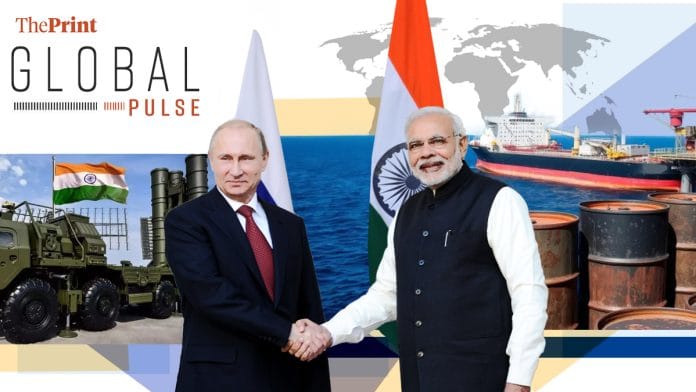



New Delhi: There’s a phantom that’s going to be present at the India-Russia negotiating table, as Russia President Vladimir Putin kicks off his visit to India, reports Anupreeta Das and Valerie Hopkins in the New York Times.
“The timing is especially fraught for India, which has been searching for a way to resolve its economic tangle with the Trump administration. Mr. Trump has accused India of financing Russia’s war on Ukraine by buying its oil, and last month, India’s biggest oil companies stopped buying Russian crude almost entirely after U.S. sanctions on Russian oil giants threatened the companies that do business with them,” the report notes.
It also addresses the two questions on everyone’s minds. Will India resume its purchase of Russian oil? And what’s going to happen on the military front?
“Even if India intends to keep buying Russian oil, private and public companies will be reluctant to buy,” said Harsh V. Pant, vice-president at New Delhi-based think tank Observer Research Foundation. “The risk exposure has grown, and so it is very difficult for the relationship to continue,” is the answer to the former.
What Russia loses on oil, it might gain in defense equipment, write Das and Hopkins.
“India could potentially announce the purchase of S-400 air-defense system units during the summit, according to Indian media reports. The S-400 and long-range BrahMos missiles played a significant role in India’s four-day conflict with Pakistan in May,” says the report
The Financial Times also looks at the geopolitical context in which Putin’s visit is taking place, and the storied history of the India-Soviet Union relationship.
“Ties between Moscow and New Delhi date back decades. When India went to war with Pakistan in 1971 to support the creation of independent Bangladesh, the Soviet Union openly backed then-prime minister Indira Gandhi—even sending nuclear submarines to the Bay of Bengal—despite fierce opposition from the US, which sided with Islamabad,” reads the analysis.
In recent days, Indian officials have made a “flurry” of trips to Russia in order to “shore up ties in the face of Washington’s pressure.”
“Modi and Putin held an hour-long conversation in a limousine at a security forum in China in September. Later that month, New Delhi sent dozens of troops to the Zapad military exercises—drawing criticism from Brussels,” says FT.
In Politico, Daniel Block, an editor with Foreign Affairs, profiles The Caravan––a magazine that remains a fierce propounder of independent media. Block, who also worked at the magazine for a year, looks at the crackdown on independent media and assesses whether the US is going the same way.
“As American journalists contemplate life under an illiberal government, they would thus do well to study these places. They provide a template for how independent media can survive—and even fight back—when staring down autocracy,” he writes.
Today, says Block, India’s coverage of PM Narendra Modi is mostly “fawning.”
“The country’s main television news channels all resemble Fox, with anchors who constantly praise the country’s leader for his strength and smarts. They berate his critics as mendacious “anti-nationals”—people whose hate for India is boundless,” reads the story.
Publications critical of Modi—which comprise The Caravan, The Wire, Newslaundry and The News Minute—must fight to survive, it says.
“Independent publications also usually have small readerships relative to the country’s main newspapers, and are thus less concerning to officials,” says the report. “But their persistence is also the result of smart decisions by their owners and editors. Some outlets, for example, stay small even when they have the chance to grow, opting to save money rather than risk overextension,” it adds.
(Edited by Tony Rai)