





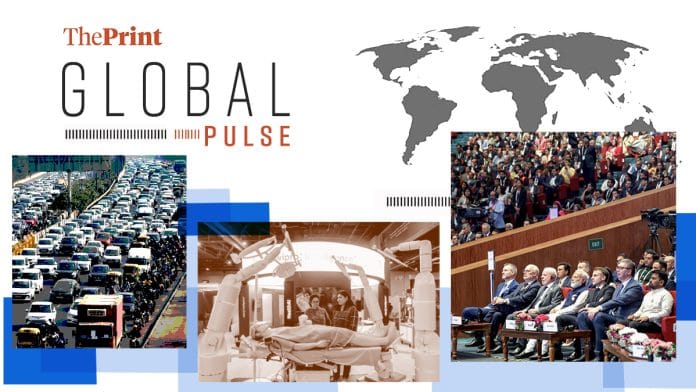



New Delhi: India hosted the global AI Summit last week and although it could not get a lot done in terms of partnerships and regulations, the summit made headlines for viral moments on plagiarism, a shirtless protest, key speakers pulling out at the last moment, and visitors’ frustration with organisers.
The Economist reports on the ‘out-of-control’ VIP culture of India, which made matters worse for visitors at the summit. When Prime Minister Modi arrived at the summit on 19 February, much of the area around the summit was closed off to ordinary people, and visitors to the summit were allowed only after several hours, according to the report.
However, it was not just the Prime Minister who was accorded this level of security. “On one of the summit’s evenings, the roads leading to the venue were closed to all but VIPs. Unimportant persons were forced to walk over a mile to find cabs and public transport. Delhiites outside the blast radius of the convention centre did not escape unscathed. Huge chunks of the city were closed or restricted to ease travel for VIPs.”
Regular visitors also faced severe restrictions that banned items ranging from bags and laptops to hand sanitisers and even water bottles, while VIPs were allowed to pass without interference. “The summit was designed to… show the country’s modern face to the world. What tens of thousands of attendees saw instead was a fulsome display of India’s retrograde VIP culture.”
The Financial Times reports how India’s global ambitions “hit limits” at the summit. Modi called for “sharing” of technology for meaningful participation in the AI revolution. The call came as India tried to find its place in the “AI arms race” between the heavyweights US and China, the report said, adding: “Despite its huge tech talent pool and being home to global IT groups such as Infosys and Tata Consultancy Services, it is not a leader in developing large language models or creating products from the technology’s rollout.”
But India’s push for a global regulation framework for AI was not met with the same confidence by others. As Financial Times reports, Michael Kratsios, White House chief of science and technology policy, Friday, “totally” rejected any and all sorts of global AI framework. He said, “We believe AI adoption cannot lead to a brighter future if it is subject to bureaucracies and centralised control,” FT reports.
The New Delhi summit comes at a geopolitically precarious moment, J. Trevor Hughes, chief executive of Boston-based not-for-profit IAPP, told The Financial Times. The summit was conducted at an “odd moment” because “geopolitics is changing around the world,” he said.
“There is a broad deregulatory mood in the air. So the idea of imposing AI regulation creates an allergic reaction right now in many, and yet, risk management in AI is still a critical thing,” he added.
With the AI Summit coming to a close, the focus has moved from the global tech event to art, literature and history. A new exhibition called ‘Typecasting: Photographing the Peoples of India, 1855-1920’, organised by DAG, the Delhi-based art gallery, caught the BBC‘s attention. The exhibition, Sudha G. Tilak of BBC reports, brought together around 200 photographs from a time in British India when the camera was used to profile Indian subjects.
The British would photograph different peoples in order to identify, categorise and classify them, making them more “legible” to the Crown, writes Tilak. Across 65 years, the exhibition documents people “from Lepcha and Bhutia communities in the north-east to Afridis in the north-west; from Todas in the Nilgiris to Parsi and Gujarati elites in western India.”
The photographs also trace the lives of dancing girls, agricultural labourers, barbers and snake charmers.
“These images did not merely document India’s diversity; they actively shaped it, translating fluid, lived realities into apparently stable and knowable ‘types’.”
(Edited by Viny Mishra)