





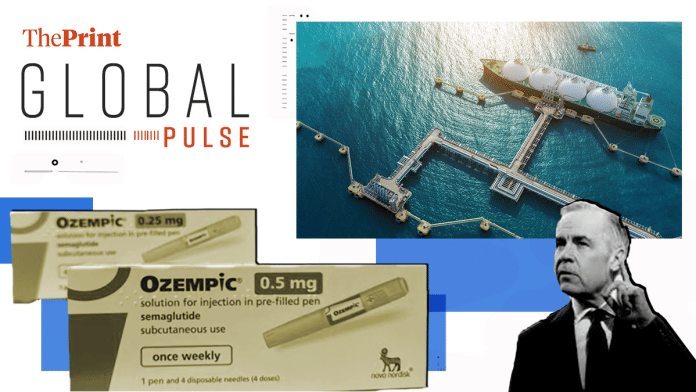



New Delhi: India could soon get a lot thinner—at least in theory, Soutik Biswas of the BBC reports on the patent of Ozempic, the popular anti-obesity drug, expiring on Friday.
“The patent on semaglutide—the molecule behind Danish drugmaker Novo Nordisk’s blockbuster weight-loss drugs Wegovy and Ozempic— expires in the country,” reports Biswas.
This would enable domestic pharmaceutical companies to produce lower-cost generic versions, sparking strong competition that could cut prices by more than half and significantly widen access for patients in India, and eventually in other countries as well.
“Investment bank Jefferies has called it a potential ‘magic-pill moment’ for India.”
Analysts say that over 50 generic copies of the drug would hit the market within months of Ozempic’s patent expiring.
“When the diabetes drug sitagliptin went off patent in 2022, about 30 branded versions appeared within a month and nearly 100 within a year.”
As the war in West Asia continues, after the LPG scare, India’s piped gas could be next, Biswas reports for BBC.
“Demand for this natural gas comes from fertiliser plants, industry and gas-fired power, as well as city gas networks – which supply PNG (Piped Natural Gas) to households and CNG (compressed natural gas) to vehicles.”
There’s a growing dependence on gas with more than 15 million PNG connections, and CNG becoming India’s second-largest auto fuel after petrol.
However, Biswas notes that piped gas is not immediately under threat as India’s piped gas supply is a blend of domestic production and imports of liquefied natural gas (LNG).
“About half of India’s PNG supply is domestic gas drilled from onshore and offshore fields—for example by companies such as ONGC and Reliance. The balance is met through LNG imports.”
But most of India’s LNG imports come from Qatar, hence even India’s piped gas is not entirely insulated from geopolitical shocks.
“LNG cargoes from Qatar and the UAE must pass through the Strait of Hormuz, the narrow maritime choke-point now at the centre of the Middle East war after the US and Israel launched attacks on Iran. Roughly 50-55% of India’s LNG imports move through this corridor.”
Exports from Qatar’s massive Ras Laffan LNG complex, which produces 77 million tonnes a year, have been halted since 2 March. This means these vessels could be among the last shipments—13 LNG cargoes loaded between 10-26 February, currently en route to India—until safe passage through the Strait of Hormuz resumes.
Thus, “for India’s urban consumers using piped gas, the immediate risk is price rather than shortage.”
Meanwhile, Ian Austen of The New York Times revisits Canadian PM Mark Carney’s diplomatic tour of the Asia-Pacific.
“As Carney travels the globe for new alliances, he looks away on human rights.”
“As the leader of a country long seen as a global leader in using trade and diplomatic relations to promote human rights, Mr. Carney has made no-strings-attached deals with countries that do not embrace democratic norms.”
Austen takes note of Carney’s visit to India as well. Stephen Harper and Narendra Modi overcame the frosty ties to finalise a deal for Canada to supply billions of dollars’ worth of uranium to India.
“India’s staunchly Hindu nationalist government has been accused of discriminating against minorities,” Austen highlights that India, China and Qatar have “dismal human rights records”.
Additionally, he says that India has also been accused of violating the rights of Canadians.
“Mr. Carney’s predecessor as prime minister, Justin Trudeau, said Mr. Modi’s government had orchestrated the assassination in British Columbia of a Sikh nationalist who was also a Canadian citizen.”
Following the assassination of Hardeep Singh Nijjar, Canada’s spy agency last year listed India as one of the countries, along with Russia, China and Iran, “interfering” in Canada’s affairs.
And while Carney made no mention of the incident during his visit, Canada’s intelligence agency has remained firm on its assessment of India.
Steve Madeley of The Athletic, NYT’s sports magazine, writes on Sunil Gavaskar’s hardline stance on an English team signing a Pakistani player for the Hundred tournament. Gavaskar Tuesday criticised the signing claiming it could indirectly contribute to the death of Indian soldiers and civilians.
Abrar Ahmed was signed by the Sunrisers. The team, formerly known as Northern Superchargers, is run by the Sun Group, a media organisation founded by Kalanithi Maran, whose daughter Kaviya was present at the Hundred auction last week, the report notes.
“Whether it is an Indian entity or an overseas subsidiary of the entity that is making the payment, if the owner is Indian, then he or she is contributing to the Indian casualties. It’s as simple as that,” Gavaskar said in a column for an Indian newspaper.
Daniel Vettori, head coach of Sunrisers Eastern Cape and former New Zealand captain, said after last week’s auction that the franchise based its bidding decisions solely on players’ cricketing ability.
(Edited by Tony Rai)
Also Read: Crematoriums to universities, South Asia reels amid a war fought far away. And a BRICS reality check
Mr Austen of the NYT would do well to note the dismal state of human rights in Canada as well where large scale drugs and arms related crimes have taken root and the law enforcement is scared to act because of political sensitivities. His penchant for bringing in faith of a billion people and trying to gaslight using that would only backfire. People like him seem to be still under the shadows of Mr Trudeau. Trying to manufacture outrage is not journalism.