





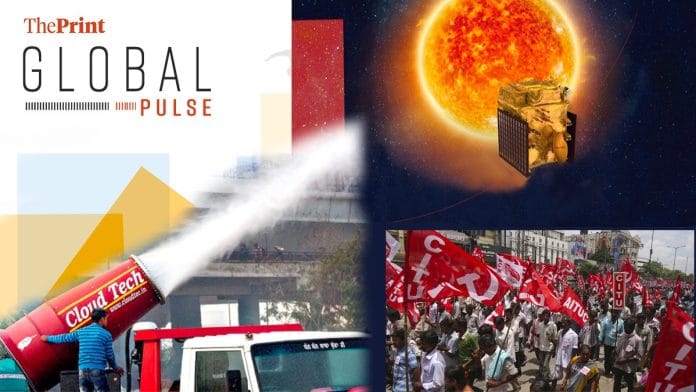



New Delhi: The New York Times’ Mujib Mashal, Pragati K.B. and Hari Kumar report on how Delhi’s citizens are contending with the debilitating blanket of smog that has covered the city. They used an air quality monitor to measure PM 2.5 levels at key spots, which was then cross checked against official data.
“What we found was a city with no escape from severely toxic air, and a population resigned to a public health emergency as its everyday reality,” says the report.
“As children arrived for classes at the D.T.E.A. Senior Secondary School, the level of dangerous pollutants at the high school’s entrance was more than 20 times the recommended daily average for safe breathing,” says the report, noting that education is “disrupted every year by pollution emergencies”.
At the LNJP hospital, patients and attendants were “resting in the hospital yard” where PM 2.5 levels were 17 times higher than what is designated as safe, says the report.
The report also delves into the contentious anti-smog guns.
“We sighted the first of many ‘anti-smog guns’—sprayers that are attached to water tanks and deployed around the city, including near key landmarks like the prime minister’s residence and major embassies,” says the New York Times. “The guns have been a matter of political debate. Many experts say the government is trying to deceive the public by spraying water around the more than three dozen air-quality monitoring stations, to lower their readings.
In the Financial Times, Andres Schipani, Chris Kay and Veena Venugopal look at the labour law reforms and the ensuing slew of protests.
“But by making it easy to hire and fire workers—it raises the threshold for companies requiring prior government approval for lay-offs from 100 to 300 workers—Tapan Sen, general secretary of the Centre of Indian Trade Unions with some 7mn members, said the reform will “totally demolish labour rights,” says the report.
“The Joint Platform of Central Trade Unions, a Leftwing and opposition grouping of Indian unions, called it a ‘deceptive fraud’ by Modi,” notes the Financial Times.
“With Modi focused on helping the economy withstand punitive US tariffs, his government is billing the reform—first passed in 2019 and 2020 but whose implementation was delayed because of opposition—as an opportunity for India’s workforce,” they write.
The upgrade could also make things more difficult for small and medium enterprises by boosting costs.
For the first time, Aditya L-1, India’s first ever solar observation mission, will be able to “watch” the sun as it reaches “its maximum cycle activity,” reports Geeta Pandey in the BBC.
“According to Nasa, it comes roughly every 11 years when the Sun’s magnetic poles flip—the Earth equivalent would be the North and South poles swapping positions,” says the report, which also refers to this time as being one of “great turbulence”.
“It sees the Sun transition from calm to stormy and is marked by a huge increase in the number of solar storms and coronal mass ejections (CMEs)—massive bubbles of fire that blow out of the Sun’s outermost layer called corona,” notes the BBC.
Studying CMEs is one of the most important scientific objectives of India’s maiden solar mission, Professor R. Ramesh of the Indian Institute of Astrophysics tells the BBC. “One, because the ejections provide an opportunity to learn about the star at the centre of our solar system, and two, because activities that take place on the Sun threaten infrastructure on Earth and in space,” adds the BBC.
“About 20 years ago, one album of photographs from the movement appeared at a London auction. Tipped off by an antiquarian dealer in Mumbai (formerly Bombay), the Alkazi Foundation, a Delhi-based art collection, acquired the album. Small in size with a coal-gray cover, the album gave few clues about its provenance. Scrawled on its spine were the words Collections of Photographs of Old Congress Party—K. L. Nursey,” he writes, explaining the photographs’ mysterious origins. No one knew the identity of K.L. Nursey.
“Above all, the album brings to light, perhaps better than any other source, how women used the civil disobedience movement for their empowerment,” he writes. “This visual record of female leadership is unique. Despite its Leftward leanings and Gandhi’s prodding, Indian nationalist activity had remained an overwhelmingly male endeavour, with its own distinct patriarchal flavour.”
Other than the usual suspects, the album also “documents thousands of completely unknown female volunteers”—on the Chowpatty Beach, protesting the salt ban and “processions of women” pushing “men to the margins”.
(Edited by Viny Mishra)