





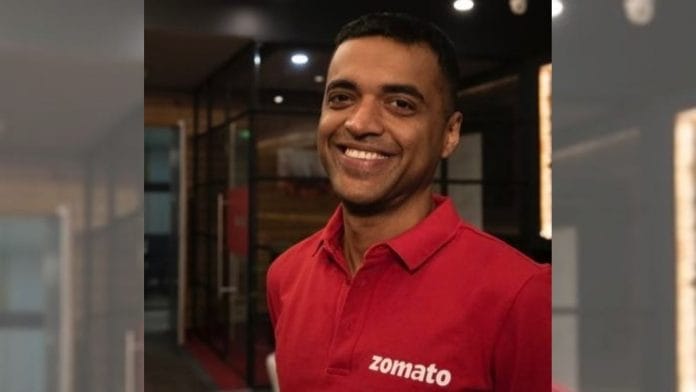



New Delhi: A day after announcing on X that Zomato and Blinkit “delivered at a record pace on 31 December” despite a nationwide gig workers’ strike, CEO Deepinder Goyal came out in defence of the gig economy.
In a post on X on 2 January, Goyal said the gig economy has shattered the invisibility of the poor at an unprecedented scale. “Suddenly, the poor aren’t hidden away. They’re at your doorstep: the delivery partner handing over your ₹1000+ biryani, late-night groceries, or quick-commerce essentials,” he wrote.
In the 12 paragraph tweet, Goyal also said, “You see them in the rain, heat, traffic, often on borrowed bikes, working 8–10 hours for earnings that give them sustenance. You see their exhaustion, their polite smile masking frustration with life in general.”
Banning gig work is ‘removing livelihoods’
Over two days, in a series of posts on X, Goyal defended the gig work system. He said the 10-minute delivery promise is only enabled when there are a high density number of stores around residences.
“It’s not enabled by asking delivery partners to drive fast. Delivery partners don’t even have a timer on their app to indicate what was the original time promised to the customer,” he said on 1 January. In the same post, he also detailed the process and time taken at each stage of an order, from booking to final delivery.
“After you place your order on Blinkit, it is picked and packed within 2.5 minutes. And then the rider drives an average of under 2kms in about 8 minutes. That’s an average of 15kmph,” he wrote.
In his post Friday, which he said to be the last one on the topic, he discussed how gig work has brought workers directly to consumers’ doorsteps “making inequality personal and emotionally uncomfortable”.
He reasons out his argument by saying “This is the first time in history at this scale that the working class and consuming class interact face-to-face, transaction after transaction. And that discomfort with our own selves is why we are uncomfortable about the gig economy. We want these people to look our part, so that the guilt we feel while taking orders from them feels less.”
He warns that banning gig work can push the workers back into an informal economy where there are fewer protections and even less accountability.
“The gig economy just exposed the reality of inequality to the people who previously had the luxury of not seeing it. The doorbell is not the problem. The question is what we do after opening the door,” he wrote.
Also read: Zomato, Blinkit, Zepto gig workers on strike. Dhruv Rathee, Kunal Kamra support
‘Most workers did not protest’
Gig workers across the country organised a protest on 25 and 31 December. The two festive days, when the delivery apps get the most number of orders. The workers had demanded basic rights, ban on the 10-minute delivery system and a transparent process of payment.
However, a day after the protest Goyal, wrote on social media app that most of the delivery partners of Zomato or Blinkit did not go on strike. In the same post, he also addressed the issue where few protestors were snatching parcels from delivery partners who had chosen to work.
In the tweet he wrote, “I am all for peaceful protests against anything and everything. But violent protests and stopping others who want to work from working is not okay (proof attached).”
He also claimed that a number of protesters were not even Zomato group’s delivery partners and a lot of them were “terminated by the system for repeated abuse and fraud on the platform.
“They were agents of political interests, piggybacking on the narrative to gain political mileage,” he added. In his tweet, he called the people who were targeting delivery partners “miscreants”.
“The 0.1% miscreants I mentioned in the tweet below were illegally snatching parcels from those who wanted to work, beating them up, and threatening to damage their bikes. Which is why local law authorities had to intervene on their own,” he said.
(Edited by Theres Sudeep)