





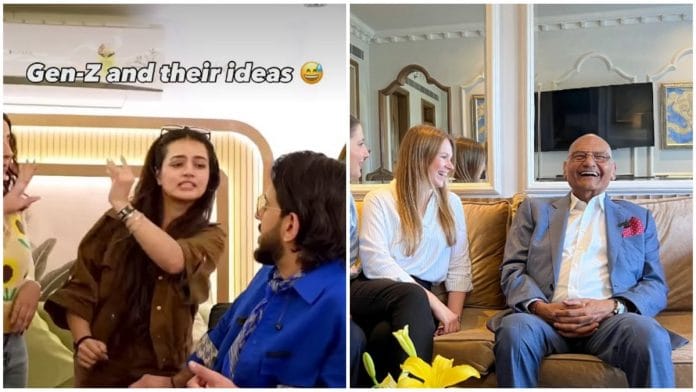



New Delhi: In a recent reel titled ‘Gen Z and their ideas’, boAt co-founder Aman Gupta listens to young employees enthusiastically pitching to him, complete with the infamous 6-7 gesture. Within seconds, the 44-year-old CEO’s expression changes from polite interest to bewilderment and he finally walks off, shaking his head.
The track accompanying the reel is a line from the 1990s hit song ‘Ghar Aaja Pardesi’: “Is gaon ki anpadh mitti padh nahi sakti teri chitti”—which roughly translates to ‘this illiterate village doesn’t understand your letters’. The caption seals the humour: “Aura-6-7… Uff… Maybe I am just not nerdy enough.”
Beyond the laughs, the reel captures a moment of tension in the Indian corporate landscape. Should Gen Z adapt to the older establishment, or should it be the other way around?
Gen Z’s work habits, foreign to their stiff-upper-lipped seniors, have been much-debated for a while now, whether it’s their internet lingo, candid insistence on time off for things like a breakup, or readiness to challenge authority. They are directly at odds with the tenets of the old vanguard who follow a top-down school of thought and for whom work-life balance is something to be shuddered at — from Infosys founder Narayana Murthy’s controversial ‘70-hour work week’ to Larsen & Toubro chairman SN Subrahmanyan’s call for 90 hours, where he asked, “How long can you stare at your wife?”
Now, a segment of India’s C-suite is taking a different position. Rather than dismissing Gen Z as entitled, CEOs ranging in age from their 40s to 70s are beginning to treat the younger workforce as an asset — one that prioritises boundaries and transparency over the long-standing ‘Yes, Boss’ culture.
“Woh samay beet gaya, jab bachhe sirf buzurgo ki baat sunte the” (Gone are the days when young people only obeyed their elders), wrote 72-year-old Vedanta Group chairman Anil Agarwal in an Instagram post about working with Gen Z. “The way they take breaks during the day, it shows they care about themselves. Instead of expecting them to become more like us, maybe we need to be more like them.”
Also Read: Meet the VCs powering India’s AI boom. Old rules aren’t working anymore
‘I love working with Gen Z’
When Naresh Harwani, CEO of recruitment platform RemoteStar, logged into a virtual meeting to find an employee with a towel on her head and green paste on her face, he didn’t miss a beat. He asked if it was “black seaweed”. When she told him it was a neem face mask, and that he should use it too, he said “ok”. A clip of the exchange got over 7 million views on Instagram. Harwani then updated his LinkedIn bio to: ‘The Face Mask CEO. The Cool CEO Redefining Work Culture for the Gen-Z Era’.
“For a few seconds I was trying to decide if this was a prank or some new Gen Z meeting protocol,” he posted later on LinkedIn, drawing a slew of comments praising him for evolving with the times and connecting with Gen Z.

But arguably no CEO has been more publicly, consistently vocal about working with Gen Z than boAt’s Gupta, across social media posts and podcasts. In a long post on LinkedIn and X last August, he recalled that a decade ago, employees would tremble outside the boss’s cabin.
“But today, in my office, 20 year old interns walk up and ask ‘AG, why are we doing this? Are you sure it’s right?’ We used to say Yes boss. And they ask, Why boss?” wrote Gupta. “They don’t say “Hanji sir, ji sir” unless they actually mean it. And honestly I HATE it when people confuse that honesty with disrespect.”
I love working with Genz and these young millenials. 10 years ago when I was in corporate, boss ke cabin ke bahar khada hota tha toh haath kaampte the. Sawaal karne ki soch bhi nahi thi.
We used to say Yes boss. And they ask, Why boss?
Boss ne bola karna hai, toh karna hai.…
— Aman Gupta (@amangupta0303) August 11, 2025
His company boAt, founded in 2014, started by selling durable charging cables before expanding into audio and wearable devices, mainly targeting young people. In keeping with that, the team is young too.
“We have a lot of under 30 and Gen Zs. And every time I talk to them, I realise that they don’t just work for money. They work because they care. They live freely. They create fearlessly… And maybe the question is not how to manage them.. Maybe the real question is, how do we make sure we work with them and learn from them,’ he added.
Vedanta, a mining conglomerate founded in 1976, has little in common with youth-focused boAt. Yet its chairman, Anil Agarwal, arrived at a similar conclusion. He praised Gen Z for being the first generation to genuinely value mental health.
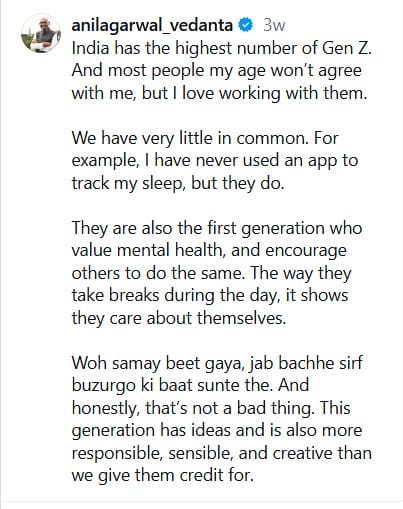
“India has the largest Gen Z population,” he wrote in an Instagram post. “Most people my age may not agree with me, but I genuinely enjoy working with them. We have very little in common—for instance, I’ve never used an app to track my sleep, but they do.”
His caption, accompanied by a photo of him laughing alongside two young women, added that GenZ is “more responsible, sensible, and creative” than they are given credit for.
Agarwal’s post got 23,000 likes and over 300 comments, with many of them praising his progressive outlook.
“Your thoughts offer valuable lessons for every generation. Your ideas inspire us to live more meaningful lives. Reflecting on Generation Z is truly motivating,” said one comment. A few, however, disagreed. “Sir Gen z batamiz hote h. They don’t know how to respect elders,” said one.
Also Read: Fear & despair outside Oracle office. ‘It was ruthless, we’re all replaceable’
Entitled generation?
A year ago, Anupam Mittal didn’t hold back: “Gen-Z is spoiled, entitled, and a nightmare to work with,” the Shark Tank judge and Shaadi.com founder posted on LinkedIn. He then predicted that “age-old principles” of discipline and hard work would prevail and warned Gen Z to stop “sidestepping the grind”.
However, he also cautioned against extreme corporate reactions, pointing out how companies either “bend over backwards rewriting policies to appease them” or adopt overly rigid approaches, both of which can backfire.
A few months later, the 54-year-old posted again with a shift in tone, if not a full reversal. This time, he called for people to “stop shaming Gen Z for switching jobs”, framing job-hopping as a natural part of early career exploration.
Another Shark Tank judge also waded into the debate. Ashish Gupta, the Bengaluru-based CEO of the ed-tech platform Bambinos, questioned whether Gen Z had enough foundational knowledge to excel at work. He claimed in a LinkedIn post that when he visited a “renowned campus” for recruitment, only two students could answer a simple question about the average speed of a car.
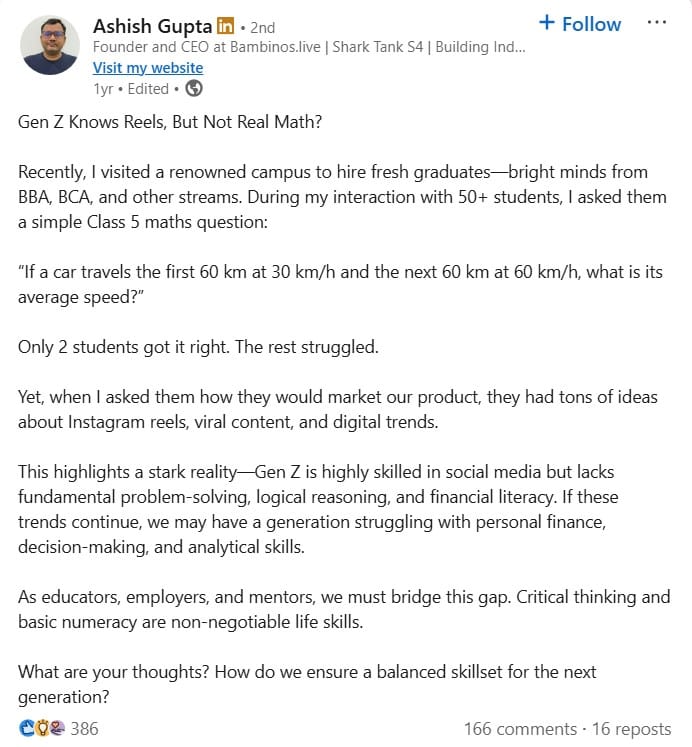
In his write-up titled ‘Gen Z Knows Reels, But Not Real Math?’, he argued: “Gen Z is highly skilled in social media but lacks fundamental problem-solving, logical reasoning, and financial literacy”.
Many in the comments questioned the relevance of such questions in real-world hiring.
“Sir, you’ve raised a valid point regarding math skills, however, I would like to understand what has this question got to do with you hiring them?” one asked. In response to such comments, Gupta’s stance was that there was no compromising on core skills, no matter the role.
If some bosses complain that Gen Z lacks grit, another complaint, or anxiety, is that they have too much self-belief. Mitul Bid, CEO of Coditas, a Pune-based software development company, tapped into that in a post about a candidate who dashed off an angry email after being rejected.
“You didn’t reject me. You rejected the damn upgrade,” said the letter in question. “And one day, when I’m sitting in that corner office, don’t be surprised if I’m the one signing your exit letter.”
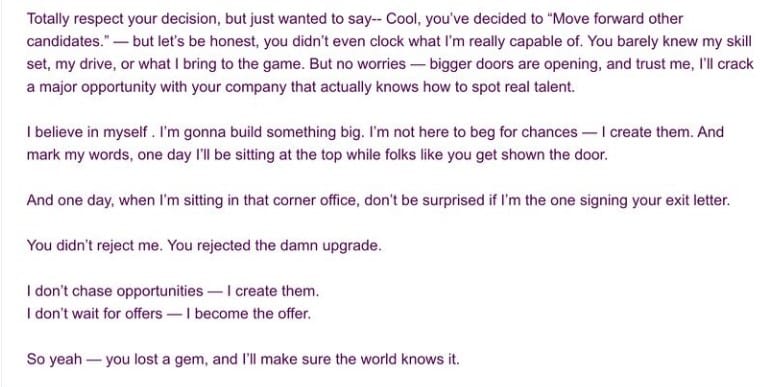
Bid said he had shared this letter with people with people from different generations and had received diverse replies.
“Boomers and Gen X were, at the very least, shocked. Some were even angered. Millennials’ opinion was mixed. Most were shocked, but some were also understanding,” he wrote. “GenZ was largely supportive and understood where the candidate was coming from. I heard terms like ‘manifestation’, ‘self-worth’, ‘motivation’, etc.”
More than 500 comments echoed all of those readings, from “love his/her confidence” to “Gen Z show offs”. But many also zeroed in on the candidate’s style of writing.
“ChatGPT ka istemal karna koi inse seekhe, seekhe inse,” rued one commenter— If you want to learn how to use ChatGPT, learn it from them.
This is the first part of a series tracking what India’s CEOs are saying about changing workplace trends, dynamics, and lifestyle.
(Edited by Asavari Singh)