





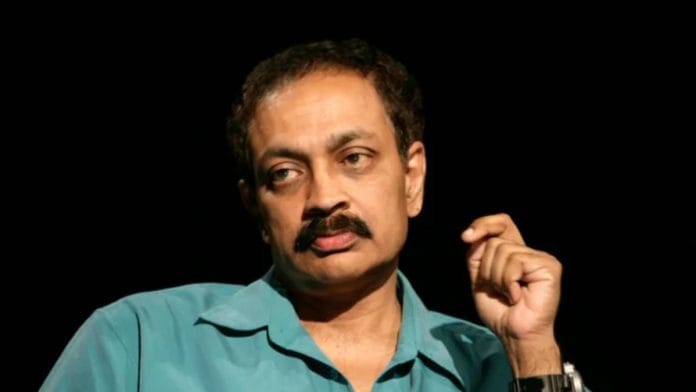



New Delhi: Late sex offender Jeffrey Epstein funded a study on an “autistic savant who displays telepathy” that was conducted by Indian-American neuroscientist Vilayanur S. Ramachandran. The neuroscientist was put in touch with Epstein through wellness author Deepak Chopra.
Chopra’s relationship with Epstein has been under scrutiny, with the author maintaining that he was merely teaching meditation. However, Ramachandran’s reported association has added a new Indian dimension to the Epstein files.
Speaking to CBS in October 2025, Chopra said that following his suggestion, Epstein visited Dr. V.S. Ramachandran’s lab at the University of California, San Diego, to learn about ongoing brain research.
“At my suggestion, he also visited Dr. V.S. Ramachandran’s lab at the University of California, San Diego, to learn about ongoing brain research,” Chopra said.
Ramachandran, emeritus distinguished professor, was the director of the US San Diego lab’s department of psychology’s Center for Brain and Cognition.
It is an email that has come under scrutiny. In his response to Chopra, Ramchandaran had written about a study his lab was conducting on an “autistic savant who displays telepathy.” Ramachandran had expressed no problem “with his lab funded by Epstein.”
Latter-day Marco Polo
In another email, Ramchandaran had enquired if Chopra’s pal (Epstein) was serious about “setting a lab in motion for the study of extraordinary brain potential… something like 500,000 to 3 million would get the administrators excited.”
In a subsequent email to his accountant, Richard Kahn, Epstein directed that $25,000 be transferred from his private foundation, Gratitude America Ltd., to the University of California Board of Regents to support Ramachandran’s research on savant syndrome. He instructed that the payment be mailed to Peter Hinkley, the former director of the psychology department and its current chief administrative officer.
Ramachandran is popularly known in American intellectual circles as a “latter-day Marco Polo.” He has earned a formidable reputation for his pioneering work in neuroscience and for pushing the boundaries of the field.
He was featured in Newsweek’s list of the “100 Most Prominent People to Watch in the 21st Century.”
A Cambridge graduate, Ramachandran has several distinctions to his name — from delivering the Reith Lectures in 2003 to receiving fellowships at All Souls College and the Royal Institution. He also presented a two-part series for Channel 4.
He has authored several books, including Phantoms in the Brain, which was widely acclaimed. His later work, The Tell-Tale Brain, was described by the Financial Times as an unimprovable “sweep of contemporary neuroscience.” The book is a non-fiction diving into human nature from a neurological viewpoint.
(Edited by Ratan Priya)