





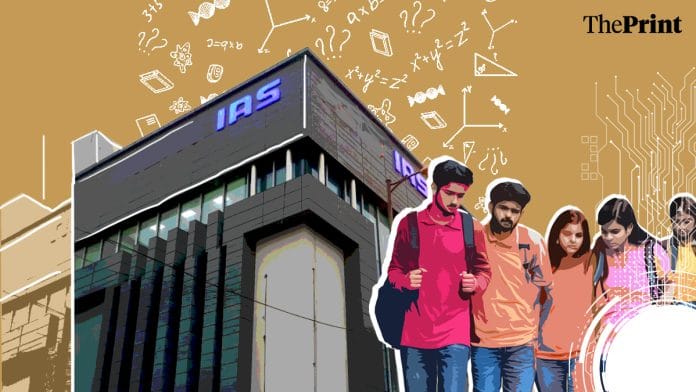



New Delhi: Six months ago, UPSC aspirant Shubham Guliya quit his coaching institute for good. He had found a “replacement” for the centre, and for the teacher he had spent a year searching for: ChatGPT. The 23-year-old is not just saving money on fees and study material, but is also part of a growing trend. Artificial intelligence is emerging as the next frontier for the UPSC coaching industry.
Guliya, who lives in Old Rajinder Nagar, now depends entirely on AI for his educational queries.
“I went to two coaching centres and realised they weren’t teaching me anything that AI can’t,” Guliya said. “ChatGPT is better because I don’t have to pay lakhs in fees, go outside, or ask the same question again and again. I can get my tests checked, access study material online and receive personalised answers.”
Launched in December 2022, ChatGPT is increasingly becoming a replacement for coaching institutes. At least three centres in Delhi have shut down in recent months, with industry players citing aspirants’ growing dependence on AI as one of the main reasons. Other factors include large institutes offering courses at lower fees and stricter government norms introduced after the death of an aspirant who drowned in a coaching centre’s basement library.
An owner of a major coaching institute said aspirants were smart and would gravitate towards the most effective option.
“The UPSC aspirant is intelligent and mature,” said Anmol Goyal, founder and CEO of 99 Notes. “When YouTube came in 2008, students moved to it and it became an important part of preparation. The same is now happening with AI. It’s true that small coaching institutes are shutting down, and AI is one of the reasons.”
Goyal’s institute, which had around 600 students until last year, is among the three that have closed in recent months. The others include Chahal Academy and IAS Gurukul.
“Our institute shut down, and AI was a key factor,” he added. “AI has become a significant part of UPSC preparation, and aspirants are moving towards it.”
Also read: India’s coaching institutes are having a meltdown. Teachers, students dropping out
A shrinking market
In recent years, the Narendra Modi government has tried to regulate the coaching industry through new guidelines and regulations. But industry experts argue the market will eventually consolidate around a few large players.
“The government’s regulatory efforts are reflected in the way institutes are shutting down,” said B Singh, CEO of NEXT IAS. “But it’s not just the government—AI is also taking over. Aspirants are shifting towards it, and small coaching centres are closing. Three or four institutes shut down recently, and some of their students joined my institute mid-session.”
The UPSC coaching industry has already seen several transformations. The first big revolution was YouTube-based learning, followed by the digital phase, when teachers began uploading classes online and study material became widely accessible. Aspirants moved quickly to these platforms.
Then came the Covid-19 pandemic, which triggered an edtech boom. Massive funding flowed in, and coaching centres saw unprecedented growth. But as funding dried up, several major players such as Byju’s, Unacademy and Vedantu struggled or downsized.
Now, in the post-edtech wave, offline coaching institutes are battling challenges created by AI.
“It’s true that aspirants are using AI in their preparation, but it hasn’t completely taken over,” said Ketan, a UPSC teacher. “They use it for mock tests, evaluations, and to generate prelims- or mains-style questions. It hasn’t replaced a teacher yet. But coaching institutes that don’t leverage AI won’t survive.”
Industry insiders agree that while AI may partially take over, coaching institutes will continue to exist.
“If you search for any [competitive] exam, you will see articles or videos created by coaching institutes,” Goyal said. “AI gathers all that information and presents it to candidates. Students will always need coaching to understand the syllabus, questions and overall strategy.”
Even so, AI has clearly changed the landscape. Tasks that once took hours can now be completed in seconds.
“When I was preparing for UPSC, we used Google and clicked through page after page to find the right information,” Ketan said. “AI has made that process much easier and, in many ways, replaced Google.”
Guliya, however, argues there is little AI cannot do — from sourcing material to building a complete preparation strategy.
“People say you need a coaching institute for certain things, but I don’t believe that,” he said. “I even created my productivity plan using AI, and it’s working fine. From strategy to answer-writing practice, I do everything with AI’s help. I considered buying a premium plan but realised the free version does everything I need.”
Guliya cleared the UPSC prelims last year, appeared for the mains, and is now preparing for the 2026 prelims.
(Edited by Prashant Dixit)