





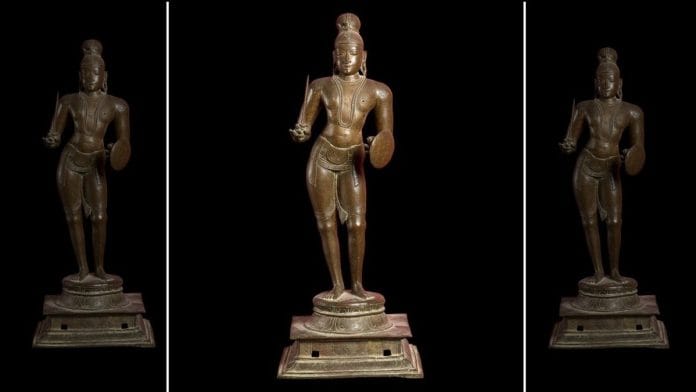



New Delhi: The Ashmolean Museum in the UK has repatriated a 16th-century bronze idol of Saint Tirumankai Alvar to India, paving the way for its return to the temple in Tamil Nadu, where the Vaishnava saint was originally worshipped.
The idol was taken from the Sri Soundararaja Perumal Temple in Thadikombu, Tamil Nadu, after the museum purchased it at an auction in 1967.
The handover ceremony for the statue of Saint Tirumankai Alvar occurred at the High Commission of India in London on Tuesday in the presence of the Director of the Ashmolean, Xa Sturgis, CBE, and Professor Mallica Kumbera Landrus, Head of the Museum’s Department of Eastern Art.
“The Ashmolean is pleased to see this important object returned to India, and we are grateful to the Indian authorities and scholars who helped establish its provenance. The museum and the University of Oxford are committed to ethical collection practices and to continued research into our collections, their origins, and their history,” said Sturgis.
The High Commission of India in London said that the return of this bronze statue to the Tamil Nadu temple demonstrates the museum’s strong leadership and moral clarity.
“The government and the people of India appreciate this action and effort, which is not merely the restoration of an object of art, but the reunification of an icon of faith with its intended shrine—restoring memory and enabling cultural continuity,” said the spokesperson for the High Commission of India in London.
Back to India
Tirumangai Alvar was the last of the 12 Alvar saints devoted to the Hindu god Vishnu.
According to the Sotheby’s catalogue, the bronze idol, about 57.5 cm tall, was sold by the private collector JR Belmont (1886–1981). However, there is no information on how the idol entered his collection.
In November 2019, an independent researcher informed the museum about the idol’s origin in the Perumal Temple. The scholar identified the bronze as one of several objects in collections in Europe and the US recorded in the IFP-EFEO archive.
The IFP-EFEO archive is a major collaborative digital and physical repository of South Indian cultural, historical, and religious materials, initiated in 1956 by the French Institute of Pondicherry (IFP) and the French School of Asian Studies (EFEO).
Later in 2019, the museum requested the High Commission of India in London to formally confirm the idol’s provenance.
The effort gained momentum on 12 February 2020 when the executive officer of the Perumal temple, Ka Raja, filed a police complaint stating that the original bronze idol had been replaced with a modern replica.
An independent researcher discovered a 1957 photograph in the IFP-EFEO archive showing the same idol in the Soundararaja Perumal Temple in Tamil Nadu. This raised questions about how the statue left India.
Also read: Brawl at Holi event in London. UK Hindu group blames Muslims
A 4-year-long tussle
The Ashmolean Museum first contacted the Indian High Commission in London on December 16, 2019, after several questions were raised over the idol’s provenance, following which the High Commission formally sought its return in March 2020.
Further research in India was delayed by the Covid-19 pandemic but resumed in July 2022, when Landrus met officials from the Tamil Nadu Idol Wing and the Archaeological Survey of India (ASI), the French Institute, Nagaswamy Temple (Icon Centre), and the Soundararaja Perumal Temple.
At ASI’s request, the museum commissioned a metal analysis of the bronze and submitted the results to support a comprehensive report on its provenance. Following the University of Oxford’s procedures for the return of cultural objects, the Ashmolean’s Board of Visitors supported the claim and the evidence presented.
The University Council approved the claim on 11 March 2024 and referred the case to the Charity Commission for England and Wales, which approved the transfer in December that year. Since then, the museum worked with the High Commission of India to arrange the idol’s return to India.
(Edited by Saptak Datta)