





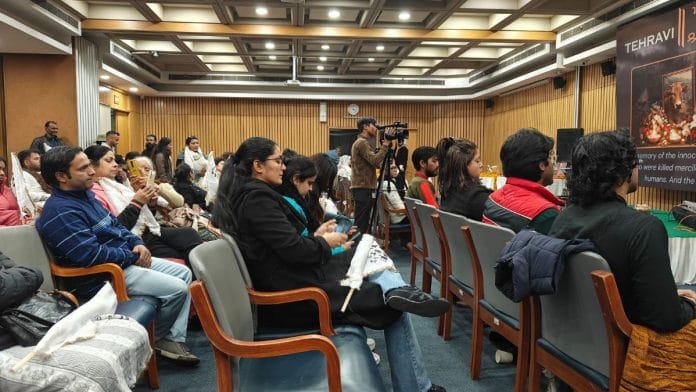



New Delhi: On an unusually rainy January afternoon in New Delhi, mourners gathered for a Terhvi, or a 13th-day prayer ceremony, in accordance with Hindu practices, to commemorate the lives of dogs allegedly poisoned and killed en masse in Telangana, along with other animals that have died in similar acts of cruelty across the country.
“These dogs trusted humans. Many of them depended on caregivers like us for survival. Holding a Terhvi for them is the least we can do—to grieve, to remember, and to promise that we will not stay silent and fight for their rights till the end,” said Sanjay Mohapatra, founder of House of Strays, which has been dedicated to the care of community dogs and animals for years.
The solemn gathering was also aimed at raising awareness about how animals, especially strays, are being increasingly abused. The Supreme Court’s order from August was also discussed and how it has led to an increase in such acts of violence.
It was in no way different from a prayer meet organised for a human, with musicians playing soft, mournful tones of ‘Hey Ram Hey Ram’, even as people greeted each other, identifying them by the work they do for animals. People of all ages and genders turned up to offer their condolences. The conference room was soon packed.
The memorial service was scheduled between 2 and 5 pm at the India International Centre (IIC). But it started only around 3 pm, and extended beyond 5, with tea breaks. Even as the rain lashed outside, the organisers put together a function that had a stage for musicians, against a giant backdrop with images of a dog, cat, monkey, and a cow, and a table where one could light diyas to commemorate the dead.
Gathering of caregivers
Attendees had turned up on the rainy day from all over Delhi, and even Ludhiana, to be a part of the memorial service. They were prominent animal welfare activists, environmentalists, caregivers, legal experts, and gau rakshaks.
A young priest talked about how serving and taking care of animals is akin to serving God. “I am from Vrindavan and its culture is about worship of forests and their beings,” said the priest, narrating a story about how Lord Krishna once told Radha that his soul resides in every animal.
It was followed by the lighting of candles, and as everyone settled, some attendees shared their experience of being caretakers of animals, in the light of the ongoing case at the Supreme Court, and the incident in Telangana.
“What happened in Telangana is not an isolated act of cruelty—it is the result of institutional apathy and a dangerous normalisation of violence against animals. This Terhvi is a powerful reminder that these dogs were living beings, protected by law, and their deaths demand justice,” said animal and environmental rights activist Ajay Joe.
An FIR has been registered against nine people, including the sarpanch and panchayat officials of two villages, for allegedly poisoning and killing more than 300 dogs in Hanamkonda district of Telangana. Around 110 dog carcasses have been excavated, and police clarified that the initial claim of 300 was an overestimate.
One after the other, attendees came up to the dais with their experiences of witnessing cruelty toward animals and being part of the fight. Calling the animals ‘bacche’(kids), they narrated how an apathetic system is the root cause of the cruelty toward strays and the human-dogs conflict.
“Today, we have gathered peacefully here to request the Hon’ble Supreme Court to take strict action against all the perpetrators behind the killings of these innocent, voiceless beings. Since they cannot fight for their rights, it is we, the people, who demand ground-level action, so that such atrocious acts do not take place in the future,” said advocate and caretaker Vikas Gautam.
Also read: Historian’s role is bigger than simple questions of beef and Hinduism: Preeti Gulati at KLF
Get angry, to go to the ground
From setting a stray dog on fire to instances of sexual abuse of animals, the list of cruel acts inflicted on animals has grown. At the Tehrvi, a large-screen presentation showed visuals of such incidents and snapshots of newspaper headlines from across the country. The slideshow felt straight out of a horror film, filled with gruesome images and disturbing scenes of cruelty.
Each narration was punctuated with chants of ‘Har har Mahadev’–to emphasise Lord Shiva’s identity as pashupati, or lord of all creatures, and framing care for animals as a spiritual duty.
The narrators got angry and even shed tears, as they stressed the need for actual actio. Renu Kaur, an animal rescuer, was visibly upset as she narrated how there is a lack of unity among those who claim to love animals. People don’t show up when they’re needed.
“When people send a message that we need to attack animal feeders, they turn up in huge numbers. But when an animal feeder pleads in a group that he/she is being attacked, or the strays they feed are being attacked, not one person turns up to help,” she said.
But Kaur also emphasised the need to acknowledge when a stray dog attacks or bites someone.
“Some feeders deny that the dog has bitten or attacked someone. That does not help the cause because it leads to resentment and attacks on other strays. It is important to acknowledge and address the concern,” said Kaur.
She directed attention to how cleaning up after feeding drives is crucial, because the onus is on those feeding the stray to ensure safety.
“Sharing on social media and forwarding messages on WhatsApp will not help the animal. Get up and get to the ground,” she thundered, drawing loud applause.
(Edited by Ratan Priya)