





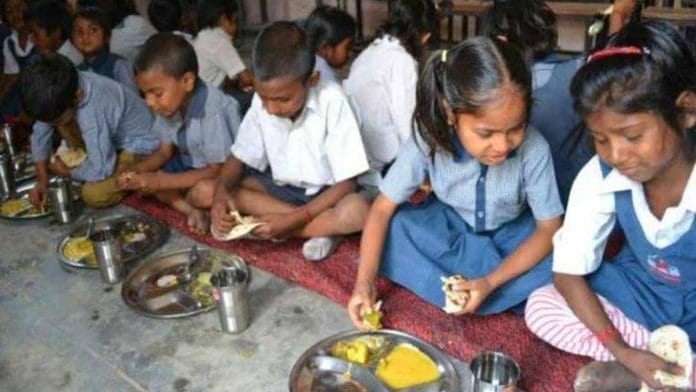



New Delhi: From ragi halwa in Delhi to kheer and pinni in Haryana to millet khichdi in Uttar Pradesh, India’s mid-day meal is no longer limited to the pale dal-rice plate. States are introducing local, culturally familiar foods in government school kitchens, projecting a shift toward diversity and nutrition. But on the ground, teachers and researchers say the transformation is more about optics. Chronic funding delays, unrealistic cost norms, and weak monitoring are hollowing out the promise of the recently rebranded PM-POSHAN scheme.
Feeding nearly 11.8 crore children every day, PM-POSHAN (Pradhan Mantri Poshan Shakti Nirman) is the world’s largest among such initiatives. Since its launch in 1995, the mid-day meal programme has moved from a hunger-relief tool to a central plank of the government’s nutrition, education, and welfare strategy. In recent years, the government has revised menus, increased per-child costs, and expanded coverage to younger children under Bal Vatika. Yet, implementation gaps—from erratic fund flow to caste-based discrimination—continue to undermine the programme.
“The teacher must manage the logistics for the whole school. We are receiving a fraction of the cost while being expected to deliver 100 per cent of the nutrition,” said Jitender Kumar, who teaches at a government school in Azamgarh, Uttar Pradesh.
At the heart of the scheme is a tight arithmetic of execution. The material cost for a primary school child now stands at Rs 6.78 per day, while upper primary students are allocated Rs 10.17. In this amount, schools are expected to provide cereals, pulses, vegetables, milk, and fruit—in addition to the ‘nutritious’ items newly introduced in several states. Teachers say the numbers simply do not add up. These gaps on the ground raise the question of whether India’s flagship school feeding programme is strengthening children’s nutrition or merely reinventing its menus.
By introducing new dietary supplements, our goal is to enhance the nutritional value of what students in schools are eating. The balanced diet includes all the nutrients that are required at the school level.
Munish Nagpal, deputy commissioner of Charkhi Dadri, Haryana
Haryana’s pinni, instant kheer
According to Arun C Mehta, former National Educational Management Information System Coordinator at the National Institute of Educational Planning and Administration, rural schools continue to struggle with delayed fund releases, inadequate kitchen infrastructure, and weak monitoring.
“Caste discrimination persists in several states, and it is the people from marginalised castes who make the food. Dalit children don’t have access to mid-day meals even now. This is prevalent in Madhya Pradesh, Rajasthan, Odisha, Gujarat, and Uttar Pradesh,” Mehta said. “Over time, dry rations have substituted for hot meals, which halves nutritional impact.”
Launched in 1995, the National Programme of Nutritional Support to Primary Education offered students dry rations. In 2001, the Supreme Court mandated all states to provide hot cooked meals and turned the programme into a legal entitlement. By 2007, the scheme’s coverage was extended to upper primary levels and in 2021, it was rebranded as PM-POSHAN, which incorporated pre-primary students. A lot has changed since.
According to government data, the budget estimate for the PM-POSHAN scheme in 2025-26 was Rs 12,500 crore. There was no revised estimate, and the fund released was Rs 4,343 crore. In 2024-25, the revised estimate was Rs 10,000 crore, while the amount released was Rs 9,902.99 crore. The year before that, the revised estimate was Rs 12,800 crore, and the amount released was Rs 12,681 crore.
The government speaks of nutrition, but the reality is that allotments lag by five months. How is a teacher supposed to convince a local shopkeeper to give pulses, oil, and spices on credit for half a year?
Jitender Kumar, government school teacher
Haryana is among the states showcasing menu diversification as a success story. The state has introduced items such as kheer, pinni, panjiri, and bajra mixtures under the revamped scheme, alongside milk bars for students. Officials say the aim is to improve calorie and micronutrient intake through familiar foods.
According to Munish Nagpal, deputy commissioner of Charkhi Dadri district, supplementary nutrition is one of the important aspects of the Integrated Child Development Services (ICDS) scheme. It bridges the gap between the recommended dietary allowance and the daily average food intake.
“By introducing new dietary supplements, our goal is to enhance the nutritional value of what students in schools are eating. The balanced diet includes all the nutrients that are required at the school level,” said Nagpal.
According to Arun C Mehta, in schools with enrolments fewer than 150, teachers have often doubled as cooks, which leads to burnout.
Based on the Aspirational Block Programme, the districts within the state documented the benefits of new nutrients in the food. The programme focuses on improving governance by converging existing schemes, defining outcomes, and monitoring results using digital tools. The exercise also mapped the number of students attending school to avail the mid-day meal.
But teachers working at the last mile say such claims rarely survive contact with reality. While pinni can be found in most mid-day meal plates in Haryana, the teachers at a government school in Nuh are struggling to make kheer available. Narender, a postgraduate teacher of English who also looks after the mid-day meals at his school, said that students prefer savoury food items.
“Children don’t like sweets that much. And it is also instant kheer… If it were made from scratch, the health benefits and nutrients are better,” he said. Teachers add milk to the ‘instant’ kheer depending on the number of students present.
Also read: Bihar Bhumihars ask ‘Who are we?’ Brahmin or OBC, zamindar or oppressed
Teachers become ‘debt managers’
In July 2025, the Uttar Pradesh government directed district magistrates to update the mid-day meal menu to include pulses and vegetables. The students will now be served bajre ki khichdi on Fridays, along with moong dal and seasonal vegetables.
Having spent about 15 years navigating various villages of Azamgarh, Jitender Kumar has seen how the scheme fares in schools.
According to him, the story remains almost the same.
While headlines about mid-day meals get coverage, he said, a teacher’s reality is different. “The government speaks of nutrition, but the reality is that allotments lag by five months. We receive the food grains, by which the conversion cost arrives with a 60 per cent cut. How is a teacher supposed to convince a local shopkeeper to give pulses, oil, and spices on credit for half a year?” he added.
Under the scheme, budgets are calculated strictly by daily plate counts: the number of children who eat on a given day. The amount of Rs 6.78, allocated to each child, is also supposed to include milk once a week.
“In a village market, this is not possible. We’re also asked to provide fruit at Rs 4 a unit. I challenge anybody to find quality fruit in Azamgarh that costs only Rs 4. The math doesn’t add up,” he said.
The menu is diverse. It includes dal, rice, vegetables, fruits, and milk. The plan is solid on paper. “But we have not been able to implement it because the resources never reach the ground on time. The teacher ends up transitioning from an educator to a debt manager for the state,” Kumar added.
Mehta pointed out that in schools with enrolments fewer than 150, teachers have often doubled as cooks, which leads to burnout.
Despite these hurdles, he added, the scheme led to diverse regional innovations that offered a roadmap for the future. In Andhra Pradesh and Telangana, there are centralised kitchens run by NGOs for urban clusters. In Odisha, SHGs came together to cook for school children, and West Bengal introduced school-level cook-cum-helpers. The arrangement of who prepares the food has evolved to meet local needs. Karnataka has tied up with Akshay Patra Foundation to provide meals to children.
“The scheme shouldn’t be limited to upper primary children, but should be extended to secondary schools as well to ensure that adolescent students are not lost to malnutrition,” Mehta added.
(Edited by Prasanna Bachchhav)