





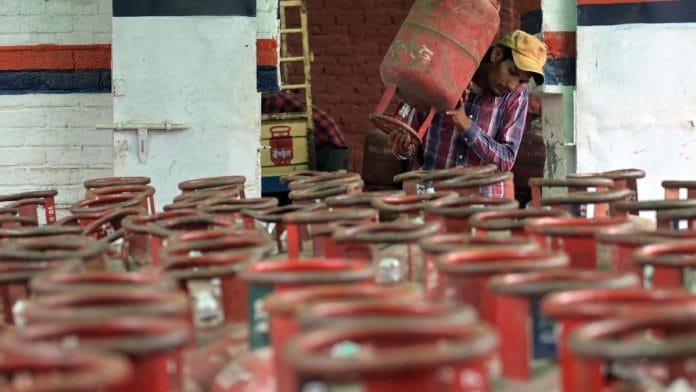



New Delhi: Restaurant owner Sumit Gulati has been losing sleep over the past few days because of a shortage of LPG cylinders across his multiple outlets, stemming from the US-Israel-Iran conflict. The businessman, who runs cloud kitchens and restaurants in Noida and Gurugram, says LPG cylinder supplies have stalled for a few days.
Vendors, he said, have told him they are unable to procure commercial cylinders due to the escalating crisis in West Asia.
“Our vendors said that they aren’t getting LPG cylinders. We had to buy from Delhi to keep the kitchens running for now, but we don’t have a game plan yet, if situations don’t improve,” Gulati told ThePrint.
He runs four outlets and four cloud kitchens of his flagship brand, Call Chotu, and brands like Spice Market, Your Truly Butter Chicken and Nayi Dilli ke Paranthe on the cloud at six locations. Out of his 10 outlets, only one has access to piped gas and is operating smoothly. The remaining are struggling as the price of LPG cylinders has risen by Rs 200, with each selling for Rs 2,100 to Rs 2,200 in Delhi.
“The online ordering business in Delhi NCR alone is roughly about Rs 8,000 to Rs 10,000 crore per annum. And the dining in would be one-fifth of this. So we cannot even think about the loss the industry will face,” he said.
The National Restaurant Association of India (NRAI) wrote to Petroleum and Natural Gas Minister Hardeep Singh Puri, seeking the Centre’s intervention for uninterrupted supply of commercial LPG cylinders to restaurants. The association warned that disruptions could have a severe impact on the industry. This letter, dated 7 March, was written in response to the government circular that mandated the supply of LPG cylinders to domestic users only.
“Though the ministry had rolled back the circular within 24 hours, NRAI got information from the LPG distributors that the three major PSUs who refill commercial and domestic cylinders have told them that commercial cylinders for restaurants and hotels won’t be refilled for now as they aren’t an essential commodity,” Varun Khera, Noida Chapter Head, NRAI, told ThePrint.
“So we wrote the letter in advance. But, we haven’t received a response yet,” he said.
Highlighting the sector’s economic contribution, the NRAI, in its letter, said it represents more than five lakh restaurants across India and has an annual turnover of about Rs 5.7 lakh crore. It underlined how the industry provides direct employment to over eight million people, making it one of the largest service segments in the country.
“The restaurant industry is predominantly dependent on commercial LPG for its operations. Any disruption therein will lead to a catastrophic closure of the majority of restaurants,” the letter read.
Khera told ThePrint that if the supply reaches a standstill and the government doesn’t back the industry, the organised sector alone will suffer “Rs 600 to Rs 700 crore loss daily” and “Delhi NCR would face losses up to Rs 50 to Rs 60 crore daily”.
“The food service industry has recorded a contribution of Rs 3,40,00,000 crore in a year to the GDP. This data is from 2024. We had to grow by Rs 4,20,00,000 crore, but at the moment, even if we take the same 2024 amount and remove 30 per cent for the piped gas service, we have Rs 2,00,000 crore annually. Divide it by 365 days, it’s approximately Rs 600 to Rs 700 crore per day, and that’s the loss the industry will face,” Khera claimed.
Unorganised sector under fire
The Bruhat Bengaluru Hotel Owners Association on Monday warned that restaurants across the city may shut down if the supply of commercial LPG cylinders is disrupted. PC Rao, president of the association, said that many restaurants were already facing difficulties due to the shortage of commercial LPG cylinders. He urged the government to step in and ensure a regular supply.
Rao added that around 25 to 30 hotels in Bengaluru were affected early Monday after suppliers stopped providing direct gas.
“We have written a letter to the central government and also approached local MPs, but there has been no response so far,” he said.
NRAI Bengaluru Chapter Head Chethan Hegede revealed that restaurants and hotels usually stock up on gas for three to four days. Therefore, the kitchen is still functional. But the associations cannot sit down and wait for the situation to get worse. He said that the LPG distributors in Bengaluru have informed the restaurant and hotel managements that they won’t be getting cylinders as per their desire.
“The actual disruption will come if the supplies are actually cut down entirely. So we are preempting it, trying to be aware, and creating a plan for what is gonna happen. If fresh stock is not delivered in the next few days, it will hit operations. And the loss is going to be huge,” Hegede claimed.
However, this only reflects the organised sector. India’s unorganised food sector is equally massive, accounting for nearly 50 per cent of the industry. Hawkers, street vendors and quick-service restaurants (QSRs) selling dosas, tikkis, chaats, rolls, pav bhaji, and even the humble roti sabji, among other things, depend on daily business to sustain their livelihoods.
“The second-largest source of employment in the country comes from this sector. Every 100 metres, you will find a food kiosk using a gas cylinder. Unlike larger establishments, the organised sector does not always have the option of piped gas or induction. Moreover, a large number of people depend on this unorganised sector for their daily meals,” Khera said.
But, rate and price fluctuation aren’t the most important thing for NRAI. The association understands that the panic will naturally lead to hoarding and the mushrooming of black markets, as everyone has to ration their cylinders. But, for them, the supply flow is a topmost priority.
“We can absorb a little rate difference, but we cannot absorb complete stoppage,” Khera said, adding that their plea to the government is to include the food sector also in the “essential commodity” category, along with hospitals, as was the case during the Covid-19 pandemic.
While the piped gas supply is currently uninterrupted, Khera fears that if the situation gets worse, the piped gas will also take a toll.
Also read: Modi govt is collecting rare manuscripts of Ramayan. Panel formed to evaluate texts
No more butter chicken; dal makhani
The first change restaurant owners have planned, if things don’t calm down, is to slash some of the crowd favourites from the menu. Gravy-based dishes, which are largely cooked on LPG cylinders, will leave the restaurant menu, but Tandoor-based dishes like Tandoori Chicken, Paneer Tikka, assorted naan and roti, Tandoori Fish, and stuffed kulchas remain.
“Initially, we will try to make the menu a little leaner. Won’t be running all departments. Some kind of stock arrangement will be done,” Hegede said.
If the LPG situation continues to worsen, Gulati has cracked a temporary plan to stay afloat. He has instructed his outlets to switch to induction cooking. And, if things go worse, his next step is to pull gas cylinders from all outlets and keep them for the functioning of just the central kitchen.
“In our central kitchen, we cook all sorts of gravies in big pots. That cannot be done on electric induction,” he said, adding that bestseller dishes like “butter chicken and dal makhani” will be removed.
However, the temporary solutions are not entirely bulletproof. The business numbers will still take a toll. And, the timing isn’t great. In Bengaluru, the restaurant industry was already facing pressure due to price hikes and labour issues. The LPG fiasco has made the situation worse.
“We were not in a great spot, so this is like a double whammy for us,” Hegede added.
(Edited by Saptak Datta)