





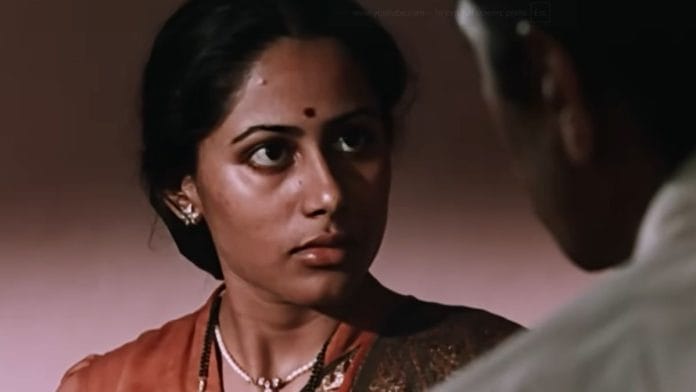



In the legacy of biopics on actors, Shyam Benegal’s Bhumika (1977) stands out for its portrayal of the grim, unsparing life of a female actor. Based on Sangtye Aika, the memoir of Marathi actor Hansa Wadkar, the film is headlined by Smita Patil, who delivers a brilliant performance at the age of just 22.
When her abusive father dies, Keshav (Amol Palekar), the family manager-cum-‘well-wisher’, gets Usha (Patil) into movies as a singer, despite her mother’s objections. Keshav posits himself as indispensable to the struggling family, manipulating Usha into marrying him. After becoming a mother, Usha wishes to quit acting. But Keshav, who is dependent on Usha as his business never takes off, dissuades her. As he gets increasingly controlling, jealous over Usha’s bond with her co-actor Rajan (Anant Nag), and abusive, Usha seeks to escape her reality through a string of affairs with different men.
Over the last few decades, Karisma Kapoor’s Zubeidaa (2001), Vidya Balan’s The Dirty Picture (2011), and Keerthy Suresh’s Mahanati (2018) have portrayed prominent actors like Zubeida Begum, Silk Smitha, and Savitri, struggling with the unbearable loneliness that success brings to a female star. But Bhumika’s depiction of Usha’s loneliness is about the inherent loneliness of a woman, who chooses a life that does not align with societal expectations. And Benegal is not afraid to show Usha as a woman who is deeply flawed.
No male gaze
Benegal wrote the film with Girish Karnad while theatre director and playwright Satyadev Dubey gave the dialogues. The flashback scenes are shown in black and white, demarcating clearly the past and present of Usha’s life. Kalpana Lajmi’s costumes in the film capture the essence of Marathi cinema and life in Maharashtra — be it Usha’s colourful pallus, quarter-sleeve blouses or gajra in hair. The music, by Vanraj Bhatia, punctuates the moments of turmoil in Usha’s life.
Despite three men at the writer’s table, the film is devoid of male gaze, except in bits where it is deliberate to showcase Usha’s reality as an actor.
Her subsequent affairs, with director Sunil (Naseeruddin Shah) and businessman Vinayak (Amrish Puri), explore male desires, where both men try to control her in their own ways. She dismisses Rajan (Anant Nag) who offers her a more egalitarian relationship — almost as if she would rather perpetuate the violence she witnessed in her mother’s abusive relationship.
A significant highlight of Bhumika, and also of films like Zubeidaa, Mahanati, and The Dirty Picture, is how women, taught to compete with each other for men’s attention, do not find allies and friendships. The only ally for Usha is Vinayak’s bed-ridden wife, who too advises her to accept her fate.
“Listen to my advice, make peace with your cage. How long will you roam around seeking freedom?” says Mrs Kale (Rekha Sabnis). She is also the one who cautions Usha that although she may change men, the exploitation will remain the same.
Also read: Loafer is proof of Dharmendra’s unmatched versatility
A Smita Patil film
Smita Patil’s performance in the film, as a young hopeful girl turning bitter as the world around her exploits her, foreshadows her own brilliant yet short-lived career to some extent. She balances the hopeful Usha, who repeatedly tries to find a way out, with her dashed expectations and the almost powerless anger she feels over what she is subjected to.
In the scenes where Usha is shown shooting for her films, with a smile and seductive steps, it is almost as if she is a different person — confident, in control of her life. But the moment the camera stops rolling, her body language shifts — crossed arms, furrowed brows, smile wiped off her face.
She owns every frame in the film, with her expressions and mannerism conveying her constant restlessness and urge to escape. The performance also won Patil a National Award that year for best actress.
While it is a Smita Patil film through and through, with the male actors in supporting roles, Palekar stands out with a performance starkly different from his warm, empathetic characters in films like Chitchor (1976) and Gol Maal (1979). He plays an abusive husband to the hilt, eyes dark and suspicious, revealing his own insecurities about Usha. The ordinary looking man, with hair slicked back, conveys a sense of dread with his mere appearance.
Even in the flashback scenes, which show how he is a manager of sorts in Usha’s parents’ house, he is borderline pedophilic, with his sights on the young Usha, who sings extremely well. His exploitation of Usha, sexual and financial, eventually shape her life decisions.
The scenes he shares with Patil are some of the most brutal yet powerful ones. Recently at a film festival, Palekar spoke of how in one scene he was asked to slap his co-star without informing her beforehand — a choice he said he later regretted.
“If it was today, I would not have done it. And it’s not just because of the theatre discipline, but also because I do not believe in raising my voice and hand on a woman,” said the actor.
Views are personal.
(Edited by Aamaan Alam Khan)