





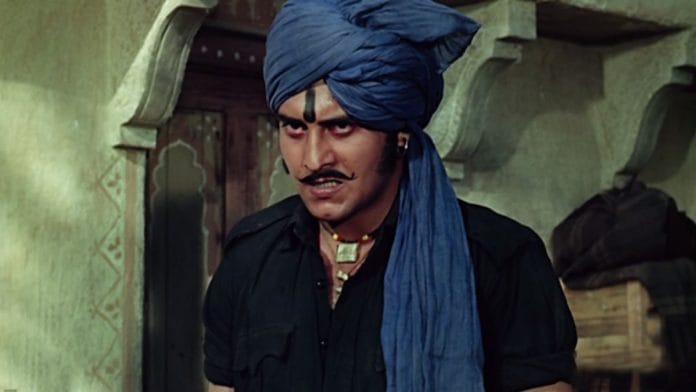



Raj Khosla was a master storyteller who defied labels. He learned from Guru Dutt, whom he met during the making of the 1951 film Baazi. On Dev Anand’s recommendation, Khosla worked as an assistant director on the set. And from then on, Khosla built a Bollywood career that had an enviable versatility.
From the neo noir CID (1956) to horror thriller Woh Kaun Thi (1964), and the family drama Do Raaste (1969), Khosla tried his hand at a variety of themes. In 1970, he made Mera Gaon Mera Desh, the western-inspired film that is often touted as the precursor to Sholay (1975).
A petty thief, Ajit (Dharmendra), is caught by Havildar Major Jaswant Singh (Jayant). But instead of seeking revenge for his arrest, Ajit ends up working for Jaswant, and eventually decides to defend a terrorised village from a ruthless dacoit, Jabbar Singh (Vinod Khanna). This is extended in Sholay to two friends, Jai (Amitabh Bachchan) and Veeru (Dharmendra), defending the villagers against Gabbar (Amjad Khan). Even the names of the villains are similar in the two films, and like Thakur (Sanjeev Kumar), Jayant’s also missing arm an arm.
Mera Gaon Mera Desh at its core, is a tale about the return of the prodigal son, and his redemption through the character of Ajit. But what makes it exciting is the fabled valley of Chambal, where the film was shot, and which was long known as the breeding ground for India’s notorious dacoits—along with its undercurrent of social justice. Woven into this is the village belle Anju (Asha Parekh). Ajit falls in love with her.
Ruthless Jabbar
The film had Dharmendra and Vinod Khanna delivering standout performances. Dharmendra’s character arc, from a thief to a man who takes responsibility and fights for a community, is a treat. While his funny drunk scene atop a water tank in Sholay is considered a classic, the one in Mera Gaon Mera Desh stands out for the pain he manages to evoke.
A drunk Ajit is thrown out by Jayant, and stumbles upon a sleeping homeless woman, whose son has run away. Slurring and in tears, he says, “Everyone has abandoned me. The man who used to call me his son has thrown me out. No one has hugged me in forever. I wish I had a mother whom I could hug and sleep.”
Ajit is the hero because he turns his life around and learns the importance of ‘farz’ or duty. In sharp contrast, there is Vinod Khanna, who evokes terror through a mere glance.
The terror he commands is crystallised in the scene early on, when he attacks the village and kills the child Munna, whom Ajit had befriended over time. Jabbar is ruthless, probably even more than Gabbar, and is single-minded in exacting his own revenge against the village headman. The violence is visceral—as he and his henchmen target villagers, sexually assault women and create a reign of terror. Jabbar feels close to reality, instead of mythical or larger-than-life.
What stands out in Khosla’s films is a variety of female characters. He did not necessarily demarcate his female characters into the heroine and vamp. Anju is the quintessential ‘good’ girl that Ajit falls for, and then there is Munni (Lakshmi Chhaya). A dancer, who aligns herself with Jabbar and looks out only for herself, she is scheming, but also hopelessly in love with Ajit.
When she wields her power in front of a captured Ajit during the ‘Maar Diya Jaye’ song, she is expressing her wrath at being dismissed and insulted by Ajit. She plays a double agent, eventually helping Ajit take down Jabbar.
Also read: Mehbooba started Rajesh Khanna’s downfall. He’s playing Hema Malini’s lover from past life
Laxmikant-Pyarelal’s music
Music in Mera Gaon Mera Desh, like in Khosla’s other films, takes the narrative forward. As a trained singer, he made sure the songs are an extension of the plot, whether it is the tense moment when Jabbar comes to a mela disguised and the police are waiting to capture him. Munni is dancing to Apni Prem Kahaiya when suddenly Jabbar’s men open fire, building up how he infuses terror in the lives of the villagers.
‘Kuch Kehta Hai Yeh Sawan’ provides a brief respite from the ongoing tensions in the film, as Ajit and Anju steal a few moments to spend with each other. Laxmikant-Pyarelal composed the music of the film, while the lyrics were written by Anand Bakshi.
The film was a box office success, becoming a significant film for the careers of all the lead actors. But four years later, when Sholay came out, it eclipsed the film completely and relegated it to just another dacoit film of Bollywood.
(Edited by Ratan Priya)