





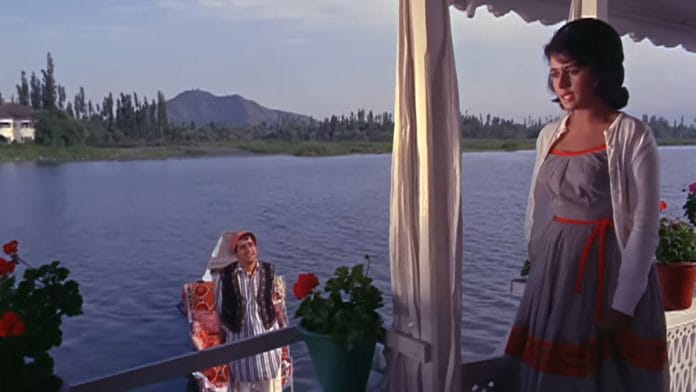



The song ‘Pardesi Pardesi’ from Raja Hindustani was a millennial anthem for heartbreak, and the film was a massive hit. But few know that Raja Hindustani borrowed its plot from the 1965 film Jab Jab Phool Khile. Directed by Suraj Prakash, it starred Nanda, Shashi Kapoor, and the lush valley of Kashmir.
From the 1960s to the 1980s, the snow-capped peaks of Gulmarg, Dal Lake, and Pahalgam were an integral part of many Bollywood romances. Songs such as ‘Chahe Koi Mujhe’ from Junglee (1961), ‘Yeh Chand Sa Roshan Chehra’ from Kashmir Ki Kali (1964) and ‘Kitni Khoobsoorat Yeh’ from Bemisal (1982), made the Valley synonymous with romance.
In Jab Jab Phool Khile, the director used Kashmir’s beauty to bring together US-returned Rita (Nanda) and shikara owner Raja (Shashi Kapoor).
In the film, Rita’s parents suggest that she visit Kashmir during her vacation. Accompanied by a chaperone named Stella (Shammi), Rita lands in the Valley and meets Raja. Over the course of the vacation, the two slowly fall in love. As their time together comes to an end, Rita leaves, promising eternal love to Raja.
But she returns with Kishore (Jatin Khanna), the man her father wants her to marry. The two lovers then struggle, not just to understand each other’s ways but also against Rita’s father, Chunnilal Khanna (Kamal Kapoor), who is determined to prevent his daughter from marrying the poor Raja.
Nanda and Shashi
Jab Jab Phool Khile is heavy on stereotypes. In one scene, Raja enters Rita’s room at the crack of dawn without knocking. While his intent is to simply replace the wilting flowers on her bedside table, it upsets Rita. Instead of offering an apology, Raja gets upset that she is offended.
The scene establishes the distance between their worlds. But as young love is often rebellious, the two fall in love and try to make the relationship work. Rita even tries giving Raja a makeover to make him fit into her society. While Raja’s sartorial choices change, his essence remains the same. He gets a rude culture shock when he sees women drinking, dancing with strangers. When Rita suggests that he could dance with someone, Raja takes affront.
Though Chunnilal is painted as the villain for realising that Raja’s view of the world doesn’t align with his daughter’s, he is not exactly wrong for spelling out their incompatibility. When he asks Rita to teach Raja ‘their ways’ so he doesn’t embarrass her, she obliges, showing that she carries reservations about their relationship. But the internal logic of the film demands that love conquer every unsurmountable obstacle, and so the lovers end up happily together.
Nanda’s job primarily is to look and act rich, which she does without coming across as vacuous. When it matters, she speaks up and rebels. When Chunnilal tries to evoke the familiar parental charter of ‘a young woman should not travel with a stranger’, she immediately counters him by asking why the same rule does not apply to Kishore.
While she asserts her ‘progressive’ nature when it comes to choosing her partner, she also fails to understand how Raja might feel at being made to deck up to impress her father’s friends, and her own.
Shashi Kapoor brings his A-game when it comes to being a charming, happy-go-lucky young man. He makes it believable that a rich heiress could fall for Raja. When he watches Rita sing the song ‘Ye Samaa Samaa Hai Pyar Ka’, he looks completely besotted with her.
Kapoor deftly portrays Raja’s patriarchal outlook as his struggle to accept Rita’s ‘modern’ lifestyle. When she dances with another man, Raja’s eyes reveal everything he feels: confusion, jealousy, heartbreak.
Along with Jab Jab Phool Khile, Waqt also became a blockbuster that year, which established Kapoor as a bankable actor.
Also read: 1976 film Chhoti Si Baat is one of Bollywood’s most progressive portrayals of masculinity
Music in Jab Jab Phool Khile
The film’s album complements the lovers’ journey. Anand Bakshi’s lyrics in ‘Yahaan Main Ajnabi Hoon’ perfectly capture Raja’s inner turmoil. The song ‘Pardesiyo Se Na Ankhiyan Milana’, which appears with a jovial Raja in the beginning of the film foreshadows the hero’s journey. The song comes back as a sad version later in the film when the two lovers have a tiff.
The album was yet another laurel for Kalyanji-Anandji, who were at the top of their game during the decade.
The success of Jab Jab Phool Khile, and that of Raja Hindustani in the 1990s, shows that Indian audiences will always be a sucker for romances that bridge worlds—provided there is great music to complement them.
(Edited by Prasanna Bachchhav)