





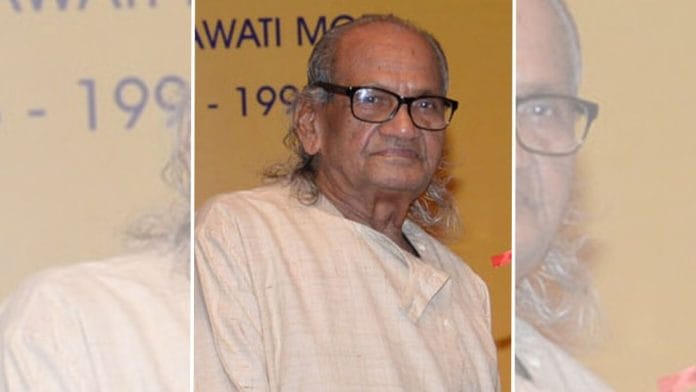



New Delhi: When celebrated sculptor Ram V Sutar saw pictures of the Statue of Liberty in his school days, he wanted to make a statue even bigger than that. He wanted to build the world’s biggest statue.
His dream came true after eight decades, when he sculpted the mammoth 522–feet Statue of Unity, which was installed at Sardar Sarovar Dam in Gujarat.
Sutar, who came to be known as the “statue man”, died on Wednesday at his Noida residence. He was 100 years old.
Sutar has shaped India’s public spaces after Independence. And the Statue of Unity isn’t the only jewel in his crown. “Believe in creating larger than life sculptures,” reads the sculptor’s website.
Sutar was born on 19 February 1925 in Maharashtra’s Dhule district. He studied at the JJ School of Art and had mastery in bronze sculptures. Artists from all over the world visited his studio to learn from him. His work was compared to that of Rodin and Michelangelo.
After doing a diploma in sculpture in 1953, Sutar joined the department of archaeology in Aurangabad as a modeller for the restoration of sculptures at the Ajanta and Ellora Caves.
After four years, he quit his government job to pursue sculpting as a professional career.
Artists, sculptors, and politicians mourn his death.
“A true visionary, he transformed metal into symbols of India’s soul, culture, and history. His monumental works stand as eternal inspirations,” wrote Arun Yogiraj, who sculpted the iconic Ram Lalla idol at Ayodhya Ram Mandir.
I am deeply saddened by the passing of Padma Vibhushan Shri Ram V. Sutar sir, the legendary sculptor of our nation. A true visionary, he transformed metal into symbols of India’s soul, culture, and history. His monumental works stand as eternal inspirations.. om shanti pic.twitter.com/mn0ILTB6hh
— Arun Yogiraj (@yogiraj_arun) December 18, 2025
Last month, Sutar was honoured with the Maharashtra Bhushan Award—the state’s highest civilian recognition.
“Each sculpture designed by Ram Sutar is an art of perfection. His sculpture brings to the fore rich culture and history. It is a legacy that has earned global recognition. They are extraordinary works,” said CM Devendra Fadnavis while awarding him.
Also read: Chandan Mitra saved The Pioneer. Now, the newspaper is being revived
‘I’m a realist to the core’
Sutar’s journey started with the making of the statue of Govind Ballabh Pant after the freedom fighter’s death in 1961.
The statue was installed at the entrance hall of the Lok Sabha lobby. It now stands at a roundabout at New Delhi’s Pandit Pant Marg.
Sutar went on to make statues of MK Gandhi, Jyotirao Phule, Jawaharlal Nehru, Indira Gandhi, and Jayaprakash Narayan.
Sutar’s bust of MK Gandhi has been installed in more than 450 cities over the world, including in France and the US. In 1999, he was awarded the Padma Shri and in 2016, the Padma Bhushan.
“As a sculptor, I am a realist to the core, I make no changes. I like my creations to be natural and life-like,” Sutar said in 2019. “Gandhi for me was created out of anubhav — experience and emotion. Vallabhai Patel, I created out of a sense of respect for a man who united India after Independence. I wanted my works on the Mahatma to portray his strength of purpose, while through the ‘Statue of Unity’ I wanted to depict the face of an Iron Man.”
Sutar’s famous works include the Krishna-Arjun monument at Kurushetra’s Brahma Sarovar, a bust of Maharaja Ranjit Singh, a bronze statue of Subhas Chandra Bose at Kolkata airport, a statue of BR Ambedkar at Dadar, and the Goddess Chambal monument in Gandhisagar Dam in Madhya Pradesh.
Sutar’s son and noted sculptor Anil Sutar once said that his father worked on his own terms. “He does not like to be bound by deadlines. He shows his best work when no one interferes in his work,” he said.
His work once also led to controversy. In 2008, Sutar sculpted a bronze statue of Bhagat Singh to be installed in the Parliament House Complex. He depicted the freedom fighter in a pagari (turban) rather than his signature fedora hat.
“He had constructed the statue installed in the Parliament House on the basis of the statue of Bhagat Singh installed in Hussainiwala,” said Anil Sutar.
In 2016, he depicted Bhagat Singh in a hat in the Delhi Assembly statue.
(Edited by Prasanna Bachchhav)