





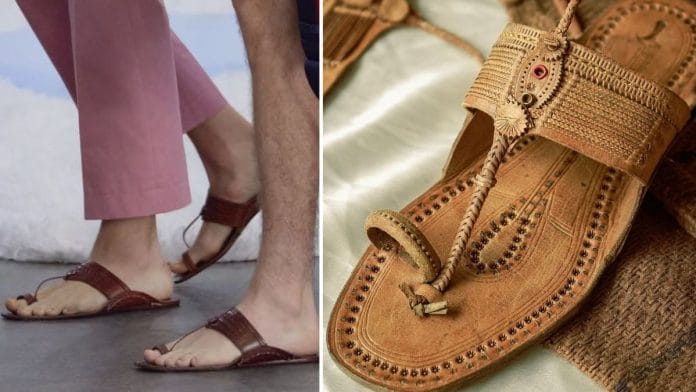



New Delhi: Italian luxury brand Prada is set to introduce a limited-edition line of Moje Puda Kapshi, one of the many variations of the Kolhapuri chappal, next year in February. The move comes after the cultural appropriation criticism the brand faced earlier this year.
The brand will be purchasing 2,000 pieces of Moje Puda Kapshi in its year-long contract. Each piece is expected to retail at around €800 ($939), which is equivalent to Rs 84,000. In the domestic market, the price of Moje Puda Kapshi swings between Rs 400 and Rs 15,000.
The collection will debut worldwide across 40 stores and Prada’s online platform.
“We have won this fight. The fight to protect our art and its rights,” Lalit Gandhi, president of Maharashtra Chamber of Commerce, Industry and Agriculture (MACCIA), told ThePrint. “This is also proof of the fact that when efforts are put in the right direction, you can win without really fighting.”
The excitement in Gandhi’s voice is unmistakable. He admits the victory still hasn’t fully sunk in, but he is pleased with how the battle concluded. Gandhi revealed that Prada will decide whether to extend the contract based on market response. But the goal for him was never to embarrass the brand—it was to secure recognition and benefits for the artisans and restore the value of traditional craft.
“Prada’s collaboration will elevate the value of our products. It means our footwear can enter mainstream fashion, not just be the sandals people wear occasionally with kurta-pyjamas or ethnic outfits,” he said.
Three-year programme for Indian artisans
Prada has signed a formal agreement with two government-backed bodies that promote leather artisanship. The Sant Rohidas Leather Industries & Charmakar Development Corporation Ltd (LIDCOM) from Maharashtra and Dr Babu Jagjivan Ram Leather Industries Development Corporation Ltd (LIDKAR) from Karnataka signed the memorandum of understanding (MoU) on 10 December. The MoU was signed at the Consulate General of Italy in Mumbai, with Lorenzo Bertelli representing the brand. Bertelli is Prada’s chief of marketing and head of corporate social responsibility.
The collaboration comes after Prada unveiled a ‘toe-ring sandal’ as part of its Spring/Summer 2026 menswear collection in Milan. The footwear resembled the traditional Kolhapuri, which got a Geographical Indication (GI) tag in 2019.
The brand didn’t credit the design’s roots. This led to massive outrage on social media. Celebrities such as Kareena Kapoor and Neena Gupta called Prada out on its cultural appropriation. The backlash forced Prada’s technical team to visit Kolhapur and meet with artisans.
Now, this partnership will involve artisans producing the sandals using traditional methods from Maharashtra and Karnataka, and the material will be provided by the brand. It will also include a three-year training programme to help Indian artisans upgrade their skills.
Union commerce minister Piyush Goyal told PTI that he was pleased that the issue had evolved into a constructive collaboration. According to him, the Kolhapuri chappal market has “the potential to become a billion-dollar export category”.
Also read: How Nancy Tyagi created Tyla’s viral Indian look. ‘The moment she saw it, her face lit up’
‘Kolhapuris will be cool now’
When Prada representatives visited Kolhapur in July, they met several shopkeepers. Among them was Shubham Satpute of Inga Leathers in Subhash Nagar.
Satpute, a fourth-generation artisan and trader who also runs his own workshop, gifted the team a pair of Moje Puda Kapshi sandals, the very design for which Prada has now signed a formal agreement.
“A world-famous brand choosing to collaborate with us is a matter of pride for everyone, from the shopkeepers to the artisans. They have given the recognition to the sandal, we are satisfied,” Satpute said.
Jaydatt, who operates a small Kolhapuri sandal stall in the famous Chappal Market of Shivaji Chowk, said the shopkeepers spent hours discussing how their collective effort had finally paid off. But some remain unsure about whether the partnership will translate into direct gains for them.
“We are happy about the collaboration, but we still don’t fully understand how it will benefit us. We are waiting for some communication from the government. That said, the fact that Prada acknowledged their mistake and changed the name is also significant for us,” he said.
For Satpute, however, the bigger expectation lies in the boost this partnership could bring to the domestic market. He believes the impact within India will surpass that of exports.
“The sandal will suddenly be seen as a luxury item, and it will become cool to wear. We’re expecting a 20-30 per cent jump in domestic sales alone,” Satpute said confidently.
He further explained why he believes the surge is imminent. Ever since the Kolhapuri sandal controversy gained national attention and journalists visited the city, sales saw an immediate spike. Leather prices have risen by 20-25 per cent over the past few months, and labour costs have increased by 10-20 per cent. Satpute notes that until winter arrived, he had barely found time to rest.
For him, this partnership is a lesson not just for global brands, but for Indian artisans as well.
“An artisan’s work cannot simply be copied and sold. You can draw inspiration—the world runs on inspiration—but giving credit matters. And we have proved it.”
(Edited by Prasanna Bachchhav)