





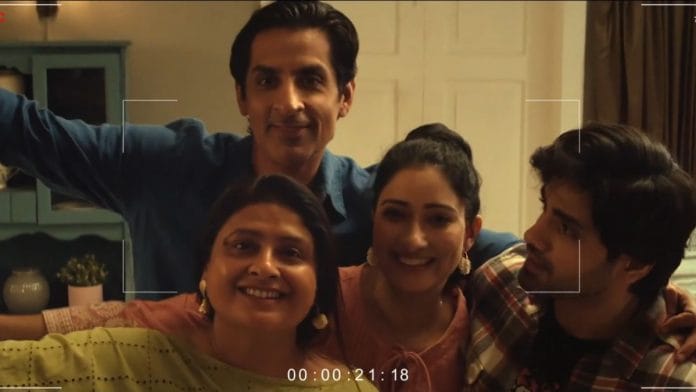



New Delhi: Passive euthanasia has long been a compelling subject for filmmakers, dating back to the 1979 film Shaayad starring Naseeruddin Shah. Several films have explored the theme over the years, including Pupa, Guzaarish, Kahaani Karuna Ki, and, more recently, the Kajol-starrer Salaam Venky. Now, a new entry is set to join the conversation on 24 April.
Mercy tells the story of a son struggling with the decision to withdraw life support from his mother. Writer and director Mitul Patel emphasises that the film offers a fresh perspective.
“We have focused on the morality of the situation rather than the technicality of it. We have attempted to tell a layered and emotional story through this story, but at the same time, make people aware,” Patel said.
Mercy’s release on the big screen comes weeks after a landmark Supreme Court judgment, which permitted the withdrawal of life support for 31-year-old Harish Rana. The ruling marked a historic moment, representing the first court-approved case of passive euthanasia.
Rana, who had remained in a vegetative state for over a decade, died on 24 March at the All India Institute of Medical Sciences, Delhi.
Produced under Raj Vasudeva and Anuradha Sachdev’s banner Everclear Films, Mercy marks the production’s feature film debut. The makers unveiled the official trailer during the Cannes Film Festival 2024, and the film was later screened at the UK Asian Film Festival on 5 May 2025.
Mercy was initially supposed to be a short film.
“It became a feature film after I met Raj in April 2023. Theatrical release was not on our mind. Now that we are getting it, it’s a big thing for us,” Patel said.
He is “cautiously optimistic”, acknowledging that subjects like euthanasia don’t typically draw mainstream attention.
“People often avoid talking about death because it’s difficult,” Patel explained. “Our aim is to make that conversation easier, to bring it into the mainstream and make it more approachable for people.”
Where Mercy began
Producer Raj Vasudeva, who plays the protagonist Shekhar in the film, returned to India from the Netherlands in 2023 and sought a good script. “Real human stories” have always attracted him. He rejected about 100 scripts before coming across Mercy, which, he said, “wasn’t even a script but a bare bone.”
The story resonated with him because someone in his family had undergone active euthanasia while battling a terminal illness.
“That experience stayed with me. When I came across this story, it struck a chord instantly. I felt this was something that truly needed to be told,” Vasudeva said.
During the shoot, there were moments when Vasudeva became completely immersed in his character. He recalled filming a scene where his character enters his mother’s room in the hospital, for which Patel had specifically instructed him not to cry.
“As soon as I walked in and saw the actress playing my mother, her face suddenly morphed into someone I know personally, and I completely broke down. It was very difficult to pull myself out of that moment,” the actor said.
Not many know that actor Paresh Rawal inadvertently inspired Mercy.
In 2022, Patel came across an interview with Rawal, where he spoke about his mother, who had once been hospitalised in Mumbai.
The dean of the hospital told Rawal that his mother’s condition was unlikely to improve, adding that they were not really extending her life, but merely prolonging her suffering. He suggested that it might be kinder to consider withdrawing life support.
Rawal found himself unable to make that decision. He kept delaying the decision, and before he could arrive at one, his mother passed away.
Patel was drawn to the moral complexity of the situation, the emotional grey areas, and the conflicting perspectives. This ultimately led him to explore the subject in depth.
“What became my inspiration for the film was what Mr Rawal took away from that experience. He expressed it beautifully, saying that his mother loved him so deeply that she chose to let go, sparing him from a lifetime of guilt and regret. That thought really highlights how nuanced and complex the situation is,” Patel said.
Also read: Dhurandhar 2’s South Indian report card — a blockbuster in Telugu, middling elsewhere
Impact of Harish Rana case
According to Vasudeva, the recent ruling by the Supreme Court has opened the door for conversations around passive euthanasia. While the concept is not new, the team hadn’t anticipated its relevance at this exact moment.
“We didn’t expect things to align like this,” Vasudeva said. “But interestingly, we had already started working on a docuseries, which we’re now releasing on Instagram.”
The series focuses on real-life experiences, featuring stories of not just families who have faced such situations, but also caregivers and palliative care doctors.
“We wanted to understand and also share what they go through while dealing with cases like these,” he added.
Patel is hopeful that when the film releases, the conversation around it will be more nuanced, thanks to the Harish Rana case.
The director reflected on whether cinema has a responsibility to address morally complex subjects, saying he views it more as an opportunity than an obligation, echoing a perspective often associated with Christopher Nolan.
“In today’s world, where people constantly debate the morality of stories, I see this as a chance not to preach, but to communicate something meaningful,” Patel said.
(Edited by Prasanna Bachchhav)