





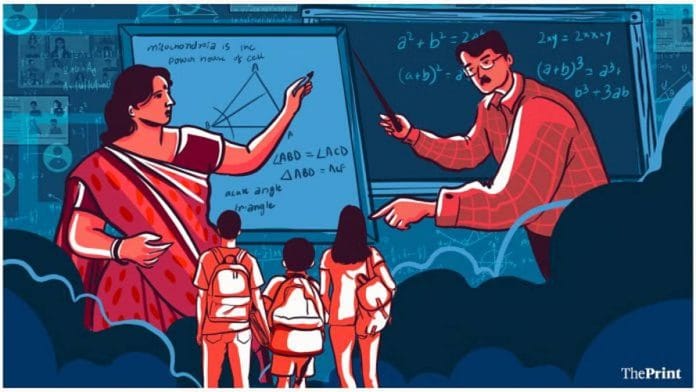



New Delhi: India’s coaching industry is worth a whopping Rs 58,000 crores, preparing students for nearly every competitive examination, from NEET, JEE and CAT to UPSC, SSC and other government recruitment tests. But its dizzying growth and future are now under scrutiny.
The problem is that it has largely been unregulated. Over time, it had become India’s parallel education ecosystem. Several government measures have tried to check its runaway profits and practices.
The Union Ministry of Education and the Central Consumer Protection Authority (CCPA), a regulatory body, introduced a series of guidelines, advisories and regulatory measures aimed to curb the industry’s influence.
The most recent committee appointed by the central government proposed a policy framework that sought to limit students’ dependency on coaching centres to 2-3 hours and restructure the methods of approaching test preparation. Earlier attempts to streamline the system—such as the proposal for a Common Entrance Test (CET) in 2012—failed to materialise, while the rollout of the Common University Entrance Test (CUET) did reduce the burden of multiple examinations but also triggered the emergence of a new wave of coaching centres.
Despite repeated interventions, industry stakeholders have rarely been formally consulted, with regulation instead arriving through notifications, guidelines and compliance requirements—signalling the government’s increasingly assertive stance toward the coaching sector.
“The aim is to bend the student to the self-study mode. The industry became a factory, a business model that needed reforms and regulation. They charge so much money and manipulate the students with false facts. And doesn’t provide basic facilities. This is the result of their arbitrariness,” said a senior official from the education ministry on the condition of anonymity.
A committee appointed by the central government recently proposed sweeping the high school education system.
“The proposals include capping coaching classes at 2-3 hours daily, redesigning school curricula to mirror post-school competitive entrance examinations, giving greater weightage to board examination results in college admissions and exploring the possibility of introducing competitive tests in Class 11,” reads an Indian Express article.
But the coaching industry does not agree to this. According to them, it’s a matter of demand and supply and the government’s failure to provide a better education system in place that does not require coaching classes.
“Students don’t come to coaching centres because of advertising; they come because schools are not preparing them for competitive exams. Coaching is filling a quality vacuum created by the formal education system,” said Keshav Agarwal, director of media, Coaching Federation of India, a global non-profit body setting standards for professional coaching with a mission to grow coaching in India.
‘It’s not about the money but the message’
In 2010 and 2012, the government took small steps to curb the coaching institutes, but the industry remained unscathed. The first dent came in 2023 when the CCPA fined multiple big coaching institutes for misleading advertisements. It issued 20 notices earlier, and for almost the last four years, it has been fining the coaching centres. By November 2024, cumulative fines exceeded Rs 54 lakh on 18 institutes.
““We did not stop imposing a fine after the first time; those who did not improve were fined the second time as well. The second time, the amount reached Rs 11 lakh. Many people trolled me and the department, saying (that) for big institutes that earn in crores, some lakhs don’t matter, but it’s not about the money but the message we are trying to deliver. We are doing everything per the rules; some institutes which took the matter to court, we are also fighting their,” said Nidhi Khare, secretary of CCPA.
After implementing a fine, the CCPA also barred the institutes from making misleading claims about the selection of toppers, guaranteeing success and using toppers’ names, images, etc. The rules also mandated clear disclosure of fees, course details and disclaimers, warning that violations could attract fines and removal of advertisements under the Consumer Protection Act, 2019.
In January 2024, the Ministry of Education released guidelines that required registration, no enrollment under 16 years of age, transparent fees, mental health support and fire safety. “The issues related to the private coaching centres, more so in the context of rising students’ suicide cases, fire incidents, lack of facilities, as well as methodologies of teaching, have been engaging the attention of the government from time to time,” reads the government advisory.
Some states, like Rajasthan, introduced the Rajasthan Coaching Centres (Control and Regulation) Bill, 2025, to regulate the industry. In 2026, a high-level committee was formed to address reforms.
“Government intervention in the coaching sector is not new—states like Bihar and Rajasthan have tried regulating it for over a decade—but those efforts were fragmented and local. What is different now is a coordinated central push that seeks to alter the academic structure itself, not just regulate infrastructure,” said Aggarwal.
Coaching centres say that the efforts being made by the government are applaudable, but they are bringing such policies without consulting the institutes.
“Coaching institutes are an important part of the ecosystem now. If you are making a policy, there should be some representation given to the coaching institutes as well,” said Aggarwal.
The nature of the coaching industry significantly changed after Covid-19. The rise of ed.tech affected the offline market, and incidents of fire and drowning in the basement libraries increased the problems for the institutes with constant policy and regulations coming from the government.
“As of now, the institute doesn’t have as many students as they used to have prior to Covid-19 era. The government and the regulations have made it very difficult for the coaching institutes to survive, but you have to see that coachings are helping students, you close the coaching institutes for two years and see how students get affected,” said B Singh, CEO of NEXT IAS.
Also read: Lawyer who fights for orphans’ rights enters SC fray for stray dogs. ‘Last line of defence’
Living in uncertainty
The other question is employment. The industry provided jobs to more than a thousand people across the country, which will be affected if the government tightens the guidelines.
Thirty-three-year-old Jitendra Singh teaches Physics in a very popular coaching institute in Janakpuri, where students are preparing for NEET and JEE. But for the last four months, he has been preparing for a side business, precisely a cafe, as for the last few years, surviving in the coaching industry has been difficult.
“I have been teaching for more than 13 years. In the last five years, I have witnessed the most pressure of losing my job as many institutes closed or went into losses. The government has been coming (up) with new guidelines, regulations and policies to curb the coaching industry, so I have a plan B for me now in case the coaching classes get affected, I will focus on my business,” said Singh.
“Thousands of people run their houses by working for coaching institutes, but the government has been trying to curb the coaching industry for a long time now. It got affected for sure, but big names still stand tall,” said Singh.
Living in uncertainty is difficult for Singh.
“Seeing all these news articles makes me anxious that there is no job security, that’s why my plan B is ready. Although teaching is my passion, and I don’t want to lose it,” added Singh.
(Edited by Saptak Datta)