





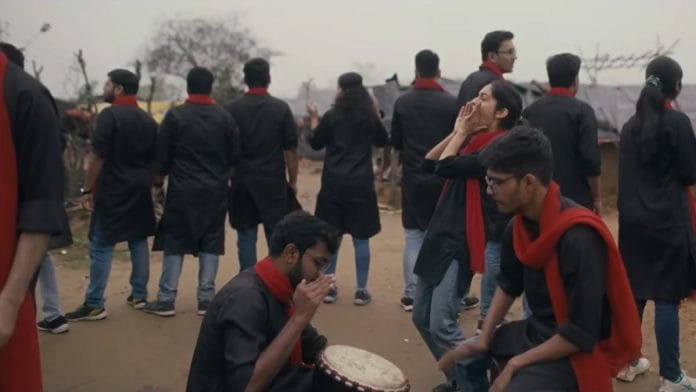



New Delhi: Zohran Mamdani’s New York mayoral campaign drew inspiration from Bollywood. And now, two Hindi filmmakers have borrowed his marketing tactics to promote their independent film.
While Mamdani’s campaign was backed by the creative agencies Forge and Melted Solids, filmmakers Tanmaya Shekhar and Molshri pulled off the marketing for their upcoming film Nukkad Naatak entirely on their own.
From collaborations with filmmaker Imtiaz Ali and content creator Parul Gulati to a promotional tour across the country in a caravan, Nukkad Naatak’s campaign has become a textbook-perfect example of guerilla marketing.
“It has been a long and difficult journey. We took money from 30-odd people, some were relatives and some were strangers. It’s been three years, so the interest has also compounded now. Everything now lies in the hands of the audience,” Shekhar told ThePrint over a Zoom call on 20 February, a week prior to the film’s release.
For its makers, a lot is riding on Nukkad Naatak, which explores social issues such as education in slums and LGBTQ+ rights. The film will open on 100 screens across India, where it will lock horns with The Kerala Story 2. But the filmmaker duo is not backing down. They’re confident that their “audience will watch Nukkad Naatak over The Kerala Story 2.”
Shekhar and Molshri are well aware of the fact that more than 1,000 independent films are made every year in India, and more than 90 per cent of them never reach the public. Films like Jugnuma, Sabar Bonda, Humans in the Loop, and Stolen had the advantage of strong industry backing, which helped them gain visibility. But not every film is that lucky; Santosh and Punjab 95 are still waiting for good release opportunities.
“We have seen up close that getting support for independent films is a challenge for the likes of Rajat Kapur as well,” Molshri said.
For newcomers, especially those without industry connections such as Tanmaya Shekhar and Molshri, breaking through can feel nearly impossible.
“But this is all we know. That’s all we have. We don’t know anything apart from films,” she added, smiling through moist eyes.
Closed doors
The time between finishing the shoot of Nukkad Naatak and its release wasn’t smooth for Shekhar and Molshri. It was full of rejections, awkward silences, and plenty of slammed doors.
The duo pitched to big production houses, distributors, OTT platforms, and well-known filmmakers, but rarely got more than a few rushed minutes. Messages were left on read, emails weren’t answered, and follow-ups led nowhere.
“There were moments when we were made to feel like our film simply wasn’t good enough. Nobody was willing to speak to us,” Shekhar said, holding back emotion.
An independent filmmaker, writer, and IIT Kanpur alumnus, he quit his job at HBO to tell socially charged stories. And he refused to let his dreams fall apart.
After months spent waiting for the callback that never came, they decided it was time to stop knocking, and build their own door instead.
They first created an audience through a micro-drama Reel series titled How to Enter Bollywood, which captured the realities of outsiders in Mumbai. It got lakhs of views on Instagram and created a buzz around the film.
“Our marketing is inspired by Zohran Mamdani,” said Shekhar, who lived in New York City for 10 years. “Political campaigning is very expensive there. And, there came a guy who made these crazy videos and with genuineness to reach people whom you cannot reach physically.”
And the social media movement was when the tide turned in their favour.
With no budget for large-scale promotions, the duo travelled from Mumbai to Kolkata in a caravan, visiting Delhi, Ahmedabad, Indore, Bhopal, Kota, Jaipur, Chandigarh along the way.
“We wanted to engage with the audiences and tell them about our film. The aim is to get 100 housefull shows on Day 1,” said Molshri.
She previously assisted on music videos at T-Series, but soon realised that her space was not behind the camera. She wanted to act.
The response on her debut so far, she said, has been “overwhelming”.
Also read: What French filmmaker saw in Gorakhpur jail. Muslims one side, lower caste people near toilet
It started at IIT Kanpur
Nukkad Naatak centres the themes of education, public awareness, and the larger socio-political realities of India. The plot draws from Shekhar’s own experience. He recalls visiting a basti near the IIT Kanpur campus, where his father is a professor. The stark contrast—a top-tier institution of higher learning just kilometres from a slum where education is out of reach—left a deep impression on him.
“The experience stayed with me. It felt like a completely different world. It felt like two different Indias,” he said.
It was during this period that the idea for the film began to take shape.
Street plays are much more than performances. They are acts of resistance, awareness, and conversation. From women’s rights to the right to education, nukkad nataks have long served as a powerful way to connect with people beyond classrooms and auditoriums. In many ways, Shekhar’s film is a tribute to that tradition.
The makers of Nukkad Naatak want their film to be successful so it can set an example for outsiders in the Hindi film industry.
“It will send out a message that you can make it in the film industry as an outsider. You don’t need big budgets and backing from the big shots to enter the field. Talent is enough,” Shekhar added.
(Edited by Prasanna Bachchhav)