








New Delhi: Thirty-year-old Pradeep Kumar, a resident of Sector 34 in Noida, had a smart meter installed at his home in August 2025. However, instead of a hassle-free life, the device acted as a burden, increasing his monthly electricity bills.
Like many others, Kumar, too, believed that since the meter was “smart” and everything was becoming digital, it would reduce the need to visit electricity offices and make things more efficient.
However, from the very next month, his electricity bills started increasing significantly. Earlier, his monthly bill was around Rs 3,000 to Rs 4,000, but it suddenly rose to Rs 7,000 to Rs 8,000. He filed multiple complaints with the electricity department, but received no response.
His difficulties deepened in March after the electricity supply to his home was abruptly cut off for five days without any prior notice, message, or update. Despite visiting offices repeatedly and paying around Rs 10,000, the power supply wasn’t restored.
“These smart meters have made our lives more difficult. We are paying higher bills, and our electricity is being cut off without any prior notice. There is no one to even listen to our complaints,” said Kumar.
Every day, residents in Noida and Ghaziabad rush to the electricity department offices, swamped with complaints about smart meters. Some are asking officials how to pay, others are asking why they haven’t received messages or alerts, and many are protesting high bills and unexpected disconnections.
‘Authorities continued to ignore us’
The electricity offices are packed, with long lines of people waiting for queries. Sometimes, RWA presidents visit the offices to hold collective meetings with the officials.
Kumar said, recalling how he visited multiple electricity offices across Noida and sent emails not just locally, but also to authorities in Lucknow.
“They just made me run from pillar to post while my house remained in darkness. I even forgot the count of how many times I have visited the electricity office in just five days,” he added.
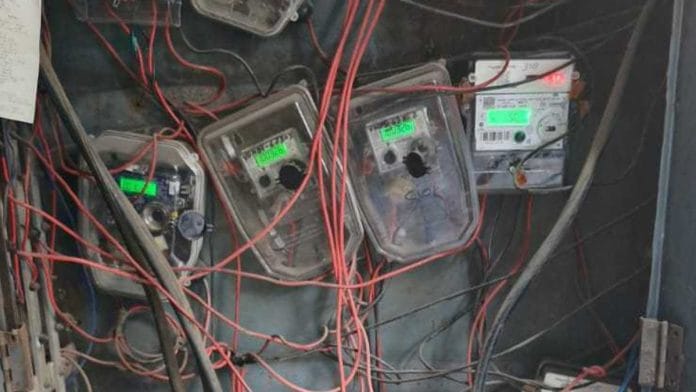
Adding to the concern, the Residents Welfare Association (RWA) of Udaigiri-I, Sector 34, Noida, sent a formal complaint on 10 March 2026 to the Executive Engineer of Uttar Pradesh Power Corporation Limited (UPPCL) in Gautam Buddha Nagar. The RWA letter highlighted multiple problems: meters left precariously inside boxes, broken plastic casings, exposed red wires, meters falling to the ground, and unusually fast meter readings.
The condition of some of the recently installed meters in Noida has raised serious concerns about safety and maintenance.
The complaint, signed by RWA President Omendra Kumar, urged the electricity department to repair or replace the damaged meter boxes, but no action has been taken yet.
“We kept complaining, but the authorities continued to ignore us. This is the reality of smart meters,” said Anuj Kumar, another resident of Noida.
Also read: ASI moves 70% of antiquities from Purana Qila to Red Fort. ‘They will no longer gather dust’
Lines at electricity offices
In offices across different zones and sectors, the scene is chaotic. In Ghaziabad Zone 1, a resident waits to update his phone number. In Zone 2, another argues with an official about missing SMS alerts. In Zone 3, someone else complains about a bill suddenly spiking to Rs 8,000.
The scene is the same in the Noida offices as well. The queues stretch outside the buildings, with people impatiently navigating both physical offices and digital platforms.
The Indian government launched the Revamped Distribution Sector Scheme (RDSS) in July 2021 to improve operational efficiency and financial sustainability in power distribution. One key initiative is the installation of smart meters, sanctioned across 45 distribution utilities in 28 states and Union Territories. As of December 31, 2025, 39 million smart meters had been installed under the scheme, with 52.8 million across the country overall.
Uttar Pradesh has installed more than 8.45 million smart meters, approximately 7.55 million of which are operating as prepaid meters. The state aims to install 30 million meters, but complaints have been mounting even before reaching half the target. These range from inflated billing to sudden disconnections without any prior notice or updates, causing concern for UPPCL.
While the department claims prepaid meters ensure accurate billing and immediate restoration, many consumers experience delays. Once electricity is disconnected, recharging often does not restore the supply immediately. In several cases, residents have had to wait between 12 hours and seven days.
“Every day, hundreds of people are coming forward with issues related to smart meters, and we are raising these concerns with the authorities,” said KK Jain, President of the Federation of Residents Welfare Associations, Noida.
Smart meters are designed to provide near real-time visibility of electricity consumption via apps, helping consumers track usage, receive low-balance alerts, recharge easily, and view historical data. However, many residents report that alerts often arrive late or not at all, and app or website errors prevent timely recharges.
“Even when we want to pay on time, the apps and websites frequently show ‘server down.’ Sometimes the payment goes through, but the balance doesn’t update for hours, leaving us unsure whether the recharge worked”, said Anuj Kumar, a resident of Ghaziabad.
Also read: ‘This isn’t India’—Indian tourists in Nepal made to clean gutkha spit on the street
Living in the dark
According to REC Ltd and PFC Ltd, of 1,24,590 consumers who downloaded the app, only 54,321 were aware of the real-time consumption feature, while 72,494 knew about recharge and bill payment options—highlighting gaps in both functionality and user awareness.
However, praising the smart meter initiative and urging consumers to maintain a positive balance in their smart meters to avoid disconnections, UPPCL Chairman Ashish Goyal in March said that apps and websites are in place to support consumers and ensure timely communication.
The consumers’ frequent visits to the electricity offices in their areas tell a different story. Consumers claimed that they are not able to monitor their electricity usage and recharge their prepaid smart meters through the official UPPCL mobile application and website because of the website server issues.
“The website server is always down, it doesn’t even show any update most of the time”, said Bunty Chaudhry, a resident of Noida.
For several residents in Noida and Ghaziabad, this means even after paying, their meters sometimes show a negative balance.
“The system is designed to simplify billing, but the apps and portals are creating additional confusion and frustration for consumers”, added Chaudhry.
In Nandgram, Ghaziabad, the story has been the same for 40-year-old Narendra Yadav, who had installed a smart meter in August last year.
“They keep insisting the readings are accurate, but no one explains why the usage suddenly spikes every month,” Yadav said.
The problem is not limited to Uttar Pradesh. In Bihar, electricity workers installing smart meters have faced violent protests, as residents opposed installations due to high bills.
(Edited by Saptak Datta)