





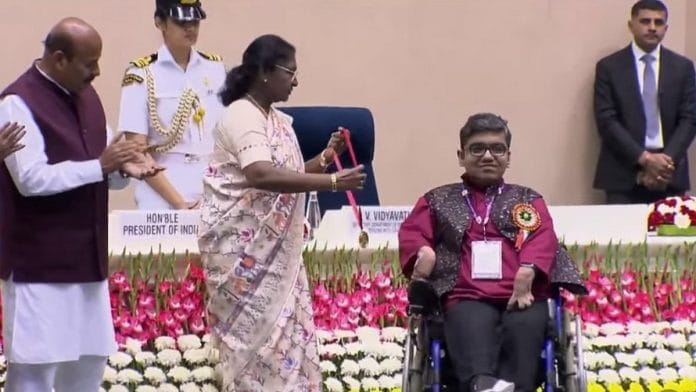



New Delhi: When Nipun Malhotra was born with “fractured and bleeding” arms and legs in 1987, doctors warned his parents to expect nothing from him. Thirty-eight years later, he received India’s highest honour for disability activism — after years of setbacks, rejections, and run-ins with an unresponsive system.
“I have a disease called arthrogryposis. Doctors told my parents that I would live the life of a wooden doll. Most of my childhood was spent visiting doctors. My arms and legs weren’t developing,” said Malhotra.
Last week, he received the National Award for Individual Excellence from the Department of Empowerment of Persons with Disabilities, with President Droupadi Murmu doing the honours at Rashtrapati Bhawan.
A former director at the Delhi-based policy and advocacy think tank The Quantum Hub and founder of the Nipman Foundation, Malhotra has spent more than a decade fighting for disability rights in the public sector, private sector, and society at large. He has advised NITI Aayog and worked with companies through initiatives such as the Equal Opportunity Awards. One of his most visible wins was persuading Zomato to add a “wheelchair-friendly” filter for restaurants, a feature later adopted by other platforms as well. His initiative ‘Wheels for Life’ helps give access to wheelchairs to those who cannot afford them.
He doesn’t want others growing up with the same barriers he did.
Also Read: No Indian Census has counted the disabled population right
Early battles
Getting admission to a ‘regular’ school proved to be a battle.
“Initially my mother kept taking me to different doctors, but one of them told her to accept me. That’s when she decided to get me admitted to a regular school. Many schools rejected me because they didn’t see me — they only saw my disability,” said Malhotra, whose organisation helps disabled people find jobs and access essential services.
Even when a school finally enrolled him, he was treated like an outsider.
“I had no friends, and people ignored me,” he added.
It was 1992, and the Disability Act was still three years away. Schools didn’t know what to do with a child like him. But he made good use of the long stretches of free time. He studied hard and eventually became the school topper. Before exams, students would call him on his landline for help.
College, however, came with a fresh set of dilemmas. After scoring well in Class 12, he wanted to join Delhi University, but his parents were convinced that no college was suitable for him.
“They got me admitted to a private university, but I left after a year and appeared for the St Stephen’s interview — my dream college. The interview went well, but they told me that the economics class was on the first floor, had been there for 120 years, and they didn’t want to change it for one student,” he said.
Malhotra accepted this, and his parents and friends pitched in however they could. When he joined the college, four students physically lifted his wheelchair up the stairs every day. The optics of this quickly worked in his favour.
“It went on for just four days. The college got embarrassed and shifted the class to the ground floor. You do make your way — it takes time, but it does happen,” Malhotra recalled.
He excelled again at academics and extracurriculars, going on to earn a master’s at the Delhi School of Economics. But during placements, he hit another wall. Recruiters couldn’t see past his disability.
“I remember people telling me, ‘We don’t have disabled-friendly toilets,’ ‘Can you sit for eight hours on this wheelchair?’ ‘Get a written letter from the principal,’ and so on. After facing all this, I started Nipman Foundation, which helps disabled people get jobs,” he said.
Also Read: DPDP Act offers no special protection for disability data. It leaves PwDs vulnerable
Barriers of perception
Over the years, Malhotra has fought numerous battles — from pushing for accessible DTC buses to lower taxes on wheelchairs.
In 2018, the Delhi High Court, hearing a batch of petitions filed by Malhotra, chastised the then AAP government for “not taking a single step for ensuring accessible transport”. It also noted that procuring buses which are inaccessible to the disabled violated the Rights of Persons with Disabilities Act, 2016.
“A lot has changed in the last few years, but so much more needs to change. I still get calls from people saying others don’t see them — only their disability. I’ve been fighting since childhood, and change comes only that way,” he added.
(Edited by Asavari Singh)