





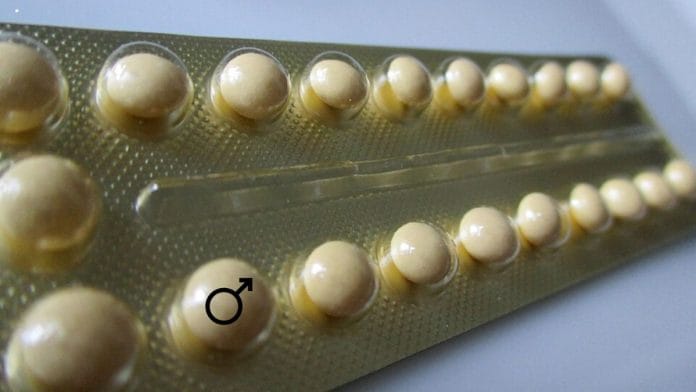



New Delhi: Researchers at Cornell University in New York have identified a “safe, reversible and non-hormonal” form of male contraception that temporarily halts sperm production. If successfully adapted for human use, it could be administered as a quarterly injection to maintain its effectiveness.
In a six-year proof-of-concept study using mice, published on 7 April in the Proceedings of the National Academy of Sciences of the United States of America, researchers demonstrated that temporarily disrupting a crucial step in meiosis, the process responsible for producing sex cells, can halt sperm production without causing permanent damage.
Male contraceptive options are still largely limited to condoms and vasectomies. Although vasectomies’ reversal is sometimes possible, men are mostly reluctant to undergo the procedure. Meanwhile, progress on hormonal methods has been cautious, due to safety concerns as previously observed in women.
Also read: The pill, for him: Contraceptive that could redefine family planning clears key trial milestone
Contraception & reproductive health
To address these challenges, Paula Cohen, professor of genetics and director of the Cornell Reproductive Sciences Center, and her team targeted meiosis rather than other stages of sperm development. This strategy allows sperm production to be completely paused while remaining reversible, helping preserve overall reproductive health.
“We wanted to avoid affecting spermatogonial stem cells, because damaging them could permanently eliminate fertility,” Cohen explained. She also noted that once sperm reach the spermiogenesis stage, there is a risk that viable sperm could still be released and potentially fertilise an egg.
“We’re practically the only the group that’s pushing the idea that contraception targets in the testis are a feasible way to stop sperm production. Our study shows that mostly we recover normal meiosis and complete sperm function, and more importantly, that the offspring are completely normal,” she added.
The team at Cornell University used JQ1, a small molecule inhibitor originally developed for cancer and inflammatory disease research, on male mice for three weeks. JQ1 itself is not suitable for clinical use due to neurological side effects. But it is said to interfere with prophase I, a key stage of meiosis, causing developing cells to die at that stage. It also blocks the gene activity required for later stages of sperm development.
During the three weeks, sperm production stopped completely, and key features of meiosis, including chromosome behaviour during prophase 1, were disrupted.
After the treatment was stopped, recovery followed quickly. The study found that within six weeks, normal meiotic activity resumed, along with the production of healthy sperm. When the mice were later bred, they proved to be fertile, and their offspring were healthy and capable of reproducing as well.
If developed for human use, this type of male contraceptive could be delivered as an injection given every three months or possibly as a patch to maintain effectiveness, Cohen said.
(Edited by Ratan Priya)