





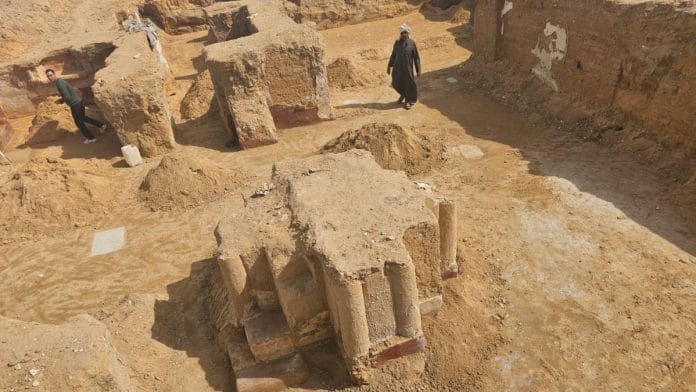



New Delhi: From the Nile Delta in Egypt, a region known for ancient settlement, archaeologists have unearthed a 5th century Christian monastery—considered significant for understanding the origins of organised monastic life in the region over 1,500 years ago.
Egyptian archaeologists in late March discovered an archaeological building, dating back to the fifth century CE. It is likely to have been used as a guest house during the early period of Coptic monasticism.
“The works have revealed a number of architectural elements that were added to the building during later historic phases, reflecting its use evolved over subsequent periods of time,” according to the Egypt’s Ministry of Tourism and Antiquities statement.
The discovery was made at the Al-Qalāyā site. The newly discovered structure consists of 13 multi-functional rooms. It includes individual and communal monastic cells, spaces for hospitality and education, a kitchen and storerooms.
“In the northern section of the building, a large hall was uncovered featuring distinctive architectural elements, including stone benches adorned with floral motifs, which were likely used to receive visitors and provide them with services,” said Zia Zahran, head of the Islamic and Coptic Archaeological Sector of the Supreme Council of Antiquities (SCA).
After the advent of Christianity, religious beliefs in Egypt shifted and new churches and monasteries rose up. This transition started around the first century CE and in the next five hundred years, Egypt was a hub of Coptic art and culture.
Before Christianity, Egypt was under the Ptolemaic dynasty, a Greek-Macedonian family that ruled for nearly 300 years, ending in 30 BC.
Also read: Was the ‘Dancing Girl’ from Mohenjo-Daro really a dancer?
Continuation of human activity
The excavation has also uncovered a number of murals depicting monastic figures, identified by their clothing, alongside a variety of botanical motifs, including a red, white and black braid pattern, and a flower.
The excavations at the site were started in 2023 and since then two “Manshubiyat” structures—complexes comprising a cluster of monastic cells (known as Qalayat) used as living quarters for monks—alongside a collection of wall paintings have been unearthed.
Alithi pointed out that the Kalaya area is the second largest monastic gathering in the history of Christian monasticism, and that its architectural style reflects the foundational nucleus of early monastery establishment.
One of the notable findings by archaeologists is a rectangular slab of limestone found at the entrance of one of the chambers.
It has a Coptic text, as the initial translation refers to the death of a person called Apa Kyr, son of Shenouda. “.. which confirms the continuation of human activity at the site during the booming periods of monastic life in the area,” said the statement.
(Edited by Theres Sudeep)