





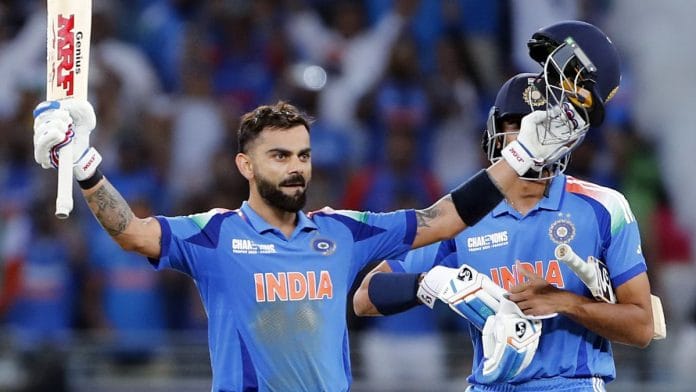



Virat Kohli’s 52nd One-Day International century laid the groundwork for India’s 17-run win over South Africa on Sunday. With the victory, India has a lead in the three-match series after South Africa swept the two-match Test series last week.
In the post-match presentation, Kohli said, “Yeah, that’s how it is going to be. I am just playing one format of the game. I have played 300-odd ODI games, and so much cricket over the last 15-16 years. If you are in touch with the game, you know your reflexes are there, you can bat two hours in the nets without taking a break, you are meeting all those markers.”
Sports psychologist Mugdha Bavare backed Kohli’s statement saying that after so many years “the body goes into auto-pilot mode, especially skill wise. One doesn’t need to hammer themselves daily with skills.”
She added that while fitness and practice is essential, it’s the mental aspect which plays a significant role. Another sports psychologist, Gandhali Bapat, also highlighted that Kohli, during the interview, appeared to bring attention toward the mental aspect of his game.
“He emphasised on living in the present moment, just focusing on one ball at a time (just ball and me) as he states. For him, the mental game comes first,” Bapat said.
Kohli landed in Ranchi three days before the match to practice. The former Indian skipper, who played his last match in October against Australia, said he had taken the previous day off to conserve his energy for the match.
“I’ve never been a big believer of a lot of preparation… all my cricket has been mental. As long as I feel, mentally, I can play the game, I work physically hard every day. As I said many times before, if I arrive somewhere, I’ll arrive 120 per cent,” he said in the post-match presentation.
Bavare, who has been associated with the Board of Control for Cricket in India (BCCI) for the last four years and has diligently followed Kohli’s performance, explained that the cricketer follows the “visualisation technique” for his mental training. And, it has significantly improved his gameplay.
In this technique, athletes visualise what kind of performance they want to deliver on the ground. And, according to Bavare, this is what Kohli does before every match.
“All sportspeople have some or the other mental training techniques. But, ‘visualisation’ is of the highest level. It takes years for athletes to perfect it,” she said.
Olympians like swimmer Michael Phelps and gymnast Simone Biles have also spoken about incorporating this technique.
Also read: Temba Bavuma is South Africa’s bulwark. He flipped the script on India
Age is just a number
Jammu and Kashmir captain Paras Dogra echoed Kohli’s sentiment. The 41-year-old, who represents J&K in Ranji Trophy, noted that after their last match against Hyderabad in mid-November, the next fixture is in January, leaving nearly two months in between.
“After years of playing, you learn to listen to your body. It tells you when to train and when to rest. It’s more important to follow that than rigid schedules like a horse with blinkers,” Dogra said, adding that he continues regular practice and physical training throughout the long break.
Dogra said Kohli summed up the situation just right. He said that for him, it is extremely important to control and win the mental battle rather than physical, because that is something he has already achieved.
“Even if he (Kohli) doesn’t play for three months, his performance will not get hampered,” Dogra said.
Meanwhile, Bapat said that though Ranji and other domestic matches are valuable, they aren’t essential for an international player who is already in good form and enjoying the game.
“Domestic cricket helps when you’re struggling or out of form, it’s a good place to return to basics. But Kohli trains consistently, maintains top fitness, and works incredibly hard even at 37, so it doesn’t matter as much for him,” she explained.
Bapat added that physical and mental fitness are what truly count, and Kohli, who has played over 300 ODIs, excels at both. For him, playing Ranji would simply serve as an extra boost or an additional training opportunity.
Referring to Kohli’s agility not only while hitting the big shots but also while running between the wickets, Bavare said the age at which cricketers retire varies from player to player. Regarding Kohli, she noted that he is among the rare players still performing at 36–37 and could continue until 40 or beyond, given his consistency and desire to keep building on his momentum.
Notably, Kohli defied his age in the Sunday match with his running between the wickets, adding 49 runs, including 40 singles, in his 120-ball 135.
“He values hard work. He dedicates a lot of time to practice and doesn’t obsess over results. That conviction shows when he speaks, like he did yesterday. Yes, he’s had rough patches, but he always bounces back, and his comebacks are even stronger,” Bavare said.
(Edited by Aamaan Alam Khan)