





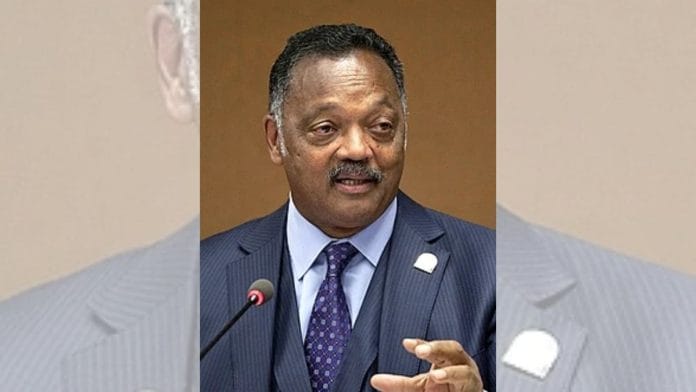



New Delhi: Jesse Jackson, a towering figure in the American civil rights movement who fought alongside Martin Luther King Jr for equal voting rights, died on Tuesday after a prolonged battle with a rare neurogenerative disease, similar to Parkinson’s. He was 84.
“Our father was a servant leader—not only to our family, but to the oppressed, the voiceless, and the overlooked around the world,” Jackson’s family said in the statement.
He was diagnosed with progressive supranuclear palsy (PSP) in 2017, and despite his weak state, Jackson continued to advocate for civil rights and was arrested twice in 2021 over his objection to the Senate filibuster rule.
Jackson was Martin Luther King Junior’s protege and was known for being the first African-American to make the jump from activism to major-party presidential politics following his rising popularity during the civil rights movement in the 1960s.
Two unsuccessful fights for presidency
Jackson was born in 1941 in South Carolina and was involved in politics at an early age. He was arrested at 18 for protesting against racial segregation at a public library in his town. Soon after, he joined MLK’s burgeoning civil rights movement and eventually launched two social justice and activism organisations—Operation PUSH in 1971 and the National Rainbow Coalition in 1984.
Jackson was present just metres away when Martin Luther King Junior was assassinated in 1968. The next day, Jackson appeared on television with his clothes stained with King’s blood.
His political career began flourishing in the 1980s. In 1983, he travelled to Syria to plead for the release of a captured American pilot Lt Robert Goodman. In 1991, he travelled to Iraq on the eve of the Gulf War to negotiate with Saddam Hussein to release Western hostages.
After two unsuccessful attempts, Jackson supported Bill Clinton, who later made him his special envoy for democracy and human rights in Africa in 1997.
He joined the Democratic party and unsuccessfully ran for the presidency twice in 1984 and 1988. However, he paved the way for other African Americans, including Barack Obama and Kamala Harris.
In 2008, when Obama won the presidential elections, Jackson called it the culmination of a 60-year race by Black people for full political inclusion.
In the fag end of his career, he remained an activist. In 2020, when George Floyd was killed, Jackson travelled to Minneapolis to take part in demonstrations and press for criminal charges.
In 2000, Jackson was awarded the Presidential Medal of Freedom, the highest civilian honour in America.
Also read: The debate about spheres of influence reorders India’s position
Tributes
Tributes poured after his death, including from Martin Luther King’s daughter Bernice King and several other leaders. She posted a photo of Martin Luther King Jr and Jackson, with a caption, “Both now ancestors…”
“He was a consequential and transformative leader who changed this nation and the world,” wrote Reverend Al Sharpton, a civil rights leader who worked closely with Jackson. “He shaped public policy and changed laws. He kept the dream alive and taught young children from broken homes, like me, that we don’t have broken spirits.”
New York City Mayor Zohran Mamdani also paid tribute to him. “He marched, he ran, he organized and he preached justice without apology,” Mamdani wrote on X.
US President Donald Trump made a lengthy post on Truth Social, saying that he knew Jackson well before becoming President. “He was a good man, with lots of personality, grit, and ‘street smarts’. He was very gregarious – Someone who truly loved people!”
(Edited by Ratan Priya)