





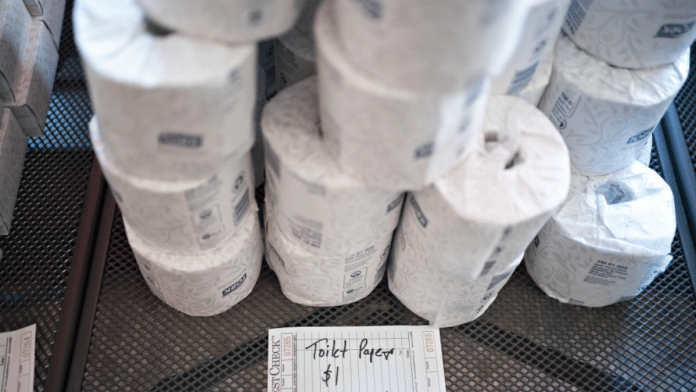



New Delhi: As tensions escalate in the Middle East, a wave of anxiety-driven buying has gripped parts of Japan—shoppers are rushing to supermarkets to stockpile toilet paper.
This has prompted Japan’s Ministry of Economy, Trade and Industry to urge citizens not to panic, insisting that there is no shortage and that supply chains remain stable. Nearly 97 per cent of the country’s toilet paper is produced domestically, officials say.
Yet posts circulating on social media showing thinning shelves and hurried purchases suggest that consumers are being driven by fear to stockpile on toilet paper.
“Today, I went out to buy toilet paper and tissues, and I was shocked to see them in short supply,” one user wrote on X in Japanese.
Another user shared a picture of a tower of toilet paper boxes and joked, “It’s best to take your time and buy only what you need.”
This is not the first time the Japanese have behaved this way. Panic buying surged during the COVID-19 pandemic, similar to the rest of the world. In fact, Japan has a long history of toilet paper hoarding. It became widespread during the 1973 oil crisis, which led to the country’s first postwar economic downturn.
Similar patterns were seen after the 2011 Tōhoku earthquake and tsunami, and again during the COVID-19 crisis.
Also read: China invented pancakes 5,000 yrs ago. Poems & paintings support new discovery
Panic or crises
While some people are sharing images of empty shelves and restocking efforts—suggesting that the crisis is real—others on social media are denying it. They say the situation is being exaggerated and driven by online panic.
“This is simply not true. I live in Japan, and there is no panic buying of toilet paper. Supermarkets are well stocked, and people are not hoarding. It’s surprising that such a baseless story is being circulated just for attention,” one user wrote on Instagram.
The debate has also expanded into discussions about the quality of domestic versus imported toilet paper in Japan.
“Imported tissues have a poor texture and feel, and they can cause toilet clogs, so I don’t buy them. It’s also risky from a supply security standpoint. During the COVID-19 pandemic, masks were difficult to obtain because there weren’t enough domestically produced ones,” a user wrote on X.
“Buying domestic products is the only choice,” the user added.
People can also be seen debating and discussing the issue in the comment sections of news articles and posts, questioning whether the reports are real. Some are even advising others on whether to visit supermarkets or avoid unnecessary shopping
“Huh? I didn’t know because I haven’t gone shopping. I want you to calm down,” one user wrote to another on X.