





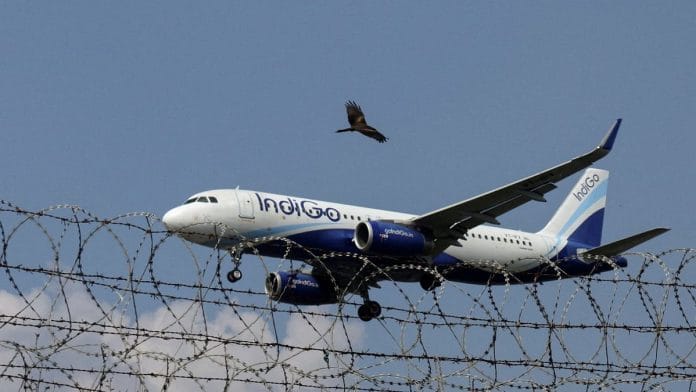



New Delhi: Captain CS Randhawa had just finished a 3 pm meeting with the government when he made his stance clear on this week’s aviation meltdown. The President of the Federation of Indian Pilots (FIP) – a body that advocates and represents pilots across India – blames this week’s airline crisis squarely on IndiGo Airlines.
“They think they can arm-twist the government and get what they want,” Randhawa said, after news broke out that the Directorate General of Civil Aviation (DGCA) has eased Flight Duty Time Limitations (FDTL) norms.
He accused India’s largest airline of “deliberately” putting the rules in abeyance.
“IndiGo Airlines was aware for the last two and a half years that this was going to be implemented,” he said.
Nearly 1,000 IndiGo flights across airports were cancelled over the last few days, leading to angry, stranded passengers facing off with airline ground staff. Social media platforms were inundated with complaints, including from Singapore High Commissioner Simon Wong, who missed a staff member’s wedding.
At the centre of the storm is the revised FDTL norms, which tighten how long pilots and cabin crew can legally operate in a day and mandate longer rest periods. The intent was safety – India has seen repeated warnings from pilot bodies about fatigue, especially on red-eye and high-density domestic routes. The DGCA had launched a review of pilot fatigue data two years ago to see if any policy changes were required after the sudden death of an IndiGo pilot before his flight in August 2023.
The rules were first announced in January 2024 and were scheduled for implementation from 1 June. But after pushback from airlines, a phased rollout was agreed upon. Phase 1, raising weekly rest from 36 to 48 hours, took effect on 1 July this year. Phase 2, which included new limits on night landings, began on 1 November.
“I don’t know what IndiGo was doing,” Captain Mandar Mahajan, a flying instructor who worked with the DGCA in 2024, said. “They have the highest market capitalisation, highest fleet and flights per day – they should have been prepared for this.”
Why the new norms matter
The fatigue rules were designed to plug a widening safety risk. They increase minimum rest time, revise night-duty bands, and generally restrict excessive duty hours. For a pilot typically flying four sectors a day – Mumbai-Bengaluru-Mumbai, then onward to Delhi and back – fatigue is inevitable.
“Put yourself in the pilot’s place – they have to sit in the cockpit waiting for the flight to board too. Imagine the fatigue in the last two sectors,” Mahajan said, who began flying commercially in the early 1990s before moving to training. “The fourth sector is the most punishing.”
Even on “completely automated” aircraft, pilots must remain mentally alert for conversations with Air Traffic Control (ATC), runway conditions, weather changes, and take-off and landing slots.
“It’s not like they are sleeping in the cockpit. And it may not be physical fatigue, but mental fatigue seeps in,” Mahajan added.
This becomes critical in crowded airfields like Mumbai, Delhi or Bengaluru, where even a two-second delay in reaction time can force ATC into evasive instructions.
One of the most consequential changes in the revised rules is the cap on night landings. Pilots can now perform only two landings between midnight and 5 am, down from the earlier four. Landing red-eye flights are particularly challenging because of circadian low, when the human brain hits its lowest alertness. It requires sound decision-making, precision, and continuous coordination with the ATC.
“That’s why road accidents are common in the early hours of the morning, despite streets being relatively empty,” Mahajan said, recalling how his trainees struggled with fatigue after cross-country flights ending late at night.
Also Read: All IndiGo domestic flights from Delhi airport cancelled till midnight
How IndiGo buckled
IndiGo’s meltdown did not unfold overnight. It was built up for weeks as the airline struggled to rejig crew rosters to match the new fatigue norms. With India’s largest domestic network, hundreds of departures, tight turnarounds, thin buffers, and heavy reliance on red-eye operations, IndiGo was uniquely exposed.
When the caps on night landings and mandatory rest took effect, the airline suddenly had far fewer pilots available per shift than its model required. Minor evening delays quickly snowballed into a national backlog as pilots timed out and were legally barred from operating the next leg.
Other airlines felt the pressure too, but not at IndiGo’s scale. Air India, still rebuilding under the Tata Group, has been running more conservative rosters and longer layovers. Akasa’s smaller network had more flexibility to restructure schedules. SpiceJet, despite its financial strain, simply didn’t have the volume to be hit as hard.
“They had not been training pilots sufficiently, upgrading them to captains,” Randhawa said, noting that IndiGo needed far more captains to operate its schedule. “They also increased schedules by 6 per cent from 1 November. All of this led to chaos in the country.”
He didn’t hold back. “You can’t just start making a mockery of rules and regulations made in the country.”
Earlier today, Civil Aviation Minister Ram Mohan Naidu said that the government anticipates IndiGo’s domestic flight operations to be restored in three days. But IndiGo CEO Pieter Elbers said it would take some time and the “situation will be normal” between 10 and 15 December. The DGCA has ordered a review of the situation that led to the mass flight disruptions at IndiGo.
A regulator forced to blink
With widespread disruptions and rising public anger, the DGCA rolled back parts of the second-phase FDTL norms. Weekly rest requirements were withdrawn, and exemptions to night-duty provisions were granted to ease staffing pressure.
The move sparked backlash on social media, with posts pointing to “blackmail” and raising concerns about passenger safety.
“The people of the country should take Indigo to task,” Randhawa said.
According to Captain Mahajan, the regulator will always look for ‘win-win’ solutions that elevate the entire industry.
“Whatever DGCA had come out with for cockpit and cabin crew was correct, and it’s nothing new,” he said. “We don’t want the airline to suffer, but there were deaths because of pilot fatigue.”
(Edited by Stela Dey)