





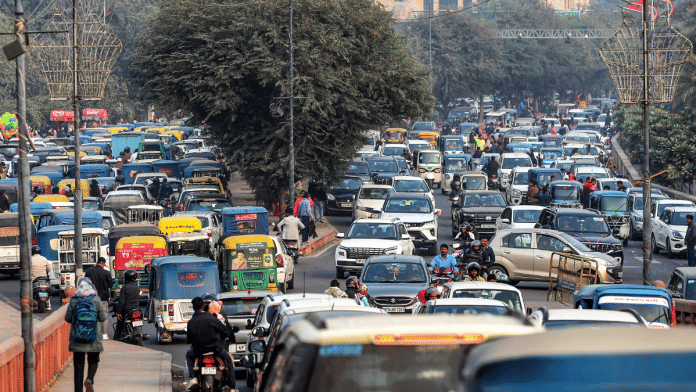



New Delhi: Indian cities are growing economically, but they are increasingly becoming unlivable, according to a new report by the non-profit organisation Janaagraha.
Cities in India contribute to nearly 60 per cent of the national GDP, with just 9 per cent of the population. As per the report titled ‘Shaping Urban India: By Design, Not by Default’, the country’s economic future will be determined by the urban areas. “Between 2005-06 and 2022-23, urban areas added 2.5 million hectares through unplanned sprawl — the equivalent of adding over a 100 Hyderabads,” the report says.
However, the planning of cities remains outdated with “insufficient technical expertise”. City dwellers are grappling with increasingly unaffordable housing, long and stressful commutes on congested and poorly maintained roads, which are often unsafe. The air quality is getting worse every year, and floods have become more frequent. These issues are eventually becoming healthcare problems, rising medical costs, and climate vulnerability, as per the report.
Need for reform
Cities are losing their appeal as a place to live and work, which is also discouraging investments despite massive allocations from the government. According to the Janaagraha report, between the 14th and 15th Finance Commission grants, about Rs 8.36 lakh crore has been funnelled into cities. The 16th Finance Commission grant’s allocation was double that of the 15th. Moreover, these urban areas were given freedom to choose how they utilise this funding. But this is development by default, not design, the report says.
“They (cities) suffer from fragmented governance, uniform models of planning applied across different typologies of cities, limited availability and quality of city-level data, and unempowered local governments.” The report also notes that government schemes seem to treat symptoms rather than reform the city systems that give rise to them.
The report gives the example of India’s four premier Tier-1 metropolitan cities that function as major economic hubs. Half of Mumbai’s population doesn’t have amenities for a dignified life. Life expectancy is going down in Delhi due to pollution. Bengaluru citizens lose about a week a year to traffic. Kolkata has lost about 40 per cent of its green cover over the last 20 years. “These everyday realities are symptoms that highlight deeper systemic challenges in how India’s cities are planned and governed,” the report says.
Infrastructure and services are not keeping pace with growth, hence impacting livability as well as incremental growth. Since at least 723 million Indians are estimated to be living in cities by 2050, the need for reform is dire at this point.
“The constitutional framework already exists. What is required now is political commitment, institutional reform, and sustained citizen engagement to make it real,” read the report.
Also read: Brand Bengaluru is stuck on bad roads. MNCs, startups are saying ‘Hello Hyderabad’ now
The report lists four systematic failures plaguing Indian cities: uncoordinated planning for growth and liveability, fragmented responsibilities across different players, with diffused accountability, a one-size-fits-all approach to cities of different typologies, and insufficient data for effective governance.
It also recommends five big shifts that the state governments can get on.
- Invest significantly in walkability and public transport.
- Implement City Action Plans in medium and small cities.
- Adopt differentiated planning and governance models for different types of cities.
- Build and use city-level data systems for governance.
- Recognise Urban Local Governments (ULGs) as governments of the city.
“The decisions made in the next decade will shape the country’s trajectory for generations,” the report adds.