





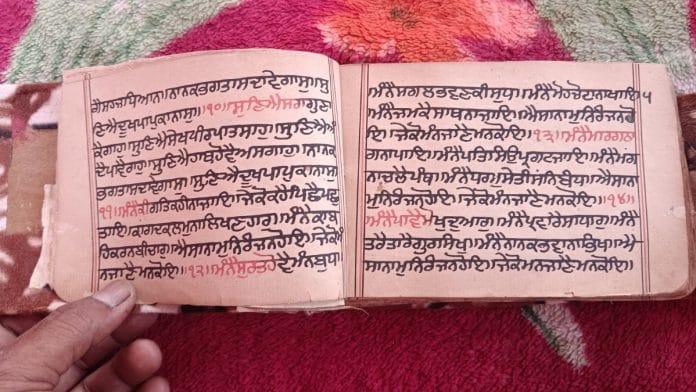



New Delhi: The Ministry of Culture recently announced that the Gyan Bharatam Mission has already documented more than 50 lakh manuscripts across the country. The development, which occurred on 10 April, comes six months after Prime Minister Narendra Modi launched the digital portal for the initiative.
India’s manuscript tradition is vast but fragile. Written on palm leaves, birch bark, and paper, these texts span over 80 languages and cover subjects such as philosophy, medicine, astronomy, and governance. The total number is estimated at more than one crore manuscripts, many of which are in private collections and are at risk of decay, theft, or simple neglect.
The Gyan Bhartam Mission, launched in the Union Budget 2025-26 with a total budget of more than Rs 490 crore for 2025-2031, aims to address this gap. It builds on the earlier National Manuscripts Mission (NMM), launched in 2003.
“Our ancient manuscripts are an invaluable treasure of our rich cultural heritage, preserving our knowledge and traditions. With the objective of their preservation, promotion, and extensive documentation, the Gyan Bharatam National Manuscript Survey is being conducted across the country,” the Ministry of Culture said in a post on X.
The digital portal, launched on 12 September 2025, at Vigyan Bhawan during an international conference on India’s knowledge systems, serves as the central platform.
“Our objective is clear – to preserve, publish, and make manuscripts accessible through modern technology and social media in a way that enables every Indian to take pride in this intellectual heritage of their ancestors. Until this knowledge connects with the practical utility of ordinary people, the movement will remain incomplete,” Gajendra Shekhawat, the Union Minister of Culture and Tourism, had said at the event.
So far, the portal hosts around 1.29 lakh digitised pages accessible to the public. The effort is supported by AI-based tools, including handwritten text recognition and OCR systems developed under the Gyan-Setu initiative to process diverse scripts.
Implementation is being coordinated across states and institutions. A mobile application allows individuals to report manuscripts in their possession, while nodal officers have been appointed in 20 states and Union Territories.
Also read: Night at National Museum—500 people in Delhi are on waiting list for a special walkthrough
From Sanskrit treatises to Persian manuscripts
The mission has 45 centres—including 28 cluster institutions and 17 independent ones—and signed 31 MoUs to expand its reach. Among them are the Bhandarkar Oriental Research Institute and the Khuda Baksh Oriental Public Library. By March 2026, Rs 13.29 crore had been spent out of the Rs 60 crore.
The progress can also be traced on the ground. From about 3.5 lakh digitised manuscripts in November 2025, the number rose to 7.5-8 lakh by February this year, following standardised reformatting processes.
Field surveys are also underway at various locations in India. In Kodagu, Karnataka, teams have begun visiting homes and temples to document manuscripts, including traditional medical texts and historical records. Similar efforts are underway in other regions, supported by local institutions and research centres.
At the institutional level, conservation and digitisation work is ongoing.
Facilities in Pune and Patna are restoring and scanning fragile texts, including Sanskrit treatises and Persian manuscripts. AI tools are being used to process handwritten material and convert it into searchable digital formats.
Despite the progress, challenges remain. Large-scale digitisation, accurate translation across languages, and scientific conservation require sustained resources and coordination. There is also the task of building trust with private collectors to ensure wider participation.
(Edited by Saptak Datta)