





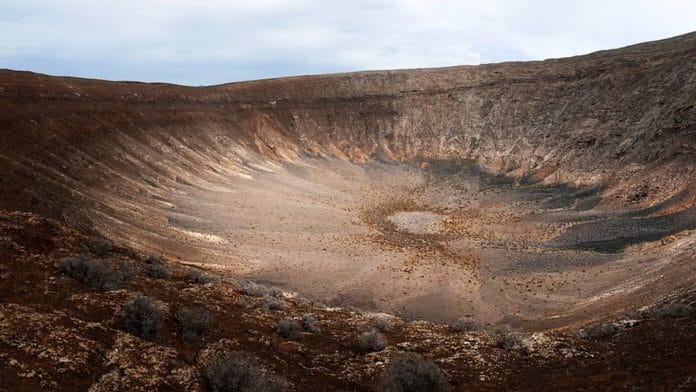



New Delhi: A 1.2-km crater in Gujarat, believed to have been formed by a meteorite that hit the Earth more than 4,000 years ago, has now been identified as an ancient smelting site from the Harappan civilisation, a new study has found.
The study, published in January in the Meteoritics and Planetary Science journal, was conducted by scientists from Ahmedabad’s Physical Research Laboratory (PRL), the US’s Scripps Institution of Oceanography, and Babasaheb Bhimrao Ambedkar University. It suggests that the Luna Structure at the Banni Plains carried the remains of a high-temperature mineral assemblage that shows similarities to iron-rich archaeological slags—a byproduct of ancient metal smelting.
“We reinterpret the Luna Structure materials as slags that are likely associated with the Bronze Age in the Harappan Civilisation and may have formed as a byproduct of copper smelting,” the study reads. “Considering the new evidence, the Luna Structure of western India is not a meteorite impact crater.”
What did the study find?
For the analysis, the research team led by PRL studied the atomic structure of rocks at the Luna Structure.
Meteorites carry high traces of a class of metals known as highly siderophile elements (HSEs), which have a strong affinity for iron-rich metals. They include elements such as osmium, ruthenium, iridium, rhodium, and platinum, among others, which are incredibly rare on Earth but abundant in outer space objects.
For the study, researchers sampled over 100 glassy rock fragments from the Luna Structure. They used X-ray fluorescence and mass spectrometry, which provide detailed information about the elements in the rocks.
The analysis found that the rocks’ chemical footprints were not consistent with any extraterrestrial object—the rocks did not contain iridium or osmium—but it did point to human activity on Earth.
Researchers also highlighted that the samples lacked planar deformation features—microscopic features formed by intense, shock-induced metamorphism, such as a space impact.
The glassy fragments found in the rocks, in fact, were consistent with the elements left behind after the extraction of copper from ores. The remains are comparable to the mineral residues from high-heat smelting furnaces.
Also read: Gyan Bhartam Mission has collected 50 lakh manuscripts. Half the target met in just 6 months
NASA backed meteorite claim
Lunar Structure in Gujarat has long been of interest to geologists and archaeologists for decades, after multiple research teams have found trace evidence of the crater being created by an impact from an object from outer space. The most compelling evidence supporting this claim came in 2024, when a team from the University of Kerala reported that the structure revealed “characteristic signatures of a meteorite impact.”
NASA also supported the 2024 findings.
“In the rocks and sediments, scientists detected several minerals that are uncommon in natural settings on Earth. These rare minerals form under the extremely high temperatures and pressures generated when a meteorite hits the ground,” NASA said in a review post published on the space agency’s website in 2024.
In this research, scientists also measured anomalously high concentrations of the rare element iridium, consistent with findings at other impact craters, further reinforcing its cosmic origin. However, the latest research has yielded completely different findings.
Scientists also underscored the technological capabilities of the people of the Bronze Age for their capability of developing such a complex system.
(Edited by Saptak Datta)