





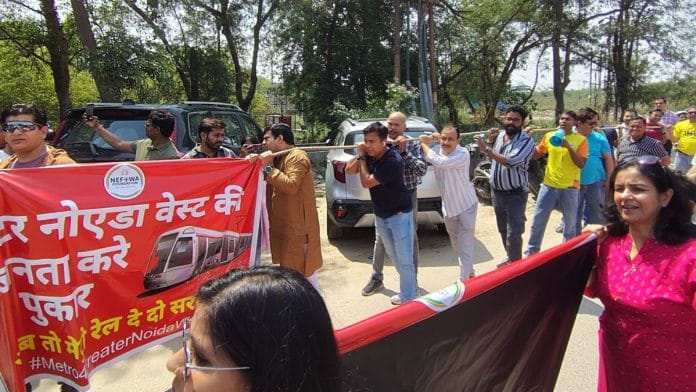



New Delhi: Days after the Union Housing and Urban Affairs Ministry rejected the revised Detailed Project Report for the proposed Noida-Greater Noida West Metro corridor, hundreds of Greater Noida West residents gathered near the final metro pillar at the Sector 71 intersection Sunday. They raised slogans against what they called a “decade-long betrayal” over Metro connectivity.
The crowd held a huge printed banner which read, “April fool ka kaisa khel, kab chalega metro rail (Is this an April Fool’s prank? When will the Metro Rail finally run?). The protest was organised by the Noida Extension Flat Owners Welfare Association (NEFOWA).
For many in the protest, anger has now given way to exhaustion. “There are at least 80 societies in Greater Noida West. Everybody who has to commute to Noida or Delhi depends on shared autos or personal cars. For 10 years, we’ve been told that the Metro is about to start, but it never actually happens,” said Abhishek Kumar, a NEFOWA member. “Every time the DPR (Detailed Project Report) gets close to approval, the Centre rejects it again. We feel we are being treated like fools.”
According to project officials, the latest rejection resulted from structural planning conflicts that will force the Metro plan to be cut down drastically. Pradeep Kumar, who heads the planning division for this corridor, said that the earlier DPR had proposed a Metro alignment from Sector 51 Metro in Noida to Knowledge Park-5. But the Regional Rapid Transit System (RRTS)—that runs between Sarai Kale Khan in Delhi and Modipuram in Meerut—later adopted the same route alignment for its Ghaziabad-Jewar corridor.
The Ghaziabad–Jewar RRTS corridor will pass through Greater Noida West, including KP-4, eventually terminating at the Noida International Airport, but it is still in the pre-construction stage. The plan is to eventually integrate it with the Meerut line.
“The earlier DPR was till KP-5, but now the RRTS is falling in the same alignment, the RRTS has already been built in the area where our line was supposed to be built,” he said. The DPR was rejected because having two mass transit lines running parallel on the same stretch between Gaur Chowk and Knowledge Park-5 was seen as counterproductive by the ministry.
‘All we get are fake promises’
For residents, this modification might fail to ease their travel as they expect from a metro. Under the truncated plan, commuters from Noida Extension travelling to Delhi will first need to board an RRTS train from KP-5, switch at Gaur Chowk to the Metro corridor, and change again at Sector 51. While travel to the Jewar airport will be streamlined, officials told ThePrint that passengers headed to the Gurugram airport may have to pay for three additional train changes.
Even the interchanges themselves may pose a challenge. Whenever one has to change from the RRTS, they’ll possibly have to walk 600 to 700 metres.
For many residents, the latest rollback is more than a transport inconvenience, as many said it has altered their financial planning and children’s education options, and family safety.
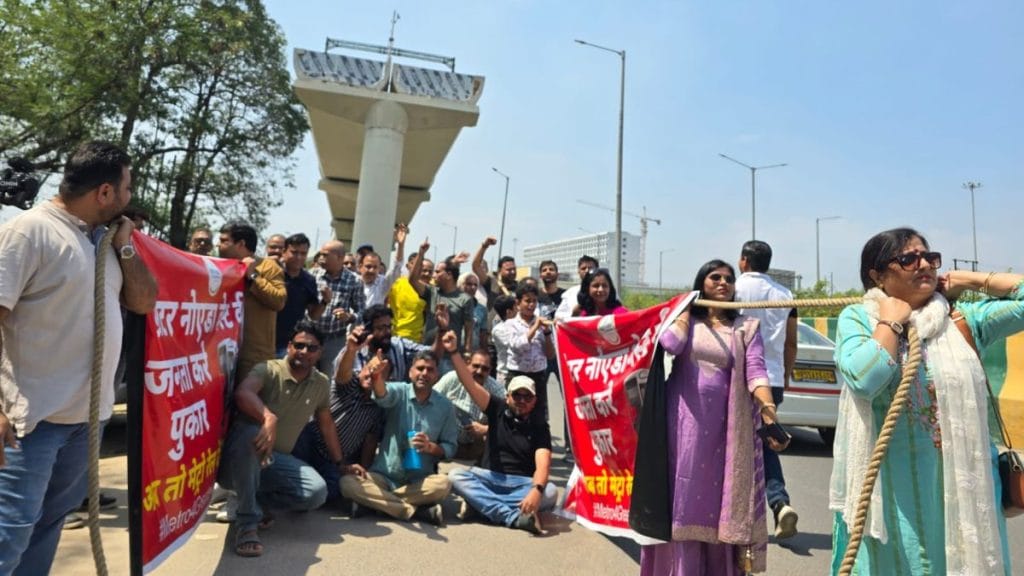
“The population here has exploded because everyone believed the Metro would come. Real estate prices shot up, people bought flats, but when it comes to the Metro, the DPR hasn’t even been approved in all these years,” said Shashi Bhushan, a resident of Ecovillage-2. “Meanwhile, the Aqua Line runs on a route where the Metro is already incurring losses, but the place where people actually need a Metro—Greater Noida West—is ignored.”
Shared autos currently charge Rs 40 one way because the nearest Metro station is Sector 52, which is 10 to 13 kilometres away. A private auto costs anywhere between Rs 150 and 200 one way. For families with students or office-goers, daily travel costs are a burden.
For a region that has exploded in population and remains underserved by public transport, the delay feels like a broken promise revived every election cycle. NEFOWA members said protests will continue until the government provides a clear timeline.
“We are forced to spend huge amounts on cabs, it’s not pocket-friendly,” says Ranjana Suri Bhardwaj, a resident of EcoVillage-1 in Bisrakh, Sector 1. Her daughter recently moved to a PG in Delhi because commuting was too time-consuming. “That’s an extra burden. And late-night travel for women in cabs or autos is unsafe. Why is Greater Noida West neglected in terms of basic amenities? Why are we compelled to come on the roads every time? Greater Noida West has a huge vote bank. But all we get are fake promises.”
Also read: New courses, own degrees, hostels—how NCERT is preparing for new ‘deemed university’ status
‘Supplementary DPR submitted’
It has now been suggested to send a new DPR or a “supplementary DPR” with a shortened alignment, one that ends before the RRTS begins. Instead of the earlier plan with nine to 10 stations, the new DPR currently in the works will restrict it to four to five stations, terminating the line at Gaur Chowk.
“We have already submitted a supplementary DPR reflecting this reduction and alignment shift,” Kumar said, adding it was undergoing internal scrutiny and was expected to go to the Public Investment Board within a month. He stated that it is not going to be an independent report but merely a modification to the one sent earlier.
Meanwhile, the stretch between Gaur Chowk and KP-5, which was previously intended for the Greater Noida West expansion, will be entirely taken over by the RRTS. For this, the RRTS will be redesigned to operate as a hybrid rail system in this segment.
(Edited by Saptak Datta)