





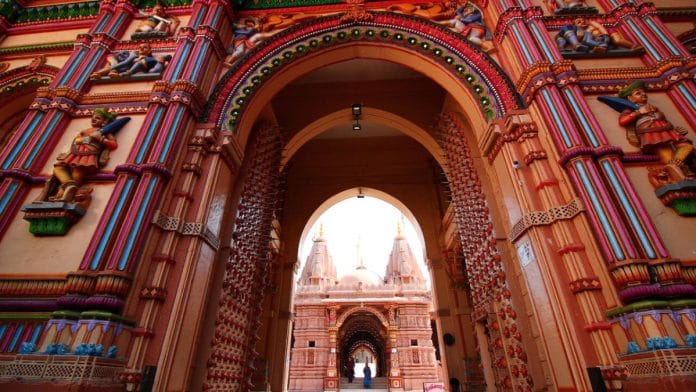



New Delhi: A team from UNESCO and ICOMOS—the International Council on Monuments and Sites—began a four‑day heritage audit of Ahmedabad’s historic core to determine whether it continues to meet the standards required of a UNESCO World Heritage City on Wednesday.
In 2017, Ahmedabad became India’s first city to be inscribed on the UNESCO World Heritage List for its historic walled city.
UNESCO conducts routine reactive monitoring for all the sites on its list—audits that examine how well a site’s historic character is being preserved amid ongoing city life and development pressures. The current inspection, which began on 18 March, is one such evaluation.
Over the next few days, the team will be examining key parts of Ahmedabad’s old city and reviewing major development projects that intersect with heritage spaces—including the redevelopment of Kalupur Railway Station, the Danapith Fire Station site, the GSRTC bus terminal, work around Bhadra Fort, and restoration efforts at the Sardar Patel Museum.
Officials from the Archaeological Survey of India (ASI) will also be part of this audit.
In 2025, a UNESCO directive raised concerns that some projects lacked proper impact assessments and coherent heritage conservation planning. This audit is seen as part of addressing those concerns.
However, no official statement from UNESCO has been released so far.
The UNESCO and ICOMOS team also visited the Ahmedabad Municipal Corporation (AMC) and held a meeting with its team. An AMC official confirmed to ThePrint that the audit is ongoing.
Also read: UNESCO flags demolition and encroachment in Jaipur—World Heritage status at risk
Ahmedabad’s heritage sites
Founded in the 15th century, the walled city of Ahmedabad, on the eastern bank of the Sabarmati River, presents a rich architectural heritage. According to the UNESCO database of the city, it has 28 ASI‑Centrally Protected Monuments. The urban structures of the historic city are distinctive due to their puras (neighbourhoods), pols (residential streets), and khadki (inner entrances to pols), largely made of timber.
“The acceptance of the proposal highlights the historic city of Ahmedabad’s exemplary settlement architecture and town planning. This achievement is especially remarkable given that the proposal had earlier been deferred,” said the Ministry of Culture in a press note in 2017 when the city received the UNESCO title.
The city is also ready to host the 2030 Commonwealth Games and is preparing a bid for the 2036 Olympics.
Ahmedabad is home to the world’s largest stadium, the Narendra Modi Stadium (formerly Motera Stadium), which boasts a seating capacity of 1,32,000.
Apart from the 28 ASI‑listed monuments, the city also has one State Archaeology monument and around 2,700 protected buildings.
Bhadra Fort is one of the historic monuments of the city. It is a 15th‑century citadel commissioned by Sultan Ahmad Shah I, with gates, walls, and an inner palace complex that reflects the early planning of the city.
The grand mosque, Jama Masjid, an example of Indo‑Islamic architecture, is another iconic monument of Ahmedabad. Muhafiz Khan Mosque and Ellis Bridge are other historical civic infrastructures that connect different sectors of the city across the Sabarmati River.
The UNESCO title not only gives the city or a monument recognition but also provides funding and support for heritage protection.
The current audit is important because it helps the city not only secure its UNESCO title but also retain international support. Losing it would undermine Ahmedabad’s reputation as a heritage city on the world stage.
(Edited by Theres Sudeep)