





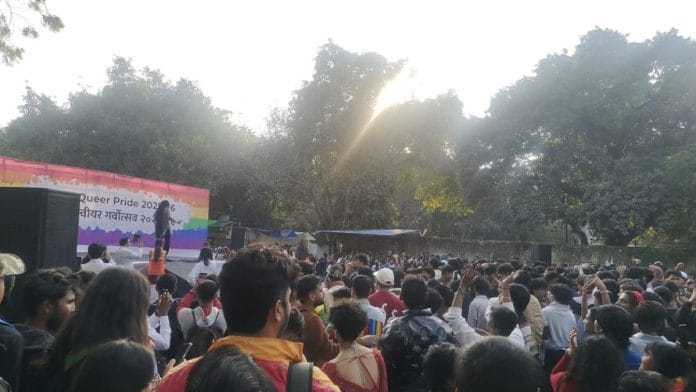



New Delhi: The age-old problem of respectability at pride marches resurfaced at Delhi Queer Pride Sunday when a dancer was asked to step off the stage mid-performance. It was deemed too “obscene” by the organisers.
Starting from Barakhamba-Tolstoy Intersection, the march ended at Jantar Mantar, where the stage was opened for performances. But as freelance dancer Saurav Singh took off his jeans mid-performance—to huge cheers from the crowd—the music was cut off and the MC asked him to stop.
The 25-year-old was wearing black skin-tight shorts underneath his jeans. He described them as “dancer’s hot pants”.
“This is not how we want our community to be represented,” the MC announced. “There can be a legal obscenity case because of this.”
Singh, who has been struggling to find work as a queer artist, was hopeful about his performance at Delhi Queer Pride.
“I see my performance as art. I don’t see it as vulgar. I wear these pants in my dance class around heterosexual people. How can these queer people say they are uncomfortable?” he told ThePrint.
The performances continued as scheduled post the interruption.
“When I want to perform among the community, I am being humiliated. This is very humiliating,” Singh said.
The organising team behind Delhi Queer Pride refused to comment.
Also read: There is more to queer life than young couple falling in love, facing challenges, then uniting
Worst kind of censorship
Attendees noted that there was significantly more police presence at Pride this year as opposed to 2025.
Singh speculated that his performance may have been stopped in light of the police presence.
“I think all that drama has happened just because they (the organisers) don’t want to mess with these cops,” he said.
He doesn’t remember being provided guidelines on his costume by the organisers.
The community’s response is overwhelmingly negative.
“Having performed for the last 10 years, no one has asked me to step down the stage, no matter what I was wearing, what I was doing,” said drag queen Shabnam Bewafa. “I feel really bad for the artist.”
For Sahil Asha Verma, business and partnerships lead at Queerbeat, the dance performances telecasted across Indian households in TV shows are steamier than anything performed at the DQP stage.
“Cis-het men perform ‘gay’ dances wearing very skimpy clothes and no one bats an eye, they get standing ovations. But you (queer people) want a few hours in one day in a year, and that’s when all the censorship, policing, and morality comes out. To limit a queer performer from expressing themselves on the day of queer pride, do you get the irony?” he said.
Swaja Saransh, who performs as Avatari Devi, sees it as a case of mismanagement.
“If you’ve chosen a performer, you should talk to them about their number. If they’re undressing, it’s part of their act. It could’ve been discussed and the many layers of that conversation addressed. What ended up happening was censorship in the worst way possible,” she said.
The organisers’ actions go against their fight for rights and freedoms, she added.
(Edited by Theres Sudeep)