





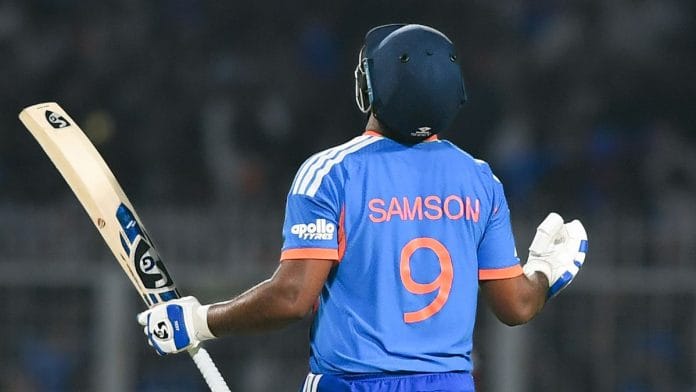



New Delhi: After leading India into the semi-finals of the ongoing ICC Men’s T20 World Cup, Sanju Samson dropped to his knees. He removed his helmet, looked up at the sky and offered a prayer. The gesture—folded hands, arms spread wide and the sign of the cross—seemingly encompassed Christianity, Hinduism and Islam. Many fans felt it symbolised gratitude and faith in its purest form.
Eden Gardens erupted. The unpredictably dangerous West Indies had fallen, beaten by five wickets in the last Super 8 match, a virtual quarter-final for both teams. As Samson walked back after his match-winning effort, skipper Suryakumar Yadav greeted him with a bow and tipped his cap, a tribute to his masterful chase.
But this victory carried a deeper resonance. Samson, a Malayali Christian from a coastal village near Vizhinjam in Keralam’s Thiruvananthapuram district, had just guided India into the last four with an unbeaten knock. His innings, and the prayers he offered, were a story larger than sport. For many, this was “The Real Kerala Story.”
“The Real Kerala Story ft Sanju Samson,” a tweet by Luckyram 9887 read.
The Real Kerala Story ☪️✝️🕉️
ft. Sanju Samson ❤️ pic.twitter.com/slCZHUHvWA
— Luckyram9887.base.eth π² (@Luckyram9887) March 2, 2026
“Whether it’s drawing a note, drawing a cross, or bowing and praying.. When Sanju’s prayer went viral in India, social media said that even in the prayers of Malayalis, there is an unconscious religious harmony,” tweeted Rahul Easwar, an advocate and activist from Kerala.
Another one read, “He prayed on the ground…Allah, Jesus and Lord Sriram….Thanking all Gods, Bro…He celebrated without anyone getting hurt.”
Social media users even interpreted Samson’s gestures as a fitting counter to The Kerala Story 2 hate campaign.
The Kerala Story 2 has been accused of fueling negative narratives against a particular community. The film is about the consequences three Indian women across different states face after choosing love over tradition.
The Kerala Story 2, directed by Kamakhya Narayan Singh, has minted Rs 10.15 crore within three days of its release.
Also read: ‘Only proper cricket on Earth now is in Hubballi’—England fans travel 7,500 km to watch Ranji final
A knock to remember
Samson wasn’t India’s first or second choice opener for the tournament. He got an opportunity in the second match only because Abhishek Sharma fell ill. But Samson couldn’t capitalise, scoring just 22 runs off eight balls.
However, big games call for big players. Samson rose to the occasion. Not once during his 50-ball stint did Samson panic despite the game’s swinging momentum. There was no hint that the rising required run rate was forcing him into reckless strokes.
As wickets fell at the other end, Samson, much like chasemaster Virat Kohli, held the fort at one end.
Whenever the asking rate began to climb into uncomfortable territory, he responded with timely boundaries. There were barely any risky shots. He brought up his first half-century in 13 innings off just 26 balls.
This was the first time in the IPL and T20Is that Samson opened and stayed unbeaten in a successful chase.
India’s earlier league-stage defeat to South Africa, while chasing 187, had sparked questions about the batting unit’s ability to construct a composed chase, the way Kohli did. Samson just proved that he can.
“I think right from the day I started playing, started dreaming to play for the country, this is the day I was waiting for. I kept on believing, and thanks to the Lord Almighty for actually blessing me today. So I am very happy,” Samson said in his post-match interview.
He added that watching Virat Kohli and Rohit Sharma play has helped him fine-tune his game.
Kohli had twice scored 82 not out while chasing in the T20 Men’s World Cups. One came against Australia in Mohali in 2016, and the other against Pakistan at the MCG in 2022, in a match which India had almost lost. Samson surpassed both. His 97 is the highest score by an Indian batter while chasing in men’s T20 World Cup history.
(Edited by Theres Sudeep)
Don’t print nonsense.Sanju is a christian and he prayed like one.Everything else is one’s own imagination.