





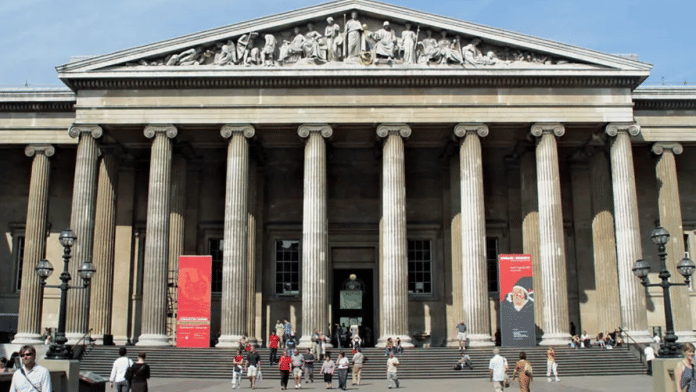



New Delhi: Bowing to pressure from the UK Lawyers for Israel, the British Museum removed the term “Palestine” from its ancient Middle East galleries. The move was announced in via the museum’s Ancient Levant and Egypt galleries last week.
“Applying a single name – Palestine – retrospectively to the entire region, across thousands of years, erases historical changes and creates a false impression of continuity,” reads a letter dated 7 February by the UKLFI to museum director Nicholas Cullinan.
The pro-Israel group objected to display labels for the 1700-1500 BCE that referred to the eastern Mediterranean coast as Palestine, which has now been changed to “Canaan” and “Canaanite descent”.
“We use the UN terminology on maps that show modern boundaries, for example, Gaza, West Bank, Israel, Jordan and refer to ‘Palestinian’ as a cultural or ethnographic identifier where appropriate,” said a spokesperson for the British Museum spokesperson.
The museum said that the decision was made as a matter of “historical precision”.
The change has since triggered backlash from scholars and activists who argue that it reflects political interference in curatorial practice and is part of a broader pattern of efforts to dilute or erase Palestinian historical identity.
Political activist Taghrid Al-Mawed started an online petition on change.org to reinstate the name Palestine in the British Museum.
“This selective removal suggests inconsistency in curatorial standards and raises concerns about political pressure influencing historical presentation,” reads the petition.
The British Museum is not the first public institution targeted by the UKLFI. Earlier this month, following pressure from the group, Encyclopaedia Britannica had amended several entries to Britannica Kids relating to Palestine.
In 2023, London’s Chelsea and Westminster Hospital removed an artwork designed by children in Gaza.
Also Read: Silver palki from Gujarat, necklace for an elephant—What’s in Amrapali Museum’s new floor
‘Ridiculous and pathetic’
Scottish art historian William Dalrymple, in a series of posts on X, called the museum’s move “ridiculous, pathetic and appalling”.
“Ridiculous of the British Museum to remove the word ‘Palestine’ from its displays, when it has a greater antiquity than the word ‘British’,” wrote Dalrymple.
Dalrymple added that the first reference to Palestine is on the Egyptian monument of Medinet Habu in 1186 BCE. “The first reference to Britain is the 4th century BC when it appears in the work of the Greek traveller Pytheas of Massalia.”
He shared a brief history of Palestine, and said that the temple of Medinet Habu near Thebes, there is inscribed in hieroglyphs the name of the people who had invaded the Nile Delta from the north, whom the Egyptians knew as the “Peleset”.
“The name Palestine, in other words, long predates Britannia and most European place names,” he wrote.
Scholars such as Marchella Ward, lecturer in classical studies at the UK’s Open University and Giovanni Fassina, executive director at the European Legal Support Centre (ELSC) said that ancient Palestine is a historically accurate term for the region in antiquity.
“And yet after looting Palestinian artefacts from across the Middle East, it is now unreluctantly preparing itself to rewrite history, to erase Palestine, and its millions of people, out of the history books,” said Global Energy Embargo for Palestine, a worldwide campaign to halt energy flows sustaining Israel’s military, in their statement.
UK-based trade unionist and activist Howard Beckett, in a post on X, reacted to the change, “The influence of Israeli lobby groups in the UK now stretches to museums & historical references. Spine tingling.”
‘The unfortunate truth’
Israeli historian Ehud Manor said, “The unfortunate truth is that debate over how to use the term ‘Palestine‘ is not an academic quarrel over geography. It reflects two fundamentally different worldviews.”
For Manor, it is a reflection of the “confident ignorance prevalent in the anti-Israel echo chamber.”
Manor further said that the name of the region is well documented. “The Romans applied ‘Palestine’ to what even the Quran calls the Holy Land, destined for the People of Israel. The term itself derives from the Philistines—Aegean migrants from Crete, Sardinia, and other ‘Sea Peoples’ who settled on the coast in the 12th century BCE. The word Philistine literally means ‘invader.’ The Canaanites certainly saw them that way. And the Canaanites themselves? The term is interchangeable with ‘Phoenicians,’ both referring to the purple dye that powered their coastal economy.”
He argued that certain scholars and activists believe that just as Ireland belongs to the Irish and Poland to the Poles, ‘Palestine’ belongs exclusively to ‘Palestinians.’
“From this, they leap to the conclusion that anyone else living between the river and the desert is a colonialist, an occupier, a racist. The chant ‘Long live Palestine!’ is not a celebration of heritage; it is a political cudgel,” he said.
(Edited by Insha Jalil Waziri)