





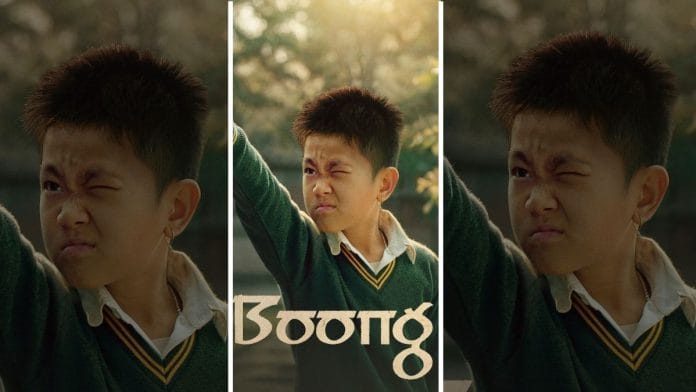



New Delhi: For nearly two years, Manipur has often appeared in the national headlines due to the conflict between the Meitei and the Kuki-Zo communities. But Lakshmipriya Devi’s first feature film, Boong, has landed as a cultural reunion. Released in 2024, the film portrays the life of a nine-year-old schoolboy who escapes the racial shackles and ignores the border division in the state to reunite his family.
The film has been nominated for the BAFTA (British Academy of Film and Television Arts) 2026 in the Best Children’s and Family Film category, alongside other international titles, including the French animated film Arco, as well as American films Lilo & Stitch and Zootopia 2.
But Devi is overwhelmed for a wholly different reason.
“The film brought together the people from the two communities at theatres in Delhi and Bengaluru. They sat together, watched it for 90 minutes and had civil discussions with each other. That is the best outcome of the film,” Devi told ThePrint, adding that she received hundreds of messages from members of both communities, talking about their experience of watching it.
The film, which wrapped up shooting just a week before the conflict erupted in Manipur in 2023, looks at myriad themes, including racism, identity and the insider-outsider debate. The film is a tribute to ‘the Manipur’, where Devi grew up and spent most of her childhood.
“Many of the things shown in the film happened to me during childhood. Adults often think kids are too young to understand certain things, but children have their own way of looking and comprehending things,” Devi said.
Boong had its World Premiere at the 2024 Toronto International Film Festival (TIFF) and had a limited release in theatres on 19 September 2025. It has been produced by Farhan Akhtar and Ritesh Sidhwani’s Excel Entertainment in association with Chalkboard Entertainment and Suitable Pictures.
Inspired by real-life events
Devi’s film is about Brojendro or Boong (Gugun Kipgen) and his mother, Mandakini (Bala Hijam Ningthoujam), who awaits her husband’s return from Moreh. Mandakini runs a small business in the women’s market in Imphal. Boong’s father has stopped responding to calls, and as whispers of his possible death started to make the rounds, Boong embarks on his idealistic adventure to Moreh with his best friend Raju (Angom Sanamatum).
Raju and his father, Sudhir (Vikram Kochhar), face constant racism despite being third-generation Marwari residents of Manipur. But Boong defends his ‘darker’ friend against a ‘fairer’ English-speaking kid, even though he and his mother are criticised for engaging with ‘outsiders’.

But what Devi’s film portrays effectively is that when Boong is frustrated at one point in the movie, he too resorts to racism—it is that ingrained. He tells Raju, “Outsider, go back! Go to Rajasthan”, showing how children pick up on what adults around them say.
“Boong stands up for Raju because he is a friend, and not because he understands political ramifications. That was also drawn from my own hostel days in Delhi, where we were from different communities and states and always stood up for each other,” said Devi. Even the scene where Boong recites Madonna’s “Like A Virgin” when he was asked to lead the school prayer meeting is drawn from an actual incident from her school days at DPS RK Puram in New Delhi.
The film, too, is a microcosm of Manipur before the conflict, with Kuki-Zo Kipgen playing the Meitei character of Boong.
Also read: Delhi-NCR people love urban rom-com movies. And it’s showing in the box office, report says
Manipur’s complex relationship with Hindi films
Moreh, where Boong travels to find his father, became a ghost town after the riots in 2024. The India-Myanmar border town is a melting pot of cultures, and Boong looks at it with wonderment.
He calls it ‘outsider’s paradise’, referring to the Hindi songs, which are not allowed in Manipur, but are heard openly in Moreh. Devi also brings in her own family history and films.
“The maternal side of the family used to own three cinema halls in Manipur in the pre-World War II era, and it breaks my heart to see how they have now become malls or barber shops. So it was one of the things I wanted to say through the film,” said Devi, who has been an assistant director for films like Lakshya (2004), Talaash (2012) and PK (2014).
She also portrays Manipur’s complex relationship with Hindi films, which were banned in the late 1990s, but people yearned to watch them. The film shows how the village chief maintains a secret screening room, with a poster of the Priyanka Chopra-starrer Mary Kom (2014). Mandakini is shown recalling the time her husband took her to the chief’s house to watch Kuch Kuch Hota Hai (1998)—the last Hindi movie screened in Manipur before the ban was imposed.
The film also gives space to the transgender community of Manipur through the character of JJ (Jenny Khurai), who finally helps Boong discover the truth about his father’s absence.
“ JJ’s bar does not exist in real life, but the transgender community used to perform on Hindi songs before they were banned. It was known as the Seven Sisters act, where one person acted like Sridevi and Madhuri, depending on which actor was popular at the time. A lot of elements in the film are not for outsiders who are discovering Manipur but for its own residents,” said Devi.
(Edited by Saptak Datta)