





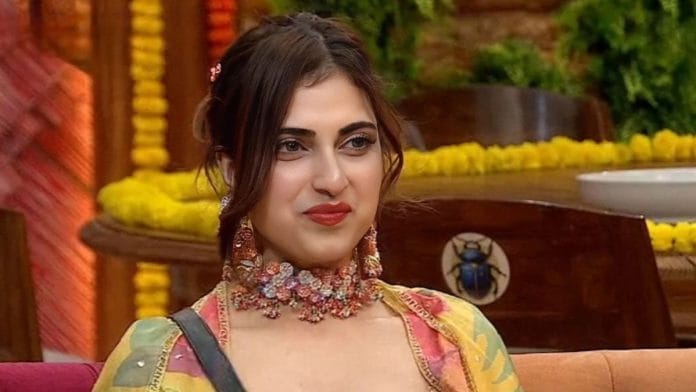



Farrhana Bhatt didn’t win Bigg Boss 19, but for three months, she was its pulse. From Baramulla’s bylanes to fan billboards in Delhi and Chennai, the Kashmiri actor triggered a frenzy rarely seen in recent seasons of the reality show – posters urging votes, hashtags climbing trends lists, Instagram edits multiplying overnight, even temple visits praying for her victory. For a contestant evicted in Week 1 by her housemates and who entered the show with barely 40,000 followers on Instagram, her ascent to first runner-up became the season’s most improbable arc.
What unfolded was more than a reality-TV comeback. Farrhana became a flashpoint for debates on aggression, gender, identity and who gets to be “acceptable” on prime-time television. Her “bebaak (fearless)” presence unsettled contestants, divided audiences and tested host Salman Khan’s patience. Yet outside the house, she built a groundswell of support that reframed her as a symbol of young women pushing back against the labels slapped on them: “dark,” “heartless,” “evil,” “witch.” Fans began calling it the “Farrhana Bhatt Season,” placing her alongside past Bigg Boss icons and winners like Sidharth Shukla and Gautam Gulati. In her fire, flaws and fight, millions of women saw their own lives reflected, and in just three months, her following crossed 2.3 million.
Before entering the Bigg Boss house, Farrhana, 28, had told her stylist: “Mere liye dua karna (Pray for me). For Mrittika Ganguly the line now feels prophetic.
“She wanted to become a heroine, god has answered her prayers. She is a heroine now,” Ganguly told ThePrint.
The stylist, who curated all of Farrhana’s looks inside the house, described her as a woman who is “caring, observant, a chronic overthinker” and someone who loves making people laugh but is deeply affected by people’s behaviour toward her.
Her outfits – pink runway gown, embroidered lehengas, dramatic sarees, Indo-western silhouettes – became a recurring talking point online. None of it was pre-planned, Ganguly said. “The only thought I had was: ‘I want her to look like every day is Weekend Ka Vaar.’”
View this post on Instagram
Conflicts and comebacks
Farrhana’s entry into the house was anything but smooth. Her clash with Baseer Ali – where she was criticised for her language – and the moment she tore up Neelam Giri’s letter became early inflection points.
Inside the house, she quickly became the “villain of the season,” and weekend after weekend, Salman Khan reprimanded her for her temper and language.
“Who would want a daughter-in-law like Farrhana?” he asked at one point.
Yet those very confrontations made her journey the most compelling storyline of the season.
Actor Mir Sarwar, who has worked with Farrhana in Country of the Blind (which was in the Oscar’s consideration in 2024), The Notebook (2019) and Laila Majnu (2018), rejects the notion that she is “difficult.”
“She is one of the most professional actors I have worked with,” he said. “She is confident, talented and a very straightforward person. BB19 was nothing in front of her personal journey.”
Her bluntness – the ability to “call a spade a spade,” as Sarwar puts it – is what made her stand out. But it also became a lightning rod.
A turning point arrived not from the show but from the outside world. During an online talk show, a talent manager associated with musician Amaal Mallik made a derogatory remark about Farrhana’s Kashmiri identity. Within minutes, social media erupted. The comment was widely condemned as Islamophobic. #WeStandWithFarrhana began trending, and suddenly, viewers began assessing her in-house conflicts through a very different lens.
Public empathy tilted. For the first time, her aggression was contextualised, not caricatured.
View this post on Instagram
Insults and identity
In the house, Farrhana rarely revealed her interior world. But when she did, it offered a striking counterpoint to her fiery persona.
“I have never met my father, have only seen him in pictures,” she told fellow contestant Kunickaa Sadanand in an episode. “He cheated on my mother… her family wanted her to give me up and remarry. But she chose me.”
A Srinagar-based police officer, who has known Farrhana for six years, said her assertiveness was forged in the face of constant judgement.
“Some people in her neighbourhood disapproved of women making videos, modelling or entering the film industry. Certain people acted as if they had a monopoly over morality,” he said, requesting anonymity.
Farrhana used to film videos in her room and post them on social media, something that didn’t sit well with the neighbours. Her relatives, she said on the show, would invite her mother to gatherings only to criticise and hurl insults at her about Farrhana’s career.
There were instances, the police officer added, where “cops had to step in to protect her and her mother.”
During an in-house press conference, when reporters asked why she had admitted to not knowing who actor and eventual winner Gaurav Khanna was before entering the show, Farrhana didn’t flinch.
“Jis age mein bachche TV dekhte hai, uss age mein main kaam kar rahi thi (I was already working at an age when children watch TV).”
In that one line, what could have been read as arrogance instantly shifted into context.
She later studied Mass Communication and Journalism from the Government College for Women in Srinagar, moved to Mumbai for an acting diploma at Anupam Kher’s Actor Prepares, debuted in Sunshine Music Tours & Travels, and became a peace activist.
Counselling psychologist Aditya Sundaray analysed her emotional framework and said her life and family’s circumstances could have easily moulded her into something else.
“Living in a conflicted region, she could have grown timid. But her mother’s fight and strength taught her there’s another way, to be clear in communicating her thoughts rather than shutting down,” he said.
Also Read: Farrhana Bhatt is the queen of Bigg Boss 19. She won’t bend, break, or beg for validation
Chink in her armour
For most of the season, Farrhana’s exterior remained steely. Even when confronting the astrologer who advised her to reconnect with her father, she appeared shaken but composed.
“Why do people bring him into my life? I have no idea,” she said.
What broke that armour was her mother’s arrival during Family Week. Farrhana wept. Her mother’s warmth toward every contestant, even those who had insulted her daughter, became one of the season’s most affecting scenes.
And then there were her one-liners, which became instant memes:
“I am not the walking dead; for you, I am walking death.”
“I used to carry weapons in my hand; now I carry them in my pocket. But that doesn’t mean I don’t know how to use them.”
Her journey montage – set to ‘Hungama Ho Gaya’ (Anhonee, 1973) and later claimed by fans as her unofficial anthem – cemented her pop-culture moment.
The Farrhana Bhatt Season
For a contestant who walked in with 40,000 followers and walked out with millions, the transformation was the collision of personality, context and a country watching a woman who refused to behave “as expected”.
Bigg Boss Season 19 belonged to many players. But the story people will remember, the one that travelled from Baramulla to living rooms across India, is the one built on Farrhana Bhatt’s grit, contradictions and refusal to be contained.
Farrhana may not have lifted the trophy, but her audience believes she reshaped the season. Her supporters summarised her arc in one line: “Heroine banne aayi thi, kambakht poora cinema ban gayi (She came to be a heroine, but ended up becoming the entire movie).”
(Edited by Stela Dey)