





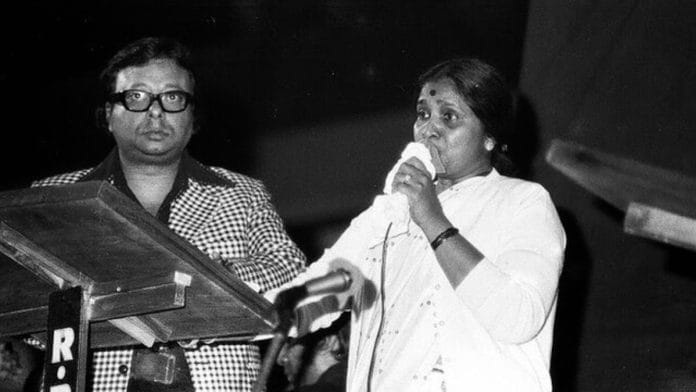



In December 2024, Asha Bhosle sang Karan Aujla’s ‘Tauba Tauba’ and performed the hook step at the age of 91, and showed that she would forever be the undisputed pop queen of Hindi cinema. Even as the live audience at the Dubai auditorium cheered, people online had only one response—age cannot dim her aura.
Bhosle died at the age of 92 at Mumbai’s Breach Candy Hospital after a cardiac arrest on 12 April. The veteran singer had recently collaborated with Gorillaz, the world’s most compelling virtual band, on their song ‘The Shadowy Light’.
Bhosle’s career, spanning over eight decades, was defined by unmatched versatility. She recorded over 12,000 songs in more than 20 languages, acing every genre from soulful ghazals to energetic cabaret numbers. Her collaboration with composer OP Nayyar gave timeless creations such as ‘Aao Huzoor Tumko’, while her work with RD Burman produced classics such as ‘Chura Liya Hai Tumne Jo Dil Ko’.
She redefined playback singing by creating her own unique space, away from the shadow of her elder sister, Lata Mangeshkar.
Bhosle was born on 8 September 1933 in Sangli, Maharashtra, to renowned Hindustani classical singer and stage actor Deenanath Mangeshkar. He died when Asha was just nine, and the family, consisting of her mother and four siblings, moved from Pune to Kolhapur and later to Mumbai. To support the family, Lata started singing at the age of 13. A year later, Bhosle made her debut in Marathi film Majha Bal (1943) and sang ‘Chala Chala Nav Bala’.
Six years later, she marked her Hindi film debut with ‘Saawan Aaya’ from Chunariya and later delivered her first solo track in Raat Ki Rani (1949). Bhosle also sang a lot of Natyasangeet in the early days of her career. She recreated her father’s magic by singing Marathi natyapadas such as ‘Yuvati Manaa Daarun Rana’ or ‘Chandrika Hi Janu’.
Peak, criticism, doubts
Hindi cinema of the 1970s was marked by two things—the establishment of Amitabh Bachchan as the ‘angry young man’ and that of Bhosle as the queen of playback singing. She would carefully observe the mannerisms of women actors and incorporate them in her vocals, be it Helen or Madhubala.
“Though Asha Bhosle had already established herself as a versatile singer with a facility for sensuous songs, it was in this decade that she acquired a monopoly over cabaret numbers. Bhosle’s vocal performances, deployed with volatile movements in pitch, volume, and timbre, played a crucial role in crafting the soundscape of the nightclub,” writes author Shikha Jhingan in her book, The Female Playback in Bombay Cinema (2025).
Bhosle won her first Filmfare award for ‘Gareebon Ki Suno’ from Dus Lakh (1966), and went on to get 18 nominations and six awards in the subsequent 30-odd years. She also won the National Film Award for Best Female Playback Singer twice, for ‘Dil Cheez Kya Hai’ (Umrao Jaan, 1981) and ‘Mera Kuch Samaan’ (Ijaazat, 1987).
She became the first Indian playback singer to be nominated for the Grammys. Her nominations include Best World Music Album for Legacy (1997) and Best Contemporary World Music Album for You’ve Stolen My Heart (2006).
She also faced many rejections.
While Bhosle recorded a number of popular tracks with Kishore Kumar at Famous Studios, the pair was rejected for the very voices that would later become indispensable to Hindi cinema. Recordist and music director Robin Chatterjee said that Bhosle’s voice was not good, and asked the studio to call in Geeta Dutt instead.
The singer was also concerned because all the ‘nice songs’ would go to her sister, while she got the more ‘bold’ ones. Many of her songs were banned from Doordarshan. ‘Dum Maaro Dum’ from Hare Rama Hare Krishna (1971), was banned by All India Radio, while Doordarshan edited the song out when airing the film.
The Doordarshan show Yeh hai Asha came only after Nayyar gave Bhosle a singing personality she could call her own. Before this, she was seen as the poor man’s Geeta Dutt. “There was no consolidated record as to how Asha sounded during those days of struggle when she was cutting her musical teeth,” wrote Bharatan in the article ‘She Stopped Singing to Save Her Marriage’. (The Female Playback in Bombay Cinema, 2025)
But Bhosle persevered, continued to sing and carved out her space in the industry. She sang deeply emotional songs such as ‘Dil Cheez Kya Hai’ and ‘In Aankhon Ki Masti’, proving her command over classical and semi-classical music. The entire album for Umrao Jaan was sung by Bhosle at the insistence of director Muzaffar Ali. It was her first foray into singing ghazals, despite a 34-year-long career.
Also read: Ashatai was a serial stealer of hearts—her music, mimicry and kebabs will live on
The Bhosle-Burman duo
The Bhosle-Burman duo marked its first blockbuster hit in the album for Teesri Manzil (1966) through lively numbers such as ‘Aaja Aaja Main Hoon Pyar Tera’ and ‘O Haseena Zulfowali’. They became an unstoppable force after that, creating one hit song after the next, including ‘Duniya Mein Logon Ko’ (Apna Desh, 1972), ‘Baahon Mein Chale Aao’ (Anamika, 1973) , ‘Do Lafzon Ki Hai Dil Ki Kahani’ (The Great Gambler, 1979), and ‘Jaane Jaan Dhoondta’ (Jawani Diwani, 1972).
It was Burman who was convinced that Bhosle could modulate her voice to suit almost anything. In an Indian Idol episode, Bhosle talked about when she was offered ‘Aaja Aaja Main Hoon Pyar Tera’.
“When I heard him perform the ‘O aa jaa, aah aah’ portion, I was a bit startled and unsure if I could pull it off. Still, I told him I’d give it a try after practising for four to five days,” said the singer.
Bhosle practised the song every day until she got it right, and the rest is history.
Their professional collaboration would soon turn into a romantic relationship, and they got married after years of working closely together.
“[Burman] made music, but he had no ego about it. People die for money, but if I gave him a diamond, he would say, ‘What is this? A stone? Instead, get a good song recorded.’ That record was more valuable to him than a diamond,” she said in an interview.
Remixes and reinvention
In the 1990s and early 2000s, Bhosle reinvented herself with a contemporary sound. She experimented with remixed Burman songs, and her album Rahul And I (1996) became quite popular. In 1997, she did a private Indian Pop album Janam Samjha Karo with Lesle Lewis. The album was hugely popular and won her many awards, including the 1997 MTV Award.
Her collaborations with AR Rahman resulted in hits such as ‘Tanha Tanha Yahan Pe Jeena’ and ‘Rangeela Re’ from Rangeela (1995). She and Rahman went on to record many more songs, including ‘O Bhanware’ (Daud, 1997), ‘Kahin Aag Lage’ (Taal, 1999), ‘Mujhe Rang De’ (Thakshak, 1999) and ‘Radha Kaise Na Jale’ (Lagaan, 2001).
Bhosle sang the title duet with Adnan Sami for his best-selling album Kabhi To Nazar Milao in 2000. In 2002, she composed Aap Ki Asha, an eight-song music and video album. The lyrics were written by Majrooh Sultanpuri. In 2006, she recorded the album Asha and Friends, singing duets with film actors Sanjay Dutt and Urmila Matondkar, and even cricket player Brett Lee, with whom she sang ‘You’re the One for Me’.
During the Covid-19 lockdown in 2020, she collaborated with Usha Uthup, Udit Narayan, Kailash Kher, Alka Yagnik, Sonu Nigam, and 200 others on the song ‘Jayatu Jayatu Bharatam’.
Until the very end, Bhosle continued to perform at concerts, creating a formidable legacy rivalled by few others in Indian music.
(Edited by Prasanna Bachchhav)