








What counts as women’s work, and who gets to decide? In Working Girls (2025), filmmaker Paromita Vohra turns the camera toward labour that often remains unseen, tracing the lives of women across India whose work ranges from care work to sex work. The 130-minute documentary opens with a mosaic of shots of women getting ready for work. With interviews, animation and voiceovers, Vohra stitches together stories of women across professions—from dancers and egg donors to ASHA workers—to examine how labour tied to care and survival is often invisibilised, underpaid or dismissed.
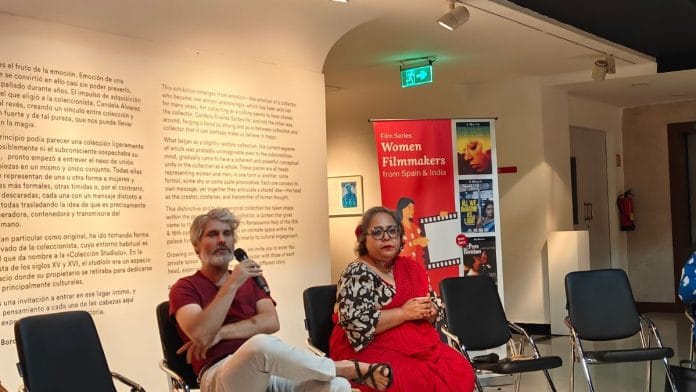
The screening held at Instituto Cervantes on 23 March was followed by a discussion, where Vohra answered questions about her process and how she brought the stories together.
“My approach is not to turn people into examples, not to think of people as representing some idea, but simply as people, and that means also not to think of people as representing an identity, a profession. I think when you encounter somebody whose articulation is stunning, you only really have to listen with interest and curiosity,” said Vohra.
From following dancers in Madurai to documenting the Accredited Social Health Activists (ASHA) workers’ protest in Kerala and interacting with police job aspirants in Mumbai, Vohra’s film presents the work that we often fail to see or recognise.
The film is based on the Laws of Social Reproduction project hosted by The Dickson Poon School of Law, King’s College London. The project studies women’s reproductive labour across the marriage-market continuum, including sex work, erotic dancing, surrogacy and egg donation, paid domestic work and unpaid domestic and care work.
Working Girls allows the viewers to meet the interviewees in their work life and domestic life, without turning them into mere subjects of inquiry.
The interviews are not in the usual sombre, documentary style, where the camera immediately focuses on the person, but rather, one is led into the lives of the women through the everyday. Before Vohra interviews Vanita, a Pune-based sex worker, she is shown cooking in her kitchen and having a small tiff with her partner over fish. This is followed by the many images of various gods in a room, along with that of Dr BR Ambedkar. “We are here because of him,” says Vanita as she prays, referring to Ambedkar, before she sits down for the interview.
Vohra engages with the women in ways that make them answer questions candidly. Rita Ghosh, an egg donation agent based in Mumbai, mentions an instance when a Bengali couple was adamant about wanting a donor from the same community. “Will the child speak in Bengali the moment it’s born? Is that the idea?” asked Vohra, which made Rita laugh, as she narrated more anecdotes.
Vohra has a calculated approach to her interviews.
“For me, the question is, how should I, as a filmmaker, respond to the hardship and the difficulties that I’m seeing? I will not represent people only in terms of their victimhood or their hardship. I will talk about them in terms of their capabilities and their worldview,” said Vohra.
Also read: People think about their sex lives in terms of jargon. Agents of Ishq wants to change that
Holding on to agency
Vohra’s film makes a point to speak of the many colonial and contemporary laws and Acts that have shaped working conditions for women in India, beginning with devdasis, where laws like the Bombay Devadasi Protection Act 1934 prohibited dedicating young women to temples, but provided no alternate employment, to surrogates. These laws are explained through animation, blending fact, humour and sarcasm through voiceover.
“I think it’s a good thing to knit the idea of labour law and care work and gender together continuously. In some ways, the film is also opening up that conversation a bit by going into strikes, by looking at the histories of law, and understanding how all of this is neatly nested under capitalism. Capitalism requires gender to be a certain way as well,” said Vohra.
These women are often seen as oppressed, trafficked, exploited and victims of their circumstances. The lack of legalisation of these works and the forced attempts at rescue take away the agency of these women that they have tried so hard to achieve.
In the documentary, a social worker in Pune talks about how, while there are cases of trafficking, there is also a considerable number of women who ‘choose’ sex work as their profession.
“The law is proactive in ‘rescuing’ women and putting them in women’s shelters. But what if they don’t want to be rescued or don’t want to do the stitching or embroidery that are taught as skills in these shelters? They should have their own choice in what careers they want to have,” said a social worker working with sex workers in Pune.
What unites these women across their diverse realities is the desire for financial independence, to have better lives and also help their families, the documentary shows. They all have the common identity of being a proud ‘working girls’, no matter which profession they are part of.
(Edited by Theres Sudeep)