





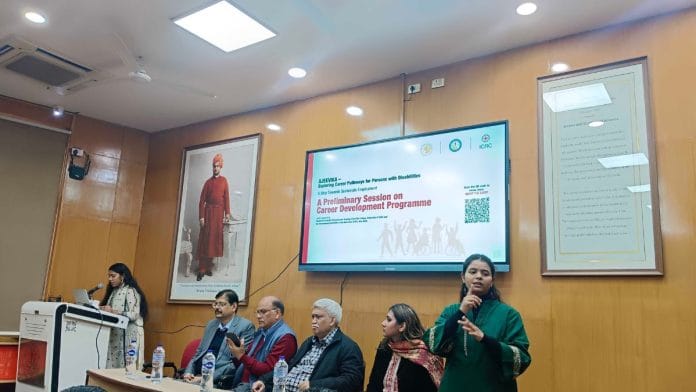



New Delhi: At a packed auditorium at the University of Delhi, two of the country’s largest employers—Indian Railways and budget airline IndiGo—came together on Thursday to question a far more basic barrier than hiring quotas: Who gets to be seen as “normal” in the workplace.
The event, AJEEVIKA, was set as an preliminary career counselling and development session aimed at promoting sustainable employment and inclusive career opportunities for Persons with Disabilities (PwDs).
“This programme is not just a session. It is not merely a career workshop. It is a statement of values. It is a commitment to dignity. And above all, it is a celebration of human potential,” said Sudeep Mishra, Principal of Kirori Mal College, University of Delhi.
The event was organised by the Centre for Disability Research and Training (CDRT), Kirori Mal College, University of Delhi, in collaboration with the International Committee of the Red Cross (ICRC), New Delhi. The session sought to highlight the importance of accessibility, inclusive work culture, and real-life corporate experiences of PwDs.
Quoting Helen Keller—“Alone we can do so little. Together, we can do so much”—Mishra highlighted the collective spirit behind the event, noting that institutions, experts, and students had come together “to ensure that opportunity is not a privilege of a few, but a right of all.”
AJEEVIKA marks the beginning of a larger dialogue on inclusive career development, bringing together government representatives, corporate professionals, Persons with Disabilities , and inclusion advocates. PwDs also shared their personal experiences of job searches, opportunities, and the challenges they face throughout their career journeys.
“Persons with disabilities do not need sympathy. They need access, opportunity, and trust. Because ability is never defined by the body, but by courage and determination,” added Mishra.
Also read: Why SIR is an exclusionary exercise for Persons with Disabilities
The idea of ‘normal’
As the event explored career options, opportunities in government jobs and private sectors—what captured everyone’s attention was professor Someshwar Sati’s explanation of how the idea of “normal” often makes people feel disabled.
“The problem is not persons with disabilities. The problem lies in how the idea of ‘normal’ has been constructed to create the problem of the disabled person,” said the senior faculty member of Kirori Mal College’s English department.
Using compelling examples—such as the absence of ramps in many places and the lack of accessible equipment in classrooms—he questioned society’s standards. “If I give you a book scripted in Braille, will you be able to read it? Perhaps not. Would the world then call you disabled? Definitely not.”
As the session progressed and speakers addressed the audience, sign language interpretation was consistently available on the left side of the stage.
Professor Sati added not only the need to change the lens through which “normal” is viewed and to create inclusive spaces for persons with disabilities, but also the importance of equal involvement of everyone in society.
Also read: Six disabled people picked to turn their lived reality into govt policy
Personal experiences
The Chief Guest, Mr. Sujit Kumar Mishra, IRPS, Principal Chief Personnel Officer, Northern Railway, spoke about the opportunities and preferences that Indian Railways offers to Persons with Disabilities to help them secure their futures.
Next, corporate professional Manisha Shah shared her journey from a small town in Bihar to becoming a senior analyst after losing her right leg in an accident.
“Disability is a part of my life, not my whole life. Your disability does not define your capability. Your mindset does,” she shared with the audience, while answering questions about overcoming rejection and balancing career and disability together.
Cybersecurity professional Pranav Lal, who is medically blind, stressed the importance of developing skills, self-advocacy, and preparation. The event concluded not with placement promises or job opportunities, but with enduring confidence and clarity toward choosing careers and securing futures, along with a necessary reality check—that what matters most is talent and skill.
“If you can deliver, you win. It’s as simple as that,” said Lal.
(Edited by Theres Sudeep)