





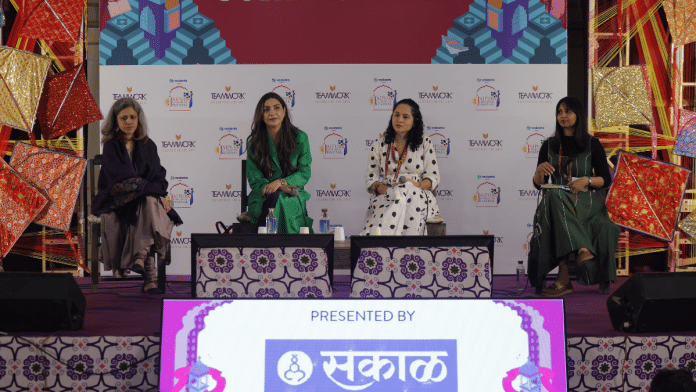



Jaipur: Women gathered at the Surya Mahal at the Jaipur Literature festival, as if in solidarity, to know exactly what it is that ‘What Women Don’t Want’, Poulumi Chatterjee, executive publisher at HarperCollins, moderated the session with panellists Bhavika Govil, Shunali Khullar Shroff, and Amrita Mahale.
Shroff started by joking that she had never thought people found women so complicated. She described her novel, The Wrong Way Home, as the story of a woman who makes “spectacularly bad choices” and how she navigates her divorce in a society that strips a woman of her identity as soon as she disassociates with a patriarchal head.
Shroff, in her usual honest and humorous manner, admitted that she has menopause fog and forgot to mention why she wrote the book.
“Many of my single friends feel left out at most of the events; society very quietly excludes them,” she said.
The panel showcased diverse stories of women. Mahale’s Real Life follows the story of two female best friends after one of the protagonists, Tara, a female biology student, disappears during one of her research projects.
“Through these characters I wanted to explore the male and the female rage,” Mahale said.
Whereas, Govil’s novel Hot Water explores the world through the eyes of a young child, at the centre of which is ‘Maa’, a single mother.
Also Read: Agnostic is the same as ‘slightly pregnant’, says Javed Akhtar at JLF
How women are labelled in society
Among other issues and their new books, the panellists also discussed the “many labels” that society puts on women and how the characters in the three novels deal with it.
Shroff said that most women have to follow a certain path from the moment they are born, and asserted that women do not often differentiate between their own choices and the ones society has made for them.
“Women are given a script the moment they’re born,” she said.
Shroff’s protagonist struggles with these uncomfortable truths; she is afraid of being “single”. However, after the eventual divorce, she aims to surpass these labels.
Mahale talked about the ‘Eldest Daughter Syndrome,’ and how, for most girls in India, it is a harsh reality; they are condemned to the various labels and the roles associated with it. Although it is not a formal diagnosis, eldest daughters are commonly made to feel immense pressure to be responsible, self-sacrificing, and a caretaker for the family, often acting as a “mini-adult” from a young age.
“It is true that girls are asked to mature faster than the boys of their age,” Govil said. She further reflected upon this similarity in the three novels, despite the diversity of the women they portray.
For Govil, Hot Water explores how labels pertaining to marriage and then motherhood lead to a sense of loss of women’s identity. “I think all of us grew up to know our mothers, just as ‘maa’. The idea of her being untethered and a person in her own sense comes very late to us,” she explains.
She went on to say that the central idea is to explore how different women are from the labels inscribed on them by society.
Also Read: Is freedom of speech a dangerous idea? JLF closing panel couldn’t find an answer
What women don’t want
Eventually, the much-anticipated question of the evening came up: what women don’t want. Through the discussion surrounding the three novels and their distinct characters, it was concluded that despite all the different ways in which women were segregated, there is consensus that both fictional and real women, like the writers and the ones in the audience, share the will to live freely.
Shroff only wants women to “get a seat at the table”, whereas Govil said she wants women to “just want to exist without labels.”
Mahale, however, took a different approach, her experience of choosing her career by elimination rather than direct choices, she asserted that, “It is easier to know what one doesn’t want than knowing what one wants.”
Among the audience members was acclaimed Indian author Sudha Murthy, who during the question and answer session disagreed with the panellists and said that women “suffer” because they were overly bothered by the idea of what others want.
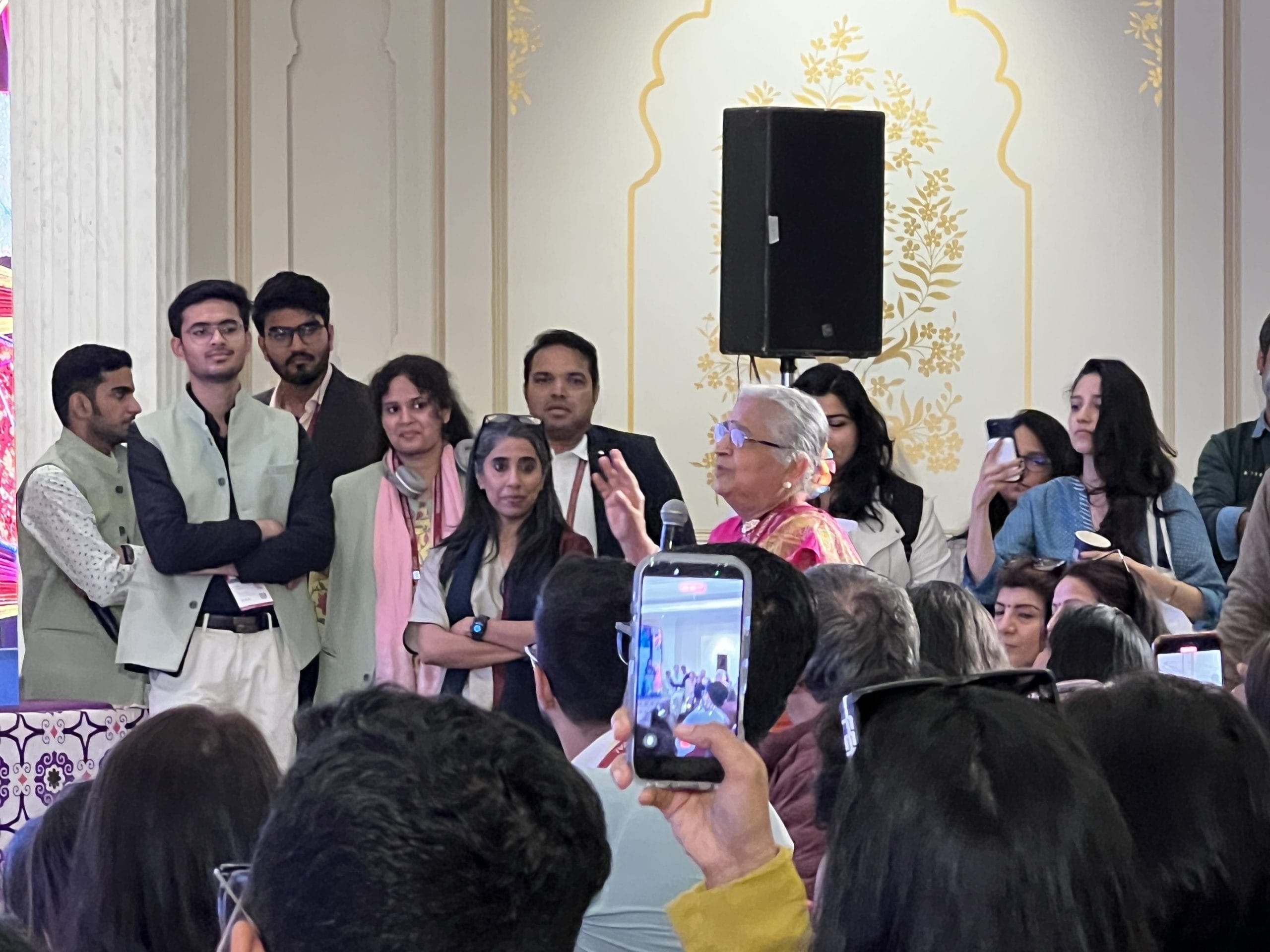
“Women should develop inner strength and do away with all the questions that come in their mind, they should have courage in themselves,” said Murthy.
The panel, however, argued that gender roles and the social laws that negate women make it very hard for women to develop such dynamics.
“The problem is that we have grown up not looking at ourselves but looking at how others look at us,” Shroff added.
“While it’s a beautiful sentiment, it is hard to realise in society like ours,” Govil said, an idea that the women in the audience agreed with.
Ankita Thakur is an alumna of ThePrint School of Journalism. She interned with ThePrint.
(Edited by Insha Jalil Waziri)