





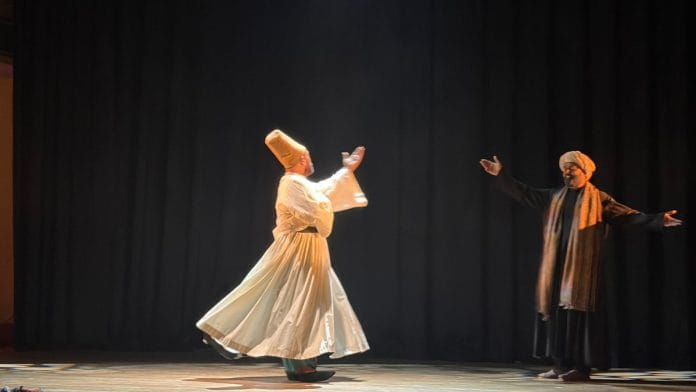



As a 20-year old art student in London, playwright Lady Mohini Noon Kent was introduced to the works of 13th century Sufi poet-philosopher Jalal-ud-din Rumi by her Persian roommate. Decades later, she would go on to write the first stage production of Rumi’s encounter with his spiritual guide, Shamsuddin Tabrizi.
Her play Rumi: Unveil the Sun, which returned to Delhi after 19 years, is a meditation on love, spiritual transformation, and the search for unity in a divided world. Written with her mother, the poet Amrit Kent in 2007—the UNESCO ‘Year of Rumi’—it was first staged across London and Delhi and was labelled ‘riveting’ by Indian playwright Habib Tanvir.
The play was staged at the NSUI Auditorium, on 4 and 5 March, in collaboration with Dhoomimal Art Gallery and Koan Advisory, inviting audiences into Rumi’s inner life and revealing the man behind the verses that continue to resonate across cultures. It opened to a houseful audience, helmed by a relatively young director, 34-year-old Rakesh Nirmal, who took up the project on a whim.
“When I was approached for the project, I was already reading a lot of Kabir. When I researched more on Rumi, I could see parallels between them. Be it Kabir or Rumi, the words resonate centuries later, the relevance never fades,” he told ThePrint.
At the heart of the play is Rumi’s life-altering encounter with the wandering dervish Shamsuddin Tabrizi. It focuses on their bond and eventual separation and how it transformed Rumi from a revered scholar into one of history’s most celebrated poets.
The play opens with an evocative performance by Kathak dancer Asavari Pawar on Rumi’s life. Performed in English, the play blends Persian verses by Rumi and is divided into a post-Shams and a pre-Shams era.
Ashaar Haque as Shams Tabriz brought a unique irreverence to the character that has been analysed and written about. The performances were soulful with a visually rich tapestry of dialogue, music, and movement. The play evokes Rumi’s internal evolution through different stages, a metamorphosis that continues to inspire across time and geography.
Also read: How Shams and Rumi met—the union that sprung the poet’s ‘Diwan-e-Shams’
The relevance of Rumi
For Nirmal, there’s a raw, everyday humanity in Rumi that mirrors what Kabir wrote about. Their ideas of love are the same. Producer Oroon Das, reprising his role as Rumi, sees a parallel with Hindu mystic Ramakrishna Paramhansa and adds that he could feel it while performing, while Lady Kent calls herself a ‘seeker’ and perceives echoes of poet and philosopher Aurobindo Ghosh and other spiritual men in the poet’s journey.
For Lady Kent, it is also deeply personal–a tangible memory of her mother. For Das, it is a spiritual experience. For all three of them, it is love’s labour.
“With Rumi, the size and expanse of the character are beyond an everyday person’s reach. Now, I channel that through surrender and gratitude—it’s beyond performance; it’s an offering and the reception feels worthwhile,” Das adds.
It was perhaps evident in the fact that Das’ embodiment of Rumi resonated to an extent where after his performance of Rumi’s sema or prayer-in-motion, the audience cheered. When each actor took the final bow, the hall erupted into claps and gave the actors a standing ovation.
Das recalls an elderly woman who, because she was unable to sit still, decided to stand through the one and a half hour long play, not wanting to leave midway. Such moments of shared awe are, in Das’s words, “our earning—the reason we put ourselves on the line of fire, at personal cost, to bring this story to life.”
Also read: Who influenced Rumi? Very few know about Sufi poet Attar
Beyond interpretations
For Lady Kent, the play straddles between the fluidity of human love and divine love and eventually merges into one. However, with Sufi mystics and especially Rumi, debates abound. Authors like Iranian poet Zirrar Ali in his article ‘Reading Rumi in the West: The burden of Coleman Bark’ argues that translators such as Coleman Barks have ‘secularised’ Rumi, stripping his verses of Islamic references to make them more palatable to a Western audience.
When asked about this after the play, Kent speaks at length about the diversity of interpretations. “Everyone interprets Rumi differently. No one gets to own it. That’s the beauty of his poetry—it transcends boundaries, both temporal and spiritual.”
The revival of the play comes at a moment of renewed global consciousness amid a shifting global space. There are wars, rising communalism and a general lack of a collective humanity.
Incidentally, in February, the play was staged in Pakistan under Shahnawaz Bhatti’s direction. However, Lady Kent or Das had no idea about it. The original videos from 2007 or the scripts are not publicly available and they were surprised to hear about the screening.
“This is about oneness. It is Advait-ism at its core. The message is the same whether it comes through Vedanta, Rumi, or the Buddha. The language may differ, but the experience is universal,” Lady Kent added.
(Edited by Theres Sudeep)