





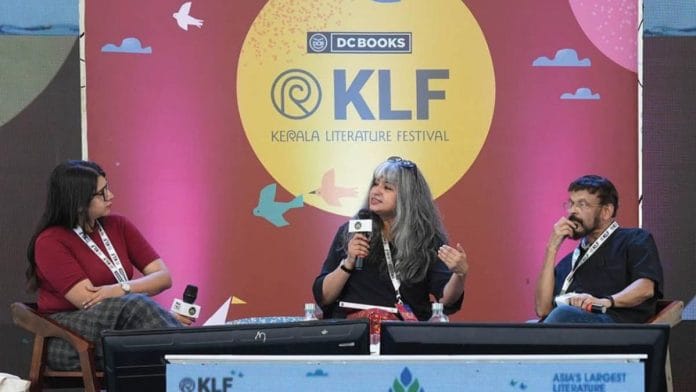



Kozhikode: At a time when romantic relationships assume many labels and even more disclaimers and complexities, a discussion on polyamory in India tried to dismantle the traps of heteronormative relationships, from ethics and patriarchal pitfalls to the importance of agency.
Speaking at the ninth edition of the Kerala Literature Festival held in Kozhikode, writer and activist Arundhati Ghosh said polyamory doesn’t have any unique pitfalls compared to monogamous relationships—such as adjusting to the schedules of partners, which she says every human being already does through their different relationships with family and friends.
Ghosh went on to say that in a monogamous relationship, loyalty is often defined by what you do not do—not traveling or sleeping with others—while in polyamory, it’s defined by what you do for your partners.
She added that complications arise when people pretend to be in a polyamorous relationship just to have sex with multiple people.
“A lot of seemingly progressive cis-heterosexual men approach women saying, ‘I’m polyamorous and therefore I have multiple people that I can sleep with. And if you are not willing, then you’re not progressive enough’,” she said.
The session featuring Ghosh and Malayalam writer Ethiran Kathiravan was moderated by author Sanjana Ramachandran.
There are still many misconceptions about polyamory, including the idea that polyamorous people don’t have agency in deciding their partners.
“I’ve had to explain to a lot of men and some women that, ‘Hey, you’re wonderful but I’m not feeling that love towards you’,” she said, adding that many also wrongly assume that polyamorous people are shallow or unable to maintain long-term relationships.
The term ethical non-monogamy was sprinkled through the discussion. But Ghosh pointed out that if the tag ‘ethical’ isn’t used for monogamous relationships, it shouldn’t be used for non-monogamous ones. “Any relationship should be built on honesty, responsibility, and dignity,” she said.
Also read: Historian’s role is bigger than simple questions of beef and Hinduism: Preeti Gulati at KLF
Shadows of an old system
No discussion on normalising polyamorous relationships is complete without acknowledging the complexities that come with it.
One audience member wanted to know Ghosh’s perspective on inequality prevalent in some polyamorous relationships.
“Many polyamorous relationships speak about equality, but in practice, I think especially in India, there often seems to be a main partner and others who have to hold back their emotions,” she asked.
Ghosh said that this is one of multiple structures of polyamory in India, where there is one primary partner and others are considered “less than”—an understanding all people in that group are supposed to have.
“And there’s another thing, patriarchy enters everything. No matter how much understanding of polyamory is there, it falls back into the structures that patriarchy has always pushed,” she said.
The structure of a polymarous relationship is unique to each person and group. There is no right or wrong way, but Ghosh warned that one should be very aware of the power dynamics in a relationship.
“But nobody can tell you to do something that you don’t want to do. Nobody can make you be what you don’t want to be. So you have to have your agency very much in your hand when you enter these complicated and complex relationships,” she said.
The session concluded with the legal rights of those in polyamorous relationships in terms of property rights and other protections. Ghosh said her interactions with lawyers revealed the difficulties in this arena, given that India’s family and marriage laws are based on heteronormative monogamy, man and woman, outside of Islamic law.
“Right now there is no legal right that polyamorous people can claim,” she said.
(Edited by Theres Sudeep)