








New Delhi: In the narrow, bustling lanes of Delhi’s Majnu Ka Tila, or MKT — where students pack into cafés chasing the pull of northeastern food and culture — a sudden burst of colour on the walls of Samyeling Gate no. 2 is forcing a pause. The project that started with just a wall has expanded into the entire lane with 12 murals, dedicated to Tibetan history, memory, and cultural identity, set to appear by mid-April.
The North Delhi neighbourhood is being visually reimagined by the Khadhok Artists’ Collective, a Dharamshala-based group founded in 2023 by artists Lea Taake, Tashi Nyima, and Tenzin Melak. The project is a collaboration with the Students For Free Tibet movement.
The project took shape in January 2026 through an open call on social media linked to Tibetan Uprising Day, which marks the 1959 protests in Lhasa that were violently suppressed by Chinese forces. The first mural was painted on 10 March, the day when the uprising began.
The response from artists was overwhelming, with Tibetan contributors such as Lobsang Soepa, Tenzin Olden, Cactus Tserma, and Tenzin Tselha taking part, alongside Indian graffiti artist Snares and other Himalayan artists expected to join through mid-April. Centered around the history, culture and memory of Tibet, the mural tells a tale of a lost land and the people who hope to return.
“So many people come to MKT just to enjoy the food and drinks, but most of them don’t really know more about history,” Lea Taake, co-founder of the Khadok Artists’ Collective, told ThePrint. These murals are an act of reclaiming space for them and the other artists — inserting Tibetan history, memory, and politics into a landscape that some see only as a fun hotspot.
Known as Delhi’s ‘Little Tibet’, MKT has long been home to a Tibetan refugee community, a settlement that took shape in the 1960s after thousands arrived in India alongside the Dalai Lama.
For these Tibetan artists, the work goes beyond aesthetics, money, or fame; it is driven by a deeper intent to keep their culture and cause alive, and to ensure they are not forgotten.
“For the cause of Tibet, art is very important. After the invasion by the Chinese, they are trying to destroy scriptures and culture… Even now, Tibetan children are forced into boarding schools where they can’t study Tibetan. Art can change the movement peacefully—not like fighting and war,” said 33-year-old Tenzin Melak.
No direct representation
Instead of turning toward imagery of grief or violence, the artists are approaching their work with determination.
“We really tried to approach this creatively,” Taake said, explaining how the team worked closely with selected artists to move beyond direct representations and toward something more interpretive, without losing the political core.
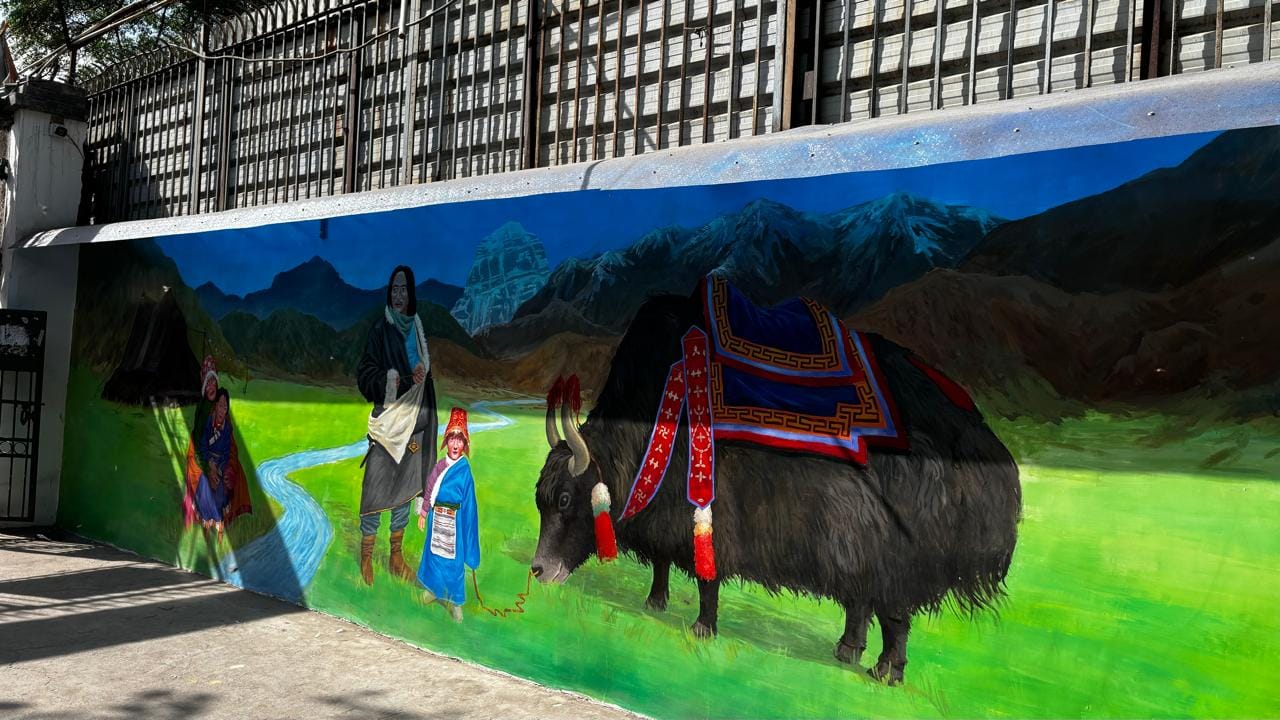
At the entrance, the first mural to catch the eye depicts a family dressed in chuba, the traditional Tibetan robe, set against a backdrop of mountains and a flowing stream, a scene that reflects the idea of home and familiarity for many Tibetans in exile.
Nearby, another mural features the words “རེ་བ་ Since 1959” (‘Rewa’ meaning hope). The graffiti painted in red and green emphasises the hope that looks onward.
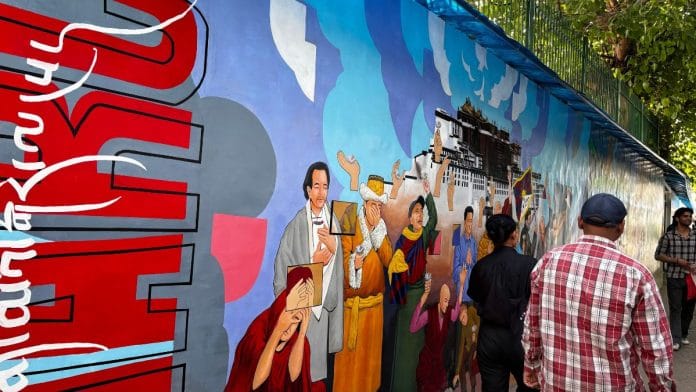
The central pieces reinterpret the events of the 1959 Tibetan uprising. Protesters from all generations crowd the foreground, clad in traditional chubas and modern shirts, symbolising the global Tibetan diaspora marching yearly on 10 March.
In the back, the Potala Palace looms amid smoky clouds, no flames, but the implication burns. Tibetan Children’s Villages (TVC) school children (from schools founded by the Dalai Lama) hold a white lotus, nodding to Buddhist non-violence.
Also read: Saeed Naqvi on how Urdu poetry lives and breathes in everyday moments
Communicating a story
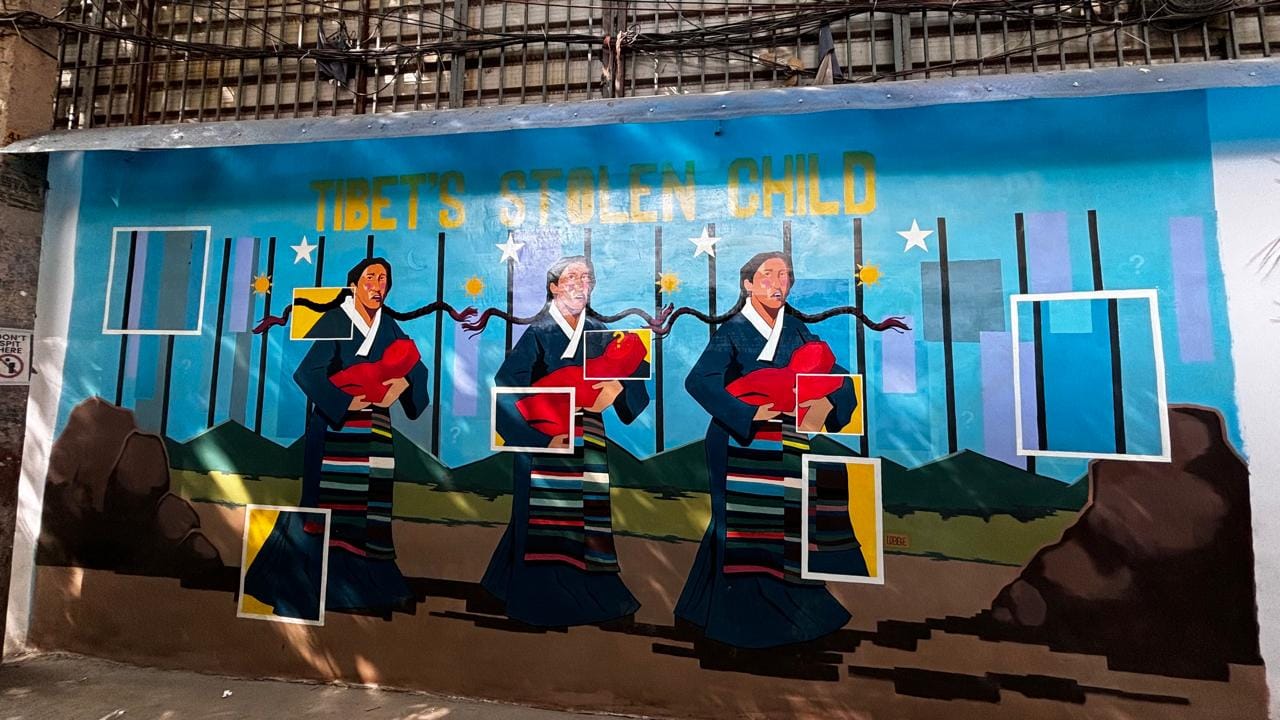
Another mural that is hard to miss is ‘Tibet’s Stolen Child.’
The mural honours and remembers Gedhun Choekyi Nyima, the 11th Panchen Lama, a high‑ranking Tibetan Buddhist religious figure who was recognised by the Dalai Lama in 1995 and then abducted by Chinese authorities at the age of six. He has not been seen publicly since, making him the “world’s youngest political prisoner”.
“Our protests have been non-violent… We’re always just there, asking for support,” says muralist Lobsang Soepa. Born and raised in Tawang, Arunachal Pradesh — a borderland China claims as South Tibet — Soepa, 26, is an illustrator, storyteller, and Students for a Free Tibet member.
“I try to do everything through my art,” said Soepa. Spotting MKT’s trash-strewn alleys packed with Indians unaware of Tibet’s plight, he saw an opportunity: ask questions with murals.
“One single wall project became such a big thing,” Soepa said. The response was more than anyone could have expected. Passersby lit up seeing the Potala; locals donated for whitewashing the walls, new roads, lights, and CCTVs. Viral reels amplified it all.
For Khadok, it’s a dual victory: conveying a message to outsiders while forging the community.
“We want to communicate the story… and build a strong artist community among Tibetans,” said Taake. “Tibetans are waiting to express themselves politically and especially through their art.”
(Edited by Aamaan Alam Khan)