





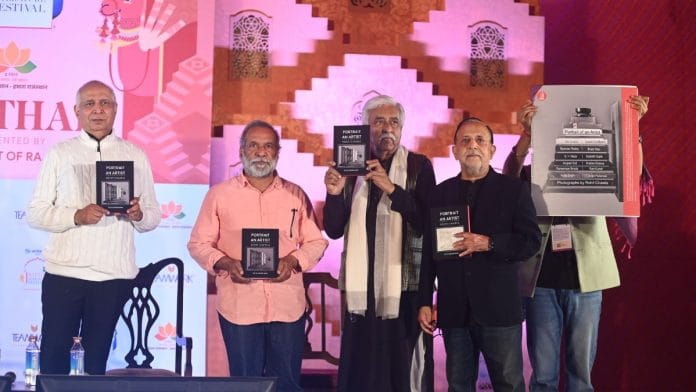



Jaipur: For photographer Rohit Chawla, studios are the one place where artists are in their “purest and rawest” form. Chawla’s book, Portrait of an Artist, was launched by the co-founder of Mapin Publishing, Bipin Shah, at the Jaipur Literature Festival. It was followed by a conversation with writer-curator Kishore Singh and sculptor Ravinder Reddy.
The book is a collection of photographs taken by Chawla over the years. Singh said that it offers a rare opportunity where both the writer and the photographer are interlopers walking into a space that is especially guarded.
The book aimed to catch the “unguarded moments, a moment bereft of artifice”, said Chawla.
“I like trespassing into people’s lives,” he said.
Speaking of his time in Reddy’s studio, Chawla said, “Walking into a sculptor’s studio is a sight to behold and not just what is being created but also the stuff lying on the floor.”
“I still believe in worshiping at the altar of beauty, but I am dead against curatorial nods that cannot stand on their own two feet, and that is what I like about Reddy’s work,” Chawla added. “When you see a work by Ravinder Reddy, it’s beautiful, and you want it in your home.”
For Reddy, making art is not about commerce. He said he wants to create works of art that can communicate with everyone, irrespective of the vendor.
Also read: A poet reimagines Sita as a woman caught in conflict. She refuses to school Ravan
Artists studios
Walking into an artist’s studio is one of the most intimate things one can do, according to Chawla. “A studio is poetry in motion; there is poetry all around you.”
“I did about 10 images in a studio of things lying on the ground, they were like pure art to me.”
He added that most things of beauty can be art, but there must be a certain craft to it.
For him, the goal behind the book was to humanise the artists, to tell their stories beyond their works. He gave the example of artist Madhavi Parekh, who keeps her fridge next to her art space.
ThePrint is a media partner for the Jaipur Literature Festival 2026.
(Edited by Ratan Priya)