





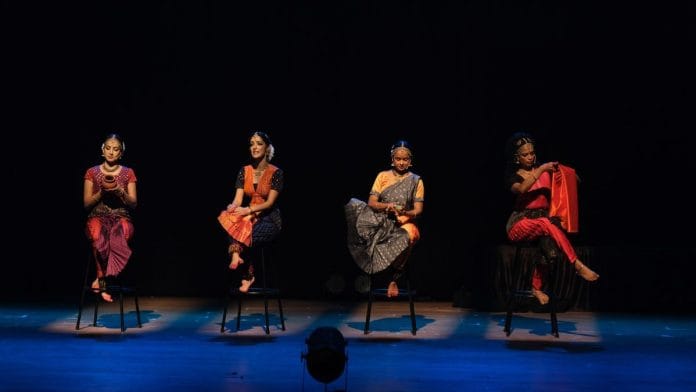



New Delhi: Most Indians will say they know the stories of Sita and Draupadi from the epics Ramayana and Mahabharata. Probably even Kaikeyi. But how many know Karaikal Ammaiyar? The play Rebel Ranis retells mythology, stripping the stories of their fairytale-like neatness, using a mix of Bharatanatyam, contemporary movement, and Tamil music to convey the characters’ stories in a far more human way.
Performed to a packed Kamani Auditorium on Thursday evening in Mandi House, New Delhi, the play, directed by Jyotsna Shourie and written by Aneesha Grover, moves through the lives of Sita, Draupadi, Kaikeyi, and Karaikal Ammaiyar. The shift, however, lies in perspective. These are not women reacting to men, like in the epics. They are driving their own narratives.
The play unfolds through a series of individual vignettes, with each character stepping forward to narrate and inhabit her own story, before all four come together in a final sequence. Drawing on the idea of viewing mythology through the female gaze, the production re-examines familiar narratives to focus on the interior lives, motivations, and choices of these women, rather than the roles they play in the journeys of their male counterparts.
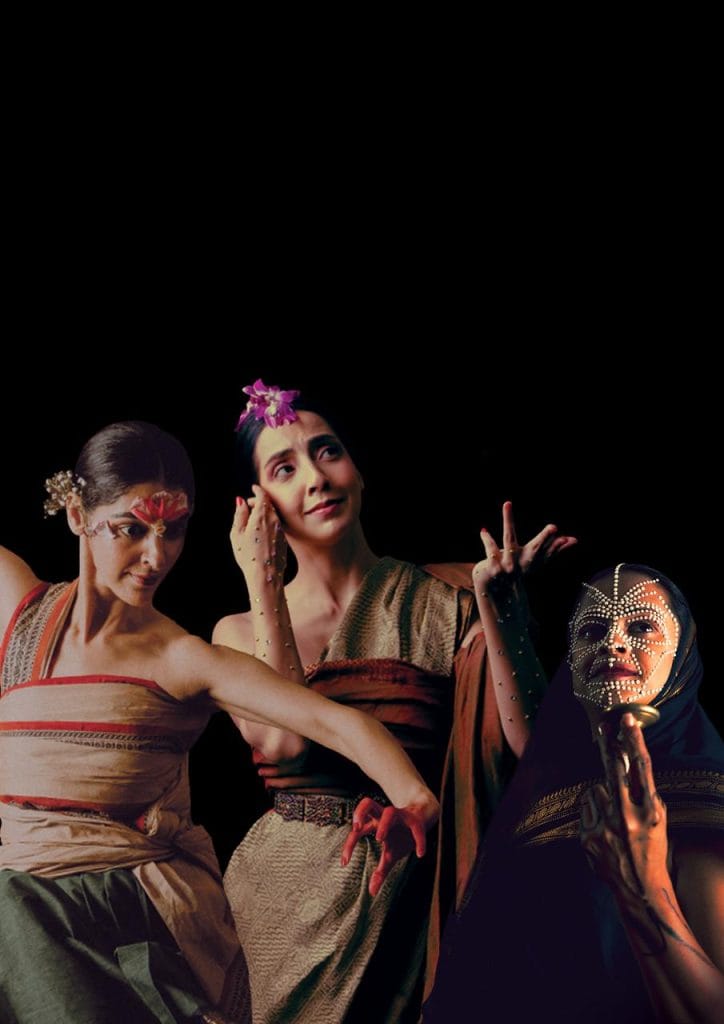
Speaking after the performance, Amrita Sivakumar, who played the role of Karaikal Ammaiyar, described the origins of the piece as deeply personal.
“We talk so much today about body image and feeling comfortable in your own skin. That really resonated with me. Every single thing—Kaikeyi after becoming a mother, Aneesha and I both having babies, and returning to dance—has been lived and experienced. That’s where this entire Rebel Ranis comes from,” she said.
Grover said the idea for the play emerged from a long-standing engagement with mythological texts.
“These stories are so deeply woven into the social and moral fabric of India, but they’re rarely explored from a female gaze. Women are usually placed into binaries, either goddesses or villains. What we wanted was to explore the nuance in between,” Grover said.
Also read: Romila Thapar on André Béteille—’He pushed us to think about society differently’
A different depiction
In one moment, when Draupadi’s, played by Harini Iyer, microphone fails mid-performance, the actor pauses, attempts to fix it, and then continues, projecting her voice across the auditorium. The audience leans in further, breaking into applause as she pushes through. It is an unscripted moment, but one that feels entirely in keeping with the play’s larger focus on voice, interruption, and persistence.
At one point, Draupadi refers to Duryodhana’s ‘fragile male ego,’ a line that cuts through the weight of mythology without undermining it. Similarly, Kaikeyi laments her centuries of infamy as not having been in ‘her contract’ that granted her the two boons. The play uses modern language alongside traditional costumes and performance.
Across the vignettes, the play starts to build a different picture of these women. Sita’s story draws from the Adbhut Ramayan, where grief pushes her into something much more extreme and she turns into Mahakali, violent and hard to look away from. Kaikeyi isn’t the scheming queen, but someone trained in warfare and statecraft, whose power just disappears after marriage and motherhood. Karaikal Ammaiyar rejects beauty and being reduced to her looks. These are not two-dimensional figures, but people with anger, contradiction, and agency, the play conveys.
After the mythological narratives unfold, Rebel Ranis returns to its opening image, four women seated, addressing the audience. But now, the frame shifts. The distance between past and present collapses.
As Draupadi sings, each woman steps forward to speak in the language of today. Statistics replace stories. Sita speaks of dowry deaths, and Kaikeyi of women dropping out of the workforce.
The song itself becomes central to this moment. Built around a Tamil chorus that translates to “nurture your righteous rage,” it pulls together the emotional arc of the performance and carries it into the present.
As the audience began to file out, one could overhear a young viewer turn to their parent and say, almost in surprise, “This makes me want to go read The Ramayana now.”
(Edited by Saptak Datta)